

Summary
B2B enterprise sales across Europe differ from those in the rest of the world due to complex cross-border engagement requirements. This is why traditional lead generation strategies are unable to meet today’s sales pipeline requirements, regardless of how good the messaging is, how regular the outreach is, or how experienced your sales team is.
If you want to build consistent sales engagement across the fragmented European market, you need a modern approach to appointment setting. You want a lead generation partner that takes a personalized approach, uses structured outreach, and delivers a GDPR-compliant pipeline that results in consistent sales-ready conversations.
Introduction
Building and managing a consistent sales pipeline across Europe has become increasingly complex for modern B2B organizations. Unlike unified markets, European regions often cover different buying patterns, communication differences, compliance requirements, and regional engagement expectations.
Therefore, for sales teams targeting countries such as Germany, France, the Netherlands, and the UK, maintaining consistent engagement can be quite challenging. This is one of the key reasons B2B lead generation in Europe has evolved rapidly over the years.
In this blog, we will dive deeper into modern, intent-driven, and personalized lead generation and appointment-setting strategies that many European companies are already adopting. These will allow IT, consulting, and SaaS companies to build a predictable B2B sales pipeline.
What Makes Sales Engagement More Complex Across Europe
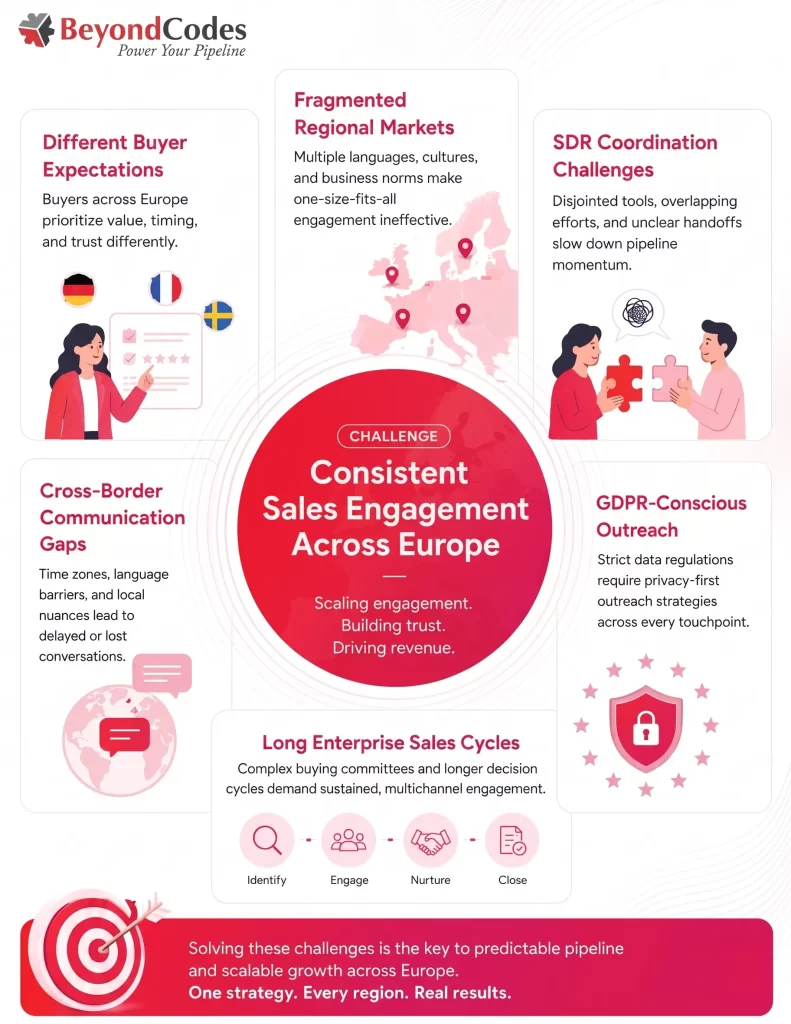
The European B2B market is different from North America’s, which has a more unified environment. Instead, Europe requires sales teams and SDRs to manage different buyer expectations, compliance needs, and sales engagement approaches across multiple regions.
This inconsistency is one of the key challenges that enterprise sales teams face across Europe. Let’s discuss these challenges in more depth below:
1. Different Expectations from Different Markets
As mentioned earlier, enterprise buyers in Europe are spread across the Netherlands, the UK, Germany, France, and other markets, and respond differently to sales conversations. This means that messaging that performs well in one region may not work as well in another, requiring constant adjustments to strategy and outbound lead generation.
2. Cross-Border Engagement Requires More Coordination
Having your target ICP across regions not only brings strategic challenges but also makes it difficult to manage different industries, regional priorities, and buying timelines simultaneously. This is why experienced lead generation companies in Europe rely on structured outreach and coordinated follow-ups.
3. Long Sales Cycles Create Engagement Gaps
Many B2B organizations involve multiple decision-makers and a longer evaluation process before advancing any sales conversation. It means companies that fail to maintain regular prospect engagement during these cycles often struggle to convert prospects into meaningful sales conversations, leading to inconsistent pipeline momentum.
4. Generic Outbound Doesn’t Work
Many outbound strategies in Europe, and across the globe for that matter, rely on standardized messaging and broad outreach. Modern buyers now expect more personalized communication aligned with their market, business priorities, and industry context.
Why Generic Outbound Strategies Often Fail Across Europe
If you are wondering why generic outbound strategies don’t work more often now, the reason behind this is simple. The European B2B market is much more complex and competitive now, and businesses focus only on engagements that speak their language, are industry-aware, and offer value.
Here are a few reasons why generic outbound campaigns often struggle:

- Limited localization across regional markets
- Inconsistent SDR outreach across countries
- Weak personalization in prospect communication
- Different buyer expectations across Europe
- Poor coordination across cross-border campaigns
- Low engagement from decision-makers
- Lack of GDPR-conscious communication strategies
If you want your sales pipeline generation and appointment setting strategies to work, your plans now need to rely more on personalized engagement, structured SDR programs, AI-driven outreach, and, most importantly, coordinated follow-ups.
How Buyer Expectations Differ Across European Markets
Buyer behavior across Europe is far from uniform. As we discussed earlier, businesses targeting multiple European regions often need to adapt their communication styles, engagement approaches, and SDR outreach strategies to local market expectations.
Let’s understand the key market difference:
1. Communication Preferences
Some markets, like the United Kingdom’s, may respond better to direct, concise communication, while others often prefer more relationship-driven engagement before business conversations progress.
2. Sales Cycle Expectations
Certain European markets may have faster engagement cycles, while others may require longer evaluation timelines and more detailed decision-making processes before moving forward with a sales opportunity.
3. Decision-Making Structures
In some markets, the buying decisions are influenced by multiple stakeholders across operations, finance, and technology teams, making sales engagement more layered and time-intensive.
4. Regional Business Priorities
Different European industries and regions may prioritize compliance, operational efficiency, digital transformation, scalability, or long-term partnerships differently during the buying process.
These regional differences are also among the reasons businesses across Europe are placing greater emphasis on structured, compliance-conscious outreach strategies.
How GDPR-Compliant Lead Generation Is Reshaping European Outreach
GDPR compliance has become an important part of modern B2B lead generation. European buyers today expect more responsible communication, transparent engagement practices, and greater control over how business interactions are managed.
So, if you want to drive consistent sales engagement across Europe, you need a stronger balance between outreach efficiency, prospect relevance, and compliance-conscious communication practices.
1. GDPR Has Increased the Need for Structured Outreach
Businesses operating across Europe often require more organized prospecting processes, better contact management, and clearer coordination of outreach. This has pushed many sales teams toward more structured sales development services and strategies designed to support consistent long-term engagement.
2. Trust and Relevance Are Becoming More Important
European buyers increasingly respond better to outreach that feels relevant, personalized, and business-focused rather than highly aggressive or volume-driven. As a result, companies are placing greater emphasis on account-based marketing initiatives in Europe and personalized prospect engagement strategies.
3. SDR Teams Need Better Engagement Coordination
Maintaining GDPR-conscious communication across multiple European regions often requires SDR teams to manage follow-ups, prospect engagement, and outreach timing more carefully. Consistency across cross-border campaigns has become increasingly important for maintaining stronger buyer relationships.
4. Compliance-Conscious Outreach Supports Long-Term Engagement
Modern European lead generation services are increasingly focused on building sustainable engagement processes rather than short-term spikes in outbound activity. Businesses that combine smarter SDR outreach, effective communication, and region-aware engagement strategies are better positioned to maintain stronger visibility into their sales pipeline.
Click Here:- How Appointment Setting Company Helps Win Long Sales Cycles and Complex B2B Deals?
What Consistent Sales Engagement Across Europe Actually Requires
By now, you probably realize that building genuine, uninterrupted sales engagement across Europe requires far more than outbound or SDR outreach. Instead, to target the fragmented European markets, businesses need a balanced engagement strategy, including:
1. Region-Aware Account Targeting
Businesses often see better engagement when outreach strategies align more closely with regional industries, buyer expectations, and local market priorities.
2. Multi-Channel SDR Outreach
Maintaining visibility across European markets increasingly requires coordinated outreach via email, LinkedIn, follow-ups, appointment setting, and ongoing prospect engagement.
3. Cross-Border Campaign Engagement
Businesses operating across Europe often need more structured communication and SDR alignment to maintain consistency across multiple regions and buyer segments.
4. Personalized Communication at Scale
Generic outbound messaging is becoming less effective across competitive European markets. Buyers increasingly expect communication aligned with their business context and operational priorities.
5. Long-Term Pipeline Visibility
Many successful European sales pipeline generation initiatives focus on sustained account engagement rather than short-term spikes in outbound activity to support more predictable pipeline growth across EMEA markets.
How to Build Scalable Cross-Border Lead Generation Programs
Simply expanding your outreach into your target European markets will not help you build scalable lead generation strategies. What you need is the right lead generation and appointment setting partner who understands coordinated outreach, timely follow-ups, and, most importantly, the fundamentals of your regional account targeting.
B2B organizations across Europe are now focusing on centralized engagement strategies that combine cross-border campaign coordination and appointment setting. This allows businesses like yours to maintain visibility across regions, eliminate inconsistencies, and build a stronger communication and follow-up structure.
Scalable lead generation programs also depend heavily on operational consistency. Aligning your SDR workflows, regional engagement strategies, reporting visibility, and prospect engagement processes is often better positioned to create a more predictable B2B sales pipeline.
Bottom Line
Modern B2B sales in Europe no longer operate as they used to, and have only become more complex in recent years. Handling buyer expectations, regional market demands, and ensuring GDPR-conscious communication practices have all made managing sales consistency difficult.
But forward-thinking companies have already begun adopting the latest outbound strategies, focusing on localized engagement, continuous follow-ups, and coordinated SDR outreach. If you haven’t already, it’s time you collaborate with the right strategic partner and start building your predictable pipeline for the European market.
Create more meaningful business conversations across European markets through region-aware sales engagement strategies.
FAQs
The European market includes regional markets such as France, Germany, the UK, the Netherlands, and others. And each of these countries has its own B2B buying environments, trends, GDPR compliance, and sales cycles. Hence, teams practicing lead generation in Europe need localized outreach solutions to maintain stronger prospect engagement and pipeline visibility.
The General Data Protection Regulation (GDPR) has changed how businesses manage prospect communication, outreach coordination, and engagement practices across Europe. With the GDPR in place, companies now need more compliance-conscious lead generation processes that support responsible communication. This compliance has made relevance, trust, and transparency of utmost importance in modern European sales environments.
A well-planned and managed SDR outreach strategy allows B2B enterprises to ensure consistent communication, follow-ups, appointment setting, and prospect engagement across the complex European market. It helps sales teams execute and manage cross-border campaigns effectively while internal sales reps focus on active opportunities and high-value accounts. However, to make the most of a B2B SDR outreach strategy, partner with an experienced and proven lead generation company in Europe.
B2B businesses across the product, IT, and SaaS industries that are looking to build a more predictable sales pipeline require a more personalized, localized, and systematic approach to pipeline generation and appointment setting. In these complex cross-border markets, lead generation teams that focus on consistency and coordination will prevail in filling the sales pipeline with genuinely interested prospects seeking sales-ready opportunities.
If you are looking to collaborate with the right sales development service provider in Europe, make sure you know whom to work with. Your ideal partner understands regional market differences, the importance of GDPR-compliant outreach, cross-border engagement, and appointment-setting strategies. Besides, your chosen partner should support personalized communication, well-designed prospect engagement, and scalable outreach plans.
Author
-
With over 7 years of experience in content marketing, he specializes in creating SEO-driven content strategies for enterprise-focused organizations. Having worked extensively across the B2B landscape, he understands how strategic content, thought leadership, and demand-generation storytelling help companies build visibility, engage decision-makers, and drive scalable business growth. His expertise lies in crafting content that connects business challenges with meaningful conversations, stronger market positioning, and measurable growth.