

The High-Stakes Reality of Modern B2B Sales Conversations
Your SDR dials in. The prospect picks up. Ten seconds later — “Just send me an email” — and they’re gone. This is the reality of B2B cold calling today.
No second chances. No recovery. Just another missed opportunity quietly draining your pipeline.
Here’s the hard truth: it’s not your sales rep’s fault. Today’s B2B buyers are bombarded with outreach from every direction. C-suite executives field dozens of calls daily, and they’ve become experts at screening out anything that doesn’t feel immediately relevant.
The problem isn’t cold calling — it’s how it’s being done.
Because when timing, context, and relevance don’t align in the first few seconds, even your best rep can’t save the conversation. And that missed moment doesn’t just cost you a meeting — it costs you buyer intent that may never come back.
The question is no longer “Should we cold call?” It’s “Are the right people making those calls?”
This is where the discussion shifts from “Should we cold call?” to “Who should be making those calls on our behalf?”—and whether working with a B2B appointment setting firm is a better way to build a consistent sales pipeline.
Why B2B Cold Calling Still Matters (When Done Right)
Despite the rise of automation and AI-driven outreach, B2B cold calling remains one of the most effective ways to create direct, real-time engagement. This is especially true when it aligns with strong buyer-intent signals.
Recent data reveals that the average cold call in 2025 lasted 93 seconds, a 10-second increase from the previous year. Why? Because buyers are giving qualified callers slightly more time to prove their worth. That extra 10 seconds isn’t luck—it’s earned through relevance, research, and respect for the prospect’s time.
The reality is simple: email inboxes are drowning in AI-generated noise. Spam filters are more sophisticated than ever. LinkedIn InMails get buried. But a well-timed, well-researched phone call? That still cuts through the clutter.
The differentiator isn’t the channel. It’s the caliber of the conversation.
Top-tier cold callers don’t wing it. They don’t rely on generic scripts or hope for the best. They bring context, insights, and a clear understanding of the prospect’s business challenges before they ever dial the number.
A well-executed call—timely, relevant, and insight-driven—still cuts through. The difference is execution.
Modern cold calling isn’t about pushing meetings. It’s about earning attention and guiding the conversation toward a qualified outcome. That’s where B2B appointment setting becomes strategic—not transactional.
When done right, cold calling:
- Accelerates pipeline creation
- Improves lead quality
- Shortens the path to meaningful conversations
But it requires a level of consistency and preparation that most in-house teams struggle to maintain at scale.
The Hidden Costs of In-House Cold Calling Teams
Let’s talk numbers—the kind that keep CFOs up at night.
Building an internal team for B2B appointment setting seems like the logical move. In reality, it is one of the most challenging and resource-intensive components of your GTM strategy. You’re not just hiring people to make calls—you’re building a complete system that many companies eventually outsource to a B2B lead generation company for better efficiency and scale.
Building and maintaining an efficient in-house cold calling team entails:
- Recruitment and onboarding: Finding BDRs who can handle rejection, think on their feet, and communicate at a C-level takes time and investment.
- Training and enablement: Training salespeople on your value proposition, ideal client profile, objection handling, and market positioning is an ongoing process.
- Technology stack: CRM systems, sales intelligence platforms, call recording tools, and enablement software add up fast.
- Management overhead: Sales leaders spend hours coaching, monitoring calls, and refining processes.
- Turnover costs: BDR roles have notoriously high turnover rates, meaning you're constantly rebuilding and retraining.
And even with all that investment, here’s the uncomfortable truth:
44% of salespeople give up after just one follow-up attempt. Only 8% persist beyond five touchpoints, yet 80% of sales require at least five follow-ups after initial contact.
Your team isn’t lazy. They’re overwhelmed, under-equipped, or simply focused on the wrong prospects at the wrong time.
Cold calling isn’t about making more calls—it’s about making smarter calls. When you partner with a team that treats every conversation as a strategic engagement, you stop measuring dials and start measuring pipeline impact.”
— Gaurav Kumar, CEO, Beyond Codes
What Top-Performing Cold Callers Do Differently
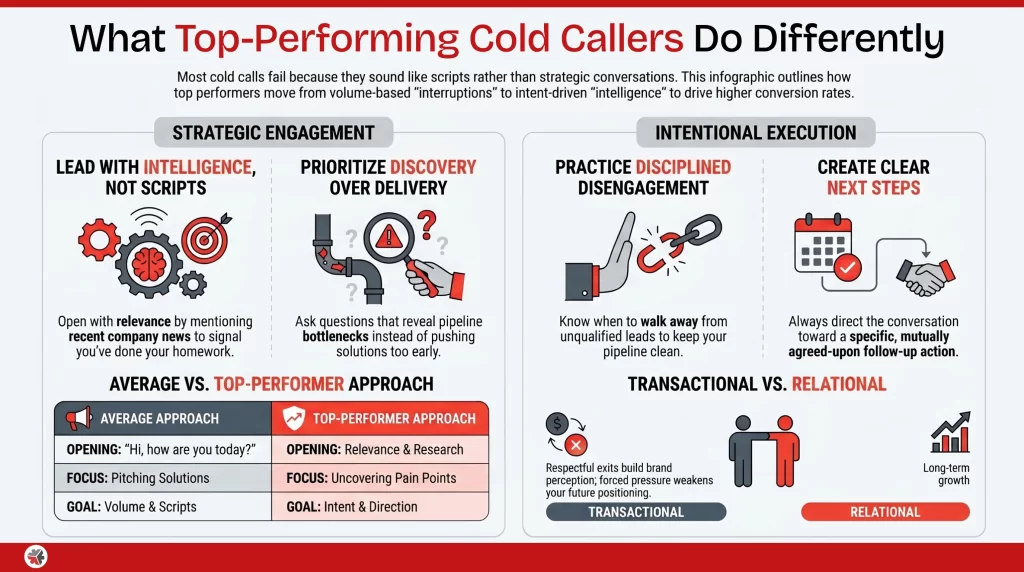
Most cold calls fail for a simple reason—they sound like cold calls. Top-performing teams understand this. They don’t rely on volume or scripts. Instead, they operate with a clear, structured approach where every conversation has intent, context, and direction.
That’s what separates average outreach from conversations that actually convert.
Here’s what the best do differently:
1. They Lead with Intelligence, Not Scripts
The days of “Hi, how are you today?” are long gone. Top SDR/ISDR performers open with relevance—something that immediately signals they’ve done their homework.
For example:
“I noticed your company just expanded into the Southeast region—most teams at this stage face challenges around lead qualification in new markets. Curious if that’s showing up for you as well?”
This isn’t a smart line—it’s a strategic entry point. It shows respect for the prospect’s time and positions the call as a conversation worth having.
2. They Ask Questions That Uncover Real Pain Points
The fastest way to lose a prospect is to start pitching too early. The fastest way to engage them is to make conversation about them.
Top performers understand that strong conversations are built on discovery, not delivery. Instead of pushing solutions, they focus on uncovering what’s actually broken inside the prospect’s pipeline.
They ask questions that make the prospect think:
- What’s the biggest bottleneck your sales team is facing right now?
- If you could fix one issue in your pipeline this quarter, what would it be?
- What would change if appointment setting weren’t a constant challenge?
These questions shift the dynamic. The prospect starts engaging, reflecting, and sharing. At that point, the call stops feeling like an interruption—and starts becoming valuable.
Not every call is worth pursuing. Top performers recognize the difference between a polite brush-off and genuine interest. They read tone, listen for hesitation, and gracefully exit conversations that aren’t going anywhere.
Click Here:- Go-To-Market Predictions for 2026: From Cold Calling to Smart Conversations in B2B Sales
3. They Know When to Walk Away
Not every conversation deserves to be pushed forward.
Top performers are intentional. They can quickly assess whether a prospect is genuinely interested or simply being polite. Instead of forcing the conversation or chasing unqualified leads, they make a conscious decision to step back when the timing or fit isn’t right.
This discipline is critical.
Pushing the wrong prospect doesn’t just waste time—it weakens your positioning and creates friction where there should be none. On the other hand, knowing when to disengage keeps the focus on high-intent opportunities that are more likely to convert.
It also reflects maturity in your sales outreach approach. Prospects remember when they’re not pressured. And often, the ones who aren’t ready today come back later—because the interaction felt respectful, not transactional.
In the long run, this approach leads to cleaner pipelines, better conversion rates, and stronger brand perception in the market.
4. They Create Clear Next Steps (Every Single Time)
A good conversation is meaningless unless it leads somewhere.
Top-performing cold callers are deliberate about what happens after the call. They don’t leave outcomes open-ended or expect the prospect to follow up. Instead, they direct the conversation toward a clear and mutually agreed-upon next step.
Even if a meeting is not scheduled immediately, they specify what happens next:
- “I’ll share a quick case study relevant to your industry. Does it make sense to reconnect next Tuesday?”
- “Let me send across something tailored for your use case. Would Thursday or Friday work for a quick follow-up?”
This clarity removes confusion and preserves momentum. The prospect understands what to expect, and the conversation proceeds with purpose. Because cold calling is more than just initiating conversations—it’s about moving them forward.
How Beyond Codes Transforms Cold Calls into Strategic Conversations
This is where Beyond Codes gives you an unfair advantage.
We do more than simply “make calls on your behalf.” With the knowledge, resources, and self-control, we reach into a qualified sales funnel and act as a smooth extension of your sales team.
As a specialized B2B appointment setting company, we act as an extension of your sales team—bringing the expertise, infrastructure, and discipline needed to build a highly qualified sales funnel.
What This Looks Like in Practice:
Thorough Pre-Call Research: Before dialing a single number, we analyze your target client profile, research prospect businesses, discover trigger events, and map organizational structures. Every call is based on intelligence, not guesswork.
Customized Engagement Strategies: We don’t use cookie-cutter scripts. Our talk tracks are personalized to your specific value proposition, buyer personas, and market positioning, and delivered in a tone that is consistent with your brand.
Real-Time Adaptability: Our team is trained to read the room, pivot based on prospect responses, and ask follow-up questions that advance conversations rather than merely fill time.
Transparent Reporting: You have full visibility into every call, including transcripts, outcomes, objections, and insights. We are not a black box. We are a strategic partner that feeds actionable data back into your sales engine.
Focused Follow-Through: We don’t simply set up appointments and disappear. We nurture leads, handle follow-ups, and ensure that every qualified prospect receives context and momentum.
Measurable Outcomes: What Does Success Look Like?
Let’s talk about results, because at the end of the day, C-level executives care about one thing: ROI.
Here’s what success looks like when cold calling is done strategically:
Higher-quality appointments with key decision-makers who are actually in-market
Shortened sales cycles because prospects are pre-qualified and educated before your closers get involved
Improved conversion rates from appointment to opportunity
Reduced burden on internal teams, allowing your sales executives to focus on closing, not prospecting
Scalable pipeline growth without the cost of hiring, training, and managing additional headcount
The math is simple: Treat every cold call as a strategic interaction rather than a numbers game, and your pipeline will fill with chances that close.
Final Thought: It’s Time to Reconsider How You Approach Cold Outreach
Cold calling in 2026 isn’t about dialing harder; it’s about dialing smarter. It’s about having meaningful interactions with B2B prospects who are ready to engage and receptive to solutions.
Your sales team is talented. However, they are stretched thin, balancing quotas, pipeline management, and the daily grind of outreach. They should not be expected to understand the art and science of high-stakes cold calling.
That’s where Beyond Codes comes in—as a strategic partner who bridges the gap between your vision and the pipeline.
Get qualified, high-intent opportunities into your pipeline—without adding headcount or burning out your team.
FAQs
Yes, B2B cold calling still works in 2026 when it is timely, relevant, and backed by research. Buyers ignore generic outreach, but they still respond to conversations that reflect their business context, challenges, and intent. The channel is not the problem. Poor execution is.
B2B cold calling is harder because decision-makers receive constant outreach and filter anything that feels generic. Reps often have only a few seconds to prove relevance. Without timing, context, and a clear reason for the call, even skilled SDRs can lose buyer attention immediately.
A successful B2B cold call starts with relevance, not a script. Strong callers research the account, open with a specific business insight, ask discovery questions, and guide the conversation toward a qualified next step. The goal is not just to talk. It is to move the buyer forward.
Most B2B cold calls fail because they sound like cold calls. Generic intros, early pitching, weak discovery, and poor follow-up make prospects disengage fast. When the conversation lacks context and value, the call feels like an interruption instead of a relevant business discussion.
Outsourcing B2B appointment setting can be better when a company needs scale, consistency, and specialized outreach skills without the overhead of hiring and managing internally. In-house teams often require ongoing recruitment, training, tech investment, and coaching, which makes outsourced support more efficient for many firms.
The hidden costs include recruitment, onboarding, training, sales tools, management time, and turnover. Internal teams also need constant coaching and process refinement. Many companies underestimate how much time and budget it takes to maintain an effective B2B cold calling operation at scale.
A strategic cold calling partner should offer pre-call research, tailored messaging, live adaptability during conversations, transparent reporting, and disciplined follow-up. The best partners act like an extension of the sales team, helping improve appointment quality, conversion efficiency, and pipeline visibility rather than just increasing call volume.
Strategic B2B cold calling can deliver higher-quality meetings, shorter sales cycles, better conversion from appointment to opportunity, lower burden on internal sales teams, and scalable pipeline growth. The real result is not more dials. It is more meaningful conversations with buyers who fit and engage.
Author
-

With 7+ years of experience and a background in media & communication, she brings stories to life that fuel lead generation success. She transforms complex B2B ideas into content that is clear, engaging, and results-driven—helping key decision-makers take action. A good cup of coffee fuels her writing ideas, and when off the clock, she enjoys unwinding with her dog by her side.