
Beyond Codes Inc.

[gtranslate]

How to Build High-Intent B2B Lead Generation Campaigns That Drive Qualified Meetings

B2B Lead Generation Services for Qualified Meetings

Your pipeline is full. Your conversion rate reveals a different story.

That is the tension most B2B revenue teams are navigating right now. B2B lead generation is no longer the difficult part; it is generating the right leads, those that lead to qualified meetings and, finally, closed revenue, that causes most efforts to quietly fail.

The numbers make it plain:

That is not a demand problem. It is a targeting and execution problem.

The shift happening among high-performing revenue teams right now is a deliberate move away from broad-based lead generation toward high-intent campaign architecture — campaigns designed to identify prospects already in an active buying cycle, engage them through channels like B2B cold calling and multi-touch outreach, and convert that engagement into qualified appointment setting outcomes. Here’s how that change is built and executed in practice.

Are You Targeting Who a Prospect Is — or What They Are Actively Doing?


Most B2B campaigns are built around the prospect’s industry, firm size, and job title. It’s a reasonable starting point. But it isn’t enough.

High-intent campaigns go further. They emphasize something more commercially important: what the prospect is doing right now.

Firmographic vs. Intent Data — What’s the Real Difference?

 Firmographic DataIntent Data
Tells youIf someone fits your ICPIf they’re in an active buying cycle
Based onStatic company attributesReal-time behavioral signals
ResultA list of potential targetsA list of in-market accounts

For example,

A CFO at a large enterprise may be a perfect ICP match, but if there is no active initiative, no meeting can be held—even with aggressive B2B appointment setting efforts. Meanwhile, a Head of Operations at a smaller firm actively researching solutions is far more likely to convert into a meaningful sales conversation.

Intent data provides exactly that kind of signal — capturing behavioral patterns across website activity, content engagement, review platforms, and search behavior to identify whether accounts are already evaluating solutions like yours.

How to Build a Tiered Account List


When ICP filtering is paired with intent signals, targeting is transformed from smart guesswork to evidence-based prioritization. The end result is a three-tiered account structure:

This single discipline reallocates SDR capacity to accounts that are most likely to convert—exactly where meeting quality is won or lost.

According to 62% of marketers, intent data significantly enhances lead quality and conversion rates. 93% of B2B teams have increased conversion rates after implementing intent signals into their targeting strategy. The early-mover advantage exists, but it is gradually declining, with intent enrichment adoption nearly doubling year-over-year.

Is Your Campaign Designed for How B2B Buyers Actually Make Decisions?


Even with smart targeting, campaigns fall short when outreach—including B2B cold calling and email sequences—does not reflect how buying decisions are actually made. The reality of modern B2B buying  is this:
it is rarely one person’s decision.

To align with how modern B2B decisions take place, high-performing campaigns follow three non-negotiable principles:

Build Around Accounts, Not Just Individuals


High-intent campaigns are designed at the account level. Before sending a single email or scheduling an SDR call, the target account list is defined. That list represents the campaign. Everything else—messaging, sequencing, channel selection—is based on it.

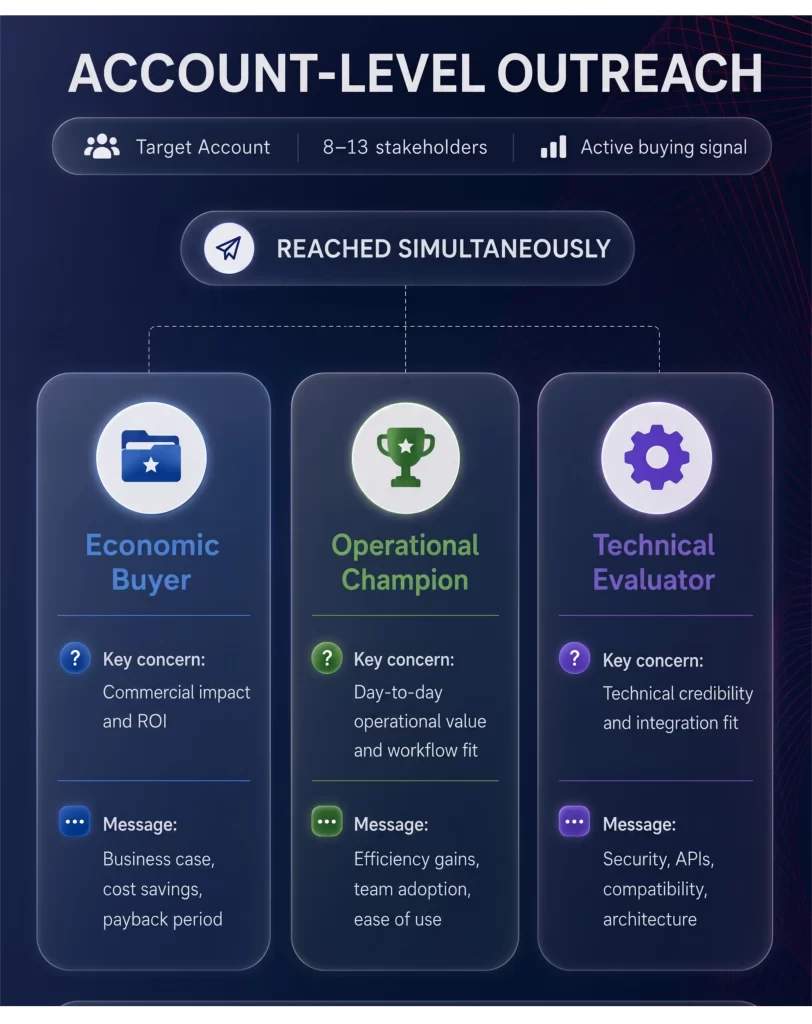
Engage Three Personas Per Account — Simultaneously


Within each target account, outreach should reach at least three distinct stakeholders at the same time:
outsourced appointment setting

Treating these three conversations as one is one of the most common — and costly — mistakes in B2B outreach.

The High-Intent Channel Sequence That Works


High-intent campaigns do not rely on a single channel. They move across multiple touchpoints in a coordinated, compressed sequence:

Companies using at least three outreach channels simultaneously achieve up to 18.96% higher engagement rates and a 9.5% annual revenue increase compared to single-channel approaches. Channel coordination is not a nice-to-have — it is a structural advantage.

Are You Running Campaigns — or Running a Revenue System?


This is the question that differentiates businesses with a consistent, qualified meeting pipeline from those who are constantly chasing activity metrics. Most B2B campaigns look similar on the surface — the same channels, tools, and outreach volume. The difference is reflected in the outcomes.

And the difference in results usually comes down to four simple things that best sales teams never compromise on—

1. Personalization That Reflects Real Buyer Context


Generic outreach in a high-intent campaign is not just ineffective — it is actively damaging. A prospect who is already on a buying journey and receives a templated message interprets it as proof that you did not do the job. That undermines trust before the conversation even begins.

In practice, personalization entails addressing a prospect’s specific industry challenge, acknowledging their apparent buying stage based on intent signals, and connecting your value proposition to their role — not to a generic pain point category. At scale, this requires AI-assisted tooling. 61% of B2B teams now use AI for lead scoring (up from 23% in 2024), and AI-driven scoring has improved lead qualification accuracy by 40%. Teams who are gaining ground use AI to improve personalization precision rather than outreach volume.

2. Qualification Discipline at Every Handoff


The quickest way to devalue a high-intent campaign is to send unqualified leads to sales. It wastes sales capacity and, more importantly, undermines the credibility of the marketing function.

A meeting should only be booked when all four conditions are met:

Companies with strong lead nurturing programs generate 50% more sales-ready leads at 33% lower cost. Nurturing here is not a drip sequence — it is a deliberate program of delivering the right content at the right moment to move prospects through qualification criteria before they reach a sales conversation.

3. Measurement Anchored to Commercial Outcomes


Campaign dashboards built around open rates, clicks, and MQL volumes are measuring activity — not outcomes. The three metrics that actually matter:

MetricWhat It Tells YouBenchmark
Meeting Quality Rate% of booked meetings that meet ICP + intent criteriaHigher = better targeting precision
MQL-to-SQL ConversionHow well qualified leads progress to sales acceptanceTop quartile: 28% vs. median: 13%
Pipeline ContributionSourced pipeline value, velocity, and cost per SALThe truest measure of campaign ROI

A campaign that books 40 qualified meetings consistently outperforms one that books 100 mixed-quality ones on every downstream metric. Report on what moves revenue — not on what is easy to measure.

4. Sales and Marketing Aligned on One Number


No campaign architecture produces qualified B2B meetings at scale when sales and marketing are operating on separate data, separate goals, and separate KPIs. Intent data only creates commercial value when it is shared in real time and acted upon the same day — not surfaced in a weekly report three days later.

Organizations with mature Revenue Operations functions grow revenue three times faster than those without.

The practical mechanism: a shared weekly pipeline review where both functions examine the same data — account intent scores, campaign engagement, meeting quality rates, and pipeline progression — and make targeting and SDR prioritization decisions jointly.

One team. One number. One accountability structure.

When these four disciplines work together, a campaign stops being a marketing program and starts functioning as a revenue system.

How Beyond Codes Builds High-Intent Prospect Pipelines


Most B2B lead generation companies hand you a list. Beyond Codes builds a pipeline powered by research, B2B cold calling expertise, and precision-driven appointment setting.

Every Beyond Codes campaign starts with a research-first approach to account selection — not a database pull. Before activating any outreach touchpoints, the team follows a disciplined approach to ensure that each prospect represents a legitimate business possibility.

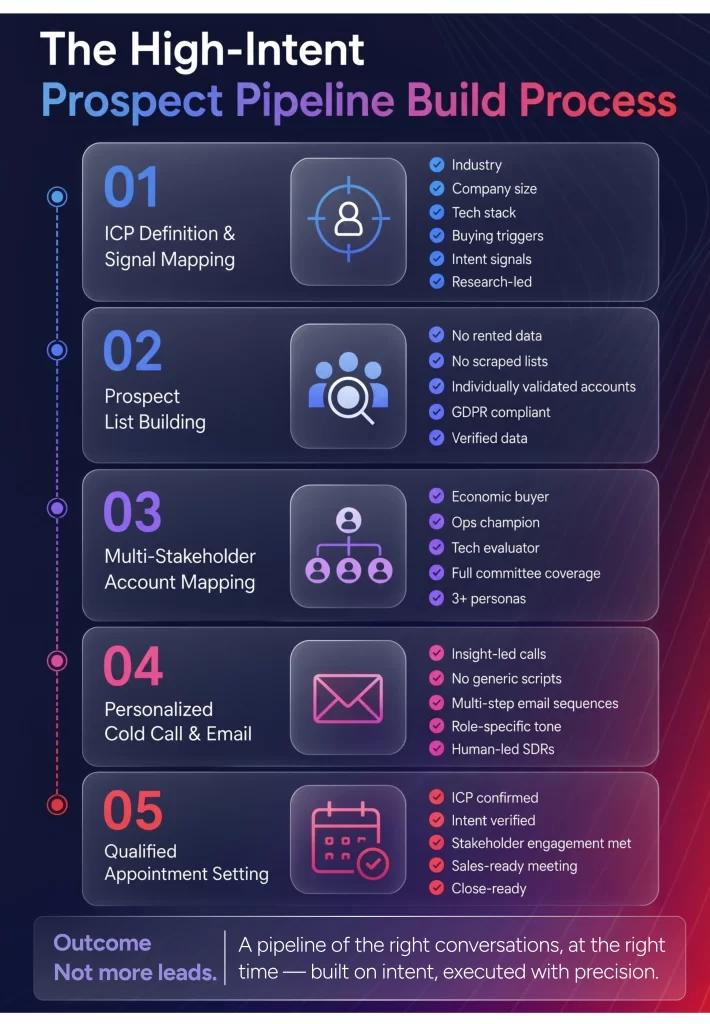
The Beyond Codes High-Intent Build Process

b2b lead generation


Step 1: ICP Definition and Signal Mapping


Beyond Codes works directly with your revenue leadership to build your Ideal Customer Profile based on firmographic and technographic factors such as industry, company size, revenue band, tech stack, geography, and buying triggers. That ICP is then mapped against intent signal categories to discover the behavioral patterns that indicate a prospect is now in an evaluation cycle.

Step 2: Research-Backed Prospect List Building 


There are no rented databases. No scraped lists. Before being added to the outreach pipeline, each prospect account is thoroughly vetted and validated per your ICP criteria. Contact-level data is checked for accuracy and compliance, ensuring that SDR time is spent on real possibilities rather than bounced emails and disconnected numbers.

Step 3: Multi-Stakeholder Account Mapping 


Beyond Codes maps various decision-making personas for each target account, including the economic buyer, operational champion, and technical evaluator, to ensure campaigns reach the entire buying committee rather than just one point of contact.

Step 4: Personalized Cold Calling and Email Outreach 


Beyond Codes SDRs are trained to lead with insight, not a script. Each cold call and email sequence is built around the specific pain points, business context, and buying signals identified during the research phase. The result is outreach that prospects actually respond to — because it reflects their reality, not a generic pitch template.

Beyond Codes SDRs are trained to lead with insight rather than generic sales scripts. Each cold call and email sequence is tailored to the exact pain concerns, business environment, and buying signals discovered during the research process. As a result, prospects respond to outreach that is tailored to their specific needs rather than a generic pitch template.

Step 5: Qualified Appointment Setting 


A prospect is only added to the meeting calendar if they match specific qualifying criteria, such as ICP fit, buying intent, and stakeholder engagement. Beyond Codes provides meetings that your sales team can walk into with context, confidence, and a true opportunity to close.

The outcome is not more leads. It is a pipeline populated with the right conversations at the right time — built on intent, executed with precision, and calibrated to the way your buyers actually make decisions.

The Pipeline Your Business Needs Already Exists — Is Your Campaign Designed to Find It? 


The accounts that will buy from you within the next 90 days are already in action. They are investigating, comparing, and reaching an internal agreement. The question is not if demand exists; rather, whether your ads are intended to identify it before your competitors do.

High-intent campaign architecture is the solution. It is not a new approach; rather, it is a more disciplined, evidence-based approach to executing the work that every B2B revenue team is currently striving to do: discovering the right accounts, reaching the right prospects, and initiating the right conversations at the right time.

Organizations that build this capability now, combining intent-based targeting, multi-stakeholder outreach, precise personalization, rigorous qualification, and aligned sales execution, will gain a structural pipeline advantage as the B2B buying environment becomes more complex, committee-driven, and resistant to undifferentiated outreach.

The pipeline is there. Just build campaigns to reach it.

Want to explore how Beyond Codes builds high-intent prospect pipelines for B2B companies? Connect with our team to discuss what a qualified meeting campaign looks like for your business.

FAQs

What is a high-intent B2B lead generation campaign?

A high-intent B2B lead generation campaign targets accounts already showing buying signals, such as website visits, content engagement, review activity, or solution research. Instead of chasing broad lead volume, it focuses on ICP-fit prospects most likely to convert into qualified meetings and sales opportunities.

How do you generate qualified B2B meetings?

Qualified B2B meetings are generated by combining ICP targeting, intent data, multi-stakeholder outreach, personalized messaging, and strict qualification. A meeting should only be booked when the account fits the ICP, shows active buying intent, and has meaningful engagement from relevant decision-makers.

Why is intent data important in B2B lead generation?

Intent data helps identify accounts actively researching solutions in your category. It improves lead quality by showing which prospects are in-market now, allowing SDRs and sales teams to prioritize outreach based on real buying behavior rather than static firmographic information alone.

What is the difference between firmographic data and intent data?

Firmographic data shows whether a company fits your ideal customer profile based on size, industry, revenue, or location. Intent data shows whether that company is actively researching or evaluating a solution. High-performing B2B campaigns use both to prioritize accounts with the highest conversion potential.

What channels work best for high-intent B2B outreach?

High-intent B2B outreach works best when cold calling, email, LinkedIn, retargeting, and content are coordinated together. The strongest campaigns respond quickly after intent signals appear and use role-specific messaging to engage different stakeholders within the same target account.

How does cold calling support B2B lead generation?

Cold calling supports B2B lead generation by creating direct conversations with high-fit prospects who are already showing buying signals. When supported by intent data and research, cold calls become more relevant, timely, and effective at converting interest into qualified appointment setting outcomes.


How should B2B lead generation campaigns be measured?

B2B lead generation campaigns should be measured by meeting quality rate, MQL-to-SQL conversion, pipeline contribution, sales acceptance, and revenue impact. Open rates and clicks are useful activity metrics, but they do not prove whether the campaign is creating real sales opportunities.

Why outsource high-intent B2B lead generation?

Companies outsource high-intent B2B lead generation when they need research-backed targeting, skilled SDR outreach, appointment setting, and consistent qualified meetings. A specialized partner can help build accurate prospect lists, map buying committees, personalize outreach, and reduce pressure on internal sales teams.

Author

  • Poonam

    With 7+ years of experience and a background in media & communication, she brings stories to life that fuel lead generation success. She transforms complex B2B ideas into content that is clear, engaging, and results-driven—helping key decision-makers take action. A good cup of coffee fuels her writing ideas, and when off the clock, she enjoys unwinding with her dog by her side.

Facebook
Twitter
LinkedIn
Threads
Pinterest

Most Popular

Power your sales pipeline.

Tell us about your growth targets and the markets you’re going after

Get The Latest Updates

Subscribe To Our Monthly Newsletter

No spam, notifications only about new services, blogs, and newsletter updates.

Contact Us Today!