

When it comes to B2B appointment setting, the assumption is simple: reach out to prospects, initiate conversations, and transform those interactions into scheduled meetings. In reality, it is far more complex.
Sales teams are driving significant outreach—emails, calls, and LinkedIn messages at scale. On the surface, this suggests a healthy pipeline. Despite this effort, many businesses experience a common challenge: meetings happen, but meaningful opportunities do not progress.
This is where the disconnect lies. The issue isn’t activity; it’s alignment with real buyer intent.
For sales and revenue leaders, the question is no longer, “Are we scheduling enough meetings?” Instead, it becomes, “Are we having the right conversations to take enterprise deals forward?”
A key reason for this gap is that appointment setting is often treated as a tactical, calendar-filling exercise rather than a strategic process aligned with sales goals. This blog explores where companies go wrong and how to fix them.
Appointment Setting Is Not a Task—It Is a Strategic Function
One of the most common reasons businesses struggle with appointment setting is that it is seen as a strictly tactical activity. In many businesses, it is known as an early-stage role intended to fill calendars and spark initial interest.
In reality, effective sales appointment setting combines strategy, messaging, timing, and market insight. Every meeting booked shows how well a company understands its Ideal Customer Profile, offers value, and engages prospects at the right time.
When these elements are out of sync, even the best B2B appointment setting services deliver ineffective results. The end result is a pipeline that appears active but lacks depth and conversion potential.
When these elements are not aligned, even the best B2B appointment setting services generate activity without impact. The result is a pipeline that appears active but lacks depth and conversion potential.
The Activity vs. Outcome Gap
One main reason why B2B appointment setting efforts fail is an overemphasis on activity data. Many organizations assess performance by the number of phone calls, emails sent, or meetings scheduled. While these measures are simple to monitor, they rarely reflect actual sales results. However, enterprise sales outcomes are determined by relevance rather than activity.
As a result, even high-performing B2B appointment setup services can create a lot of activity yet have low pipeline conversion rates. This creates a false impression of progress—dashboards appear robust, but deals do not move forward owing to a lack of genuine, business-aligned conversations.
Activity vs. Outcome in Appointment Setting
| Basis of Comparison | Activity-Driven Approach | Outcome-Driven Approach |
|---|---|---|
| Primary Focus | Volume of outreach (calls, emails, meetings) | Quality and relevance of conversations |
| Success Metrics | Number of meetings booked | Pipeline progression and conversion |
| Targeting Strategy | Broad and generalized audience | Clearly defined and refined ICP |
| Messaging Approach | Generic and standardized messaging | Personalized and context-driven communication |
| Outreach Strategy | High-speed, high-volume outreach | Timely outreach aligned with buyer intent |
| Engagement Quality | Surface-level interactions | Meaningful, value-driven conversations |
| Business Impact | High activity but low conversion | Fewer interactions but higher-quality opportunities |
Click Here:- Sales Outsourcing Mistakes That Damage Enterprise Deals
Why Businesses Still Face Challenges in Appointment Setting
The majority of teams work hard but fail to see results. Here are seven reasons why B2B appointment setting struggles to deliver real business impact.
1. Lack of a Clear Reason for the Meeting
Outreach often starts without a strong justification for why the conversation should take place right away. Prospects can agree to a meeting out of curiosity, but interest quickly declines in the absence of urgency or significance. One of the most prevalent gaps in B2B appointment setting companies is that discussions start but don’t lead to anything worthwhile.
2. Weak Definition of the Ideal Customer Profile (ICP)
Many businesses start B2B appointment setting without first identifying the ideal customer profile. Outreach efforts may reach organizations that lack the urgency, resources, or priority to participate if their targeting is too general or predicated on outdated beliefs. As a result, surface-level engagement is generated; conversion is weak and fails during certification. This eventually results in a pipeline filled with unproductive, low-quality prospects.
3. Lack of Differentiation in Messaging
These days, B2B buyers are constantly contacted. In such a setting, generic communications that emphasise value propositions are ineffective. Setting up a successful sales session involves messaging that goes beyond a simple sales pitch and shows a thorough grasp of the prospect’s business environment. Outreach attracts attention when it feels relevant and personalized. It is quickly ignored when it seems generic.
4. An excessive dependence on scripts
To stay consistent, a lot of B2B appointment setting firms mostly rely on a sales presentation. Rigid interactions can sometimes feel transactional, despite the framework’s importance. Business buyers anticipate intelligent, flexible conversations. When discussions are rigid, a few issues, problems, and priorities of each prospect are not addressed during the appointment setting. This lowers participation and restricts the possibility of deep conversation.
5. Using Only Scheduled Meetings to Measure Success
The quantity of meetings that are scheduled is sometimes the only criterion used by companies to assess appointment setting success. Although this measure indicates activity, it does not capture the caliber or significance of those interactions. Inadequately qualified B2B meetings increase sales teams’ effort without improving the pipeline. This misalignment eventually reduces productivity and affects overall performance.
6. Lack of Alignment Between Teams
When scheduling appointments is integrated into a linked revenue system, it works best. However, many businesses operate in silos, including several B2B appointment setting services. Targeting is unchanged, messaging becomes inconsistent, and important insights are lost in the absence of regular feedback and alignment. This gap hinders ongoing development and lowers overall effectiveness.
7. Failure to Adapt to Modern Buyer Behavior
B2B buyers are increasingly very selective and informed. They frequently have a solid understanding of their problems and possible solutions by the time they consent to a meeting. Strategies for scheduling appointments that just focus on introducing services are out of step with this reality. Instead of just initiating contact, modern B2B appointment settings need to align with the buyer’s goal.
What Effective B2B Appointment Setting Looks Like
Companies that successfully schedule B2B appointments adopt a different strategy. They place more emphasis on developing meaningful, high-intent conversations that can advance sales than on activity alone.
Booking meetings is only one aspect of effective B2B appointment setting services. They focus on aligning outreach with the business context, identifying the appropriate prospects based on a well-defined ICP, and engaging them with relevant content. Strong coordination between the marketing, sales, and outreach departments also guarantees that discussions continue after the first interaction. This alignment helps maintain momentum throughout the sales cycle.
In high-performing businesses, appointment setting is not measured by volume alone. It is evaluated based on:
- The relevance of conversations
- The quality of stakeholders engaged
- The progression of deals within the pipeline
Ultimately, effective sales appointment setting is not about filling calendars—it is about creating opportunities that convert.
The Strategic Impact of Getting It Right
When appointment setting is executed effectively, it creates a measurable impact across the entire sales process:
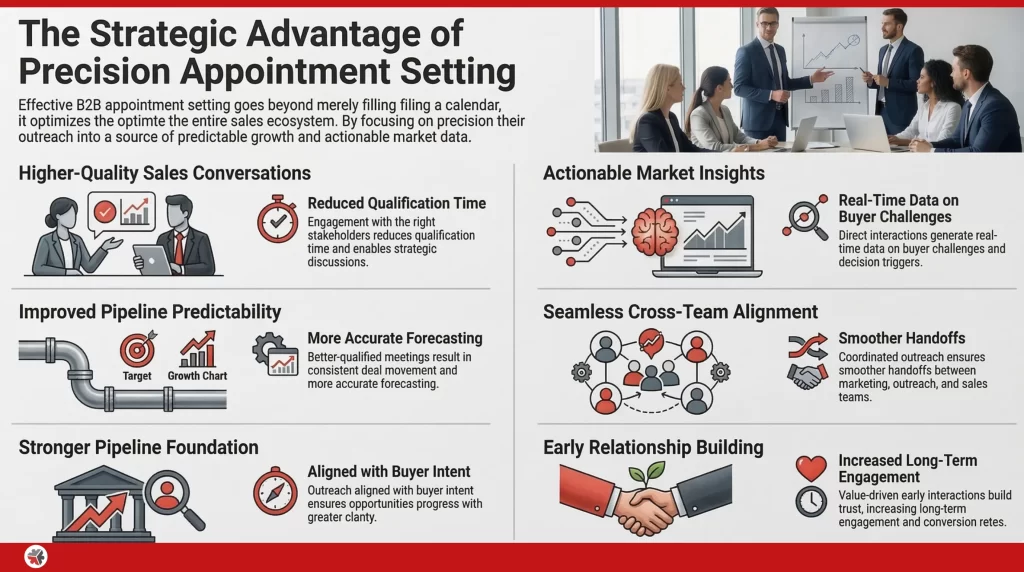
- Stronger pipeline foundation: Conversations are more focused and aligned with buyer intent, increasing the likelihood of opportunities progressing with clarity.
- Higher-quality sales conversations: Sales teams engage with the right stakeholders, reducing time spent on basic qualification and enabling more strategic discussions.
- Improved pipeline predictability: With better-qualified meetings, deal movement becomes more consistent and easier to forecast.
- Actionable market insights: Effective B2B appointment setting services generate real-time insights into buyer challenges, priorities, and decision triggers, helping refine go-to-market strategies.
- Better alignment across teams: Clear coordination between outreach, sales, and marketing ensures smoother handoffs and stronger deal momentum.
- Stronger customer relationships: Relevant, timely, and value-driven interactions help build trust early, increasing the chances of long-term engagement and conversion.
Final Thoughts
B2B appointment setting is not always challenging, but it is frequently misinterpreted. The actual issue is not a lack of effort, but rather a lack of strategic alignment. Increased outreach will not only fix pipeline gaps if the conversations are not relevant, timely, and based on real business goals.
Revenue leaders must make a clear mentality shift. Success should no longer be judged by the volume of activity generated, but rather by the effectiveness with which that effort converts into significant pipeline movement. The focus must shift from scheduling meetings to having conversations that affect decisions.
Organizations that get this right not only improve conversion rates, but also create a more predictable, scalable, and resilient sales engine. And in today’s competitive B2B landscape, this is what finally distinguishes activity from revenue impact.
Looking to turn your B2B appointment setting efforts into real pipeline impact?
FAQs
The most common mistakes are unclear meeting purpose, weak ICP definition, generic messaging, rigid scripts, and measuring success only by the number of meetings booked. Many teams also struggle because sales, marketing, and outreach are not aligned. These issues create activity, but not meaningful pipeline movement.
To improve results, define your ideal customer profile clearly, create a strong reason for the meeting, personalize messaging, and align outreach with buyer timing. Success improves when teams measure conversation quality, stakeholder relevance, and deal progression instead of activity volume alone. This creates meetings that are more likely to convert.
A qualified B2B meeting involves the right prospect, a relevant business problem, clear timing, and a real possibility of sales progression. It should not be based on curiosity alone. A strong meeting moves beyond surface interest and creates a useful conversation that supports pipeline growth and next-step decisions.
Booked meetings often fail because they are driven by activity goals instead of business relevance. When the prospect is not a true ICP match, the messaging is generic, or the meeting lacks urgency, the conversation does not move forward. This creates calendar activity without real sales impact or pipeline progression.
ICP is critical in B2B appointment setting because poor targeting leads to low-quality conversations and weak conversion. When outreach reaches companies without urgency, budget, or strategic fit, meetings may happen but opportunities stall. A refined ICP helps teams focus on prospects with stronger intent and better revenue potential.
B2B appointment setting services should measure conversation relevance, stakeholder quality, and pipeline progression rather than just calls made or meetings booked. Activity metrics are easy to track, but they do not show business impact. Better measurement helps revenue teams understand whether appointment setting is creating opportunities that can actually convert.
Team alignment matters because appointment setting performs best when sales, marketing, and outreach work as one revenue system. Without shared feedback and coordination, targeting becomes stale, messaging becomes inconsistent, and important market insights are lost. Good alignment improves handoffs, conversation quality, and overall pipeline momentum.
Effective B2B appointment setting today means creating high-intent conversations with the right accounts, stakeholders, and business context. It is not about filling calendars. It is about using relevant outreach, buyer-aware timing, and strong internal alignment to generate meetings that move deals forward and improve forecast quality.
Author
-

With 7+ years of experience and a background in media & communication, she brings stories to life that fuel lead generation success. She transforms complex B2B ideas into content that is clear, engaging, and results-driven—helping key decision-makers take action. A good cup of coffee fuels her writing ideas, and when off the clock, she enjoys unwinding with her dog by her side.