

Sales outsourcing often sounds like the ultimate shortcut to growth. Scale the pipeline without hiring. Enter new markets faster. Access an experienced sales team without building everything in-house.
It’s no wonder that businesses are investing extensively in it.
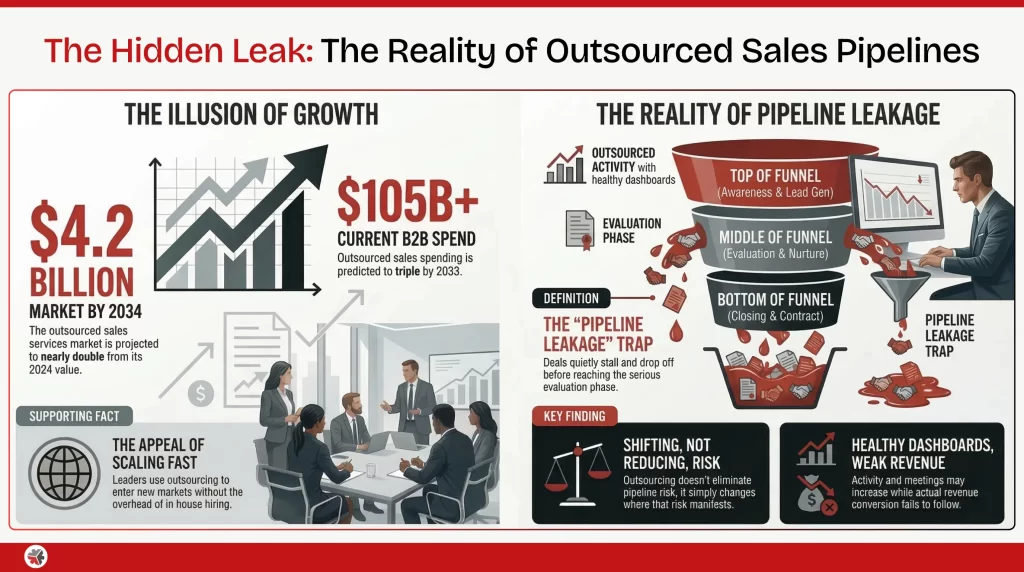
The global outsourced sales services market was valued at $2.7 billion in 2024 and is expected to reach $4.2 billion by 2034. In the broader B2B space, outsourced sales spending has already surpassed $105 billion and is predicted to triple by 2033.
Clearly, organizations—from fast-growing startups to major corporations—see outsourcing as a great tool to increase revenue.
But here’s what many sales revenue leaders finally discover:
Outsourcing sales doesn’t reduce pipeline risk. It simply shifts where that risk shows up.
Meetings happen. Activity increases. Dashboards look healthy.
Yet deals quietly stall before reaching serious evaluation. This slow drop-off—often called pipeline leakage—is one of the most overlooked risks in enterprise sales.
Here are seven common mistakes that weaken outsourced sales efforts—and how to avoid them.
Mistake 1: Viewing Outsourced Sales as a Volume Engine
Many outsourced sales initiatives are measured by activity, such as calls made, emails sent, and meetings scheduled. These numbers may look good on reports, but enterprise deals are not driven by volume. They depend on relevance and timing. This is one of the most common B2B sales errors, where activity is mistaken for actual progress.
Solution
Shift the focus to pipeline impact. Strong outsourced sales efforts prioritize ICP alignment, account research, and stakeholder relevance. Instead of asking how many activities were completed, focus on how many conversations actually moved deals forward.
Mistake 2: Ignoring Enterprise Buying Complexity
Enterprise deals include a single decision-maker. Most B2B buying involves six to ten stakeholders who assess technical, financial, and operational risks. When outsourced teams engage only one contact, early interest doesn’t spread across the organization—creating hidden enterprise sales risks that slow down deal progression.
Solution
Focus outreach on multi-stakeholder engagement. Identify key decision-makers, influencers, and evaluators early in the discussion. Enterprise deals gain significant traction when many stakeholders understand the issue and recognize its importance.
Mistake 3: Weak Ideal Customer Profile (ICP) Targeting
A common mistake is starting outsourced sales without a clearly defined Ideal Customer Profile. Without strong targeting, outreach reaches companies that lack urgency, budget, or strategic fit. These conversations may start positively, but often fail during qualification, creating a false sense of pipeline growth.
Solution
Define the right company size, industry priorities, technology environment, and business triggers. When outreach connects with businesses that are actively addressing the challenges you solve, engagement improves considerably.
Mistake 4: Inconsistent Messaging Across the Sales Journey
Enterprise sales rely on a clear and consistent story. But when outsourced teams use messaging that doesn’t match internal sales conversations, confusion sets in. One conversation focuses on efficiency, another on cost savings, and the demo tells a different story altogether. This weakens trust. From the buyer’s perspective, the story is always altering, undermining trust and credibility.
Solution
Ensure message consistency across all stages. From outreach to meetings, the value proposition should stay aligned. Consistency builds credibility and reduces enterprise sales risks during decision-making.
Click Here:- 8 Reasons B2B Cold Calling Still Drives Enterprise Sales Success
Mistake 5: Treating Appointment Setting as the Ultimate Goal
A common outsourcing failure arises when meeting volume is used as the primary success criterion. Calendars fill up rapidly, which at first seems like progress. However, experienced revenue executives understand that not every meeting adds value. Poorly qualified meetings create extra work for internal teams and rarely turn into real opportunities.
Solution
Redefine success around deal progression, not just meetings. Sales-ready meetings should include the right stakeholders, clear challenges, and defined objectives. This reduces pipeline leakage and improves overall conversion quality to move the deal forward.
Mistake 6: Cultural and Communication Misalignment
Outsourcing can introduce communication gaps due to differences in time zones, work styles, and business practices. These small misalignments can lead to misconceptions and slow down collaboration. When internal teams and outsourced partners have conflicting expectations and communication delays, this ultimately affects overall performance.
Solution
Build clear communication structures. Regular check-ins, clear reports, and collaborative message reviews enable both teams to stay on track. Strong alignment minimizes execution gaps and prevents common outsourcing failures.
Mistake 7: Lack of Continuous Feedback and Optimization
Enterprise marketplaces are continually evolving. Messaging evolves, industries alter, and new competitive dynamics arise. When outsourced sales teams don’t receive regular input from internal revenue leaders, they may continue to use outmoded messages or targeting tactics. Over time, this distance diminishes the quality of engagement and increases pipeline leakage.
Solution
Treat outsourced teams as extensions of the revenue organization. High-performing projects include shared CRM visibility, weekly insight reviews, and continuing messaging adjustments based on actual prospect discussions. Continuous improvement helps eliminate B2B sales errors over time.
How Strategic Outsourced Sales Strategies Prevent Pipeline Leakage
When correctly executed, outsourced sales can be one of the most effective drivers of enterprise funnel growth. It can significantly reduce enterprise sales risks and improve pipeline quality. But the difference is in execution.
At Beyond Codes Inc., the focus is not just on activity, but on pipeline quality. The approach emphasizes targeted outreach, meaningful conversations, and close alignment with internal sales teams.
This includes: