Key Takeaways
- A focused list of high-value companies produces stronger results than a broad list of poorly qualified prospects.
- Sales and marketing should agree on target accounts, buying priorities, team responsibilities, and revenue goals from the outset.
- Effective personalization connects each company’s business priorities with a relevant solution instead of relying on superficial details.
- Advertising, email, sales outreach, events, and content should work together across the entire buying journey.
- Qualified pipeline, opportunity progression, deal velocity, and revenue provide a clearer view of performance than engagement alone.
- Starting with a manageable account list allows teams to test their approach, learn from the results, and scale what works.
A B2B marketing team can generate hundreds of leads and still miss the companies most likely to become valuable customers. The issue is not always reach. Often, marketing attracts one audience while sales pursues another.
Account based marketing closes that gap. It concentrates sales and marketing effort on a defined group of companies instead of treating every lead as an independent opportunity. Both teams decide which accounts matter, identify the people involved in the purchase, and build engagement around problems those buyers are trying to solve.
This approach is well suited to complex B2B sales. Enterprise software and high-value services rarely have a single buyer. A department leader may recognize the need, an IT team may assess feasibility, and finance may decide whether the investment makes sense. Generic campaigns struggle to address those different concerns.
An effective ABM campaign strategy brings account selection, research, messaging, outreach, and measurement into one plan. Its purpose is not to generate activity for its own sake. It is to create meaningful conversations inside the right companies and turn those conversations into a qualified pipeline.
This guide explains how to build that process from the ground up.
What Is an Account Based Marketing Campaign?
An accountbased marketing campaign is a coordinated effort to engage selected companies with messages and experiences built around their needs.
Traditional demand generation usually begins with an audience. Marketing reaches that audience, captures responses, and qualifies individual leads afterward. ABM reverses the order. The team chooses the accounts first and then determines how to engage the people within them.
That distinction changes more than targeting. It affects how budgets are assigned, how content is developed, and how sales becomes involved. Performance is evaluated at the account and opportunity levels rather than through lead volume alone.
Suppose a software company wants to win ten national retailers. A broad campaign might advertise to thousands of retail professionals. An ABM campaign would study those ten companies, identify their likely buying committees, and develop outreach around the operational challenges each account faces.
The audience is smaller, but the commercial intent is sharper.
Which ABM Model Should You Use?
ABM programs differ in their scale and depth of personalization. The right model depends on the value of each opportunity and how much effort the business can justify.
| ABM Model | Best Suited For | How the Campaign Works |
|---|---|---|
| One-to-one | A small number of strategic accounts with substantial revenue potential | Research, messaging, and outreach are developed for each company |
| One-to-few | Groups of accounts that share a market or business problem | Campaigns are adapted for each account cluster |
| One-to-many | Larger segments that meet common targeting criteria | Technology delivers relevant content and advertising at scale |
These models can operate together. A business might run one-to-one programs for a handful of enterprise opportunities while using one-to-few campaigns for companies in a priority industry. Broader account segments may receive one-to-many outreach.
The key is to match the investment with the potential return. A campaign should not spend enterprise-level resources pursuing an account with limited commercial value.
How to Plan an Effective ABM Campaign?
Effective ABM campaign planning connects account selection, stakeholder research, messaging, campaign execution, and performance measurement within one coordinated process. Here are the steps to consider:
Step 1: Set a Commercial Goal
Begin with the result the campaign is expected to produce.
A campaign designed to enter new enterprise accounts requires a different approach from one intended to revive stalled opportunities. Customer expansion presents another set of needs. Without a clear objective, teams often combine unrelated activities and struggle to explain what the campaign accomplished.
Choose one primary outcome. It might be new pipeline, deal progression, or revenue from existing customers. Supporting measures can then show whether the account is moving in the right direction.
Make the goal specific enough to guide decisions. A cybersecurity provider, for instance, might aim to generate $1 million in qualified pipeline from 30 named companies within six months. That target gives marketing a basis for allocating resources and gives sales a defined result to pursue.
Decide how opportunities will be attributed before launch. If marketing measures engagement while sales measures pipeline, the teams may reach different conclusions about the same campaign.
Step 2: Select and Prioritize Target Accounts
The account list sets the ceiling for the campaign. Strong creative cannot compensate for targeting companies that lack the need or resources to buy.
Start with the characteristics shared by your strongest customers. Industry and company size may matter, but they rarely tell the whole story. Look at the problems those customers needed to solve. Consider the systems they used before buying and the conditions that made the purchase a priority.
Then ask three questions about each potential account. Does the company resemble the customers you serve well? Is the opportunity valuable enough to justify focused attention? Is there evidence that the company may be preparing to act?
This distinction matters. A company may be an excellent long-term fit but show no immediate need. Another may be actively researching a solution but lack the budget or operating environment required for a successful engagement.
Buying signals can help identify timing. Relevant website activity, changes in leadership, expansion plans, and active research may indicate that a problem is gaining attention. Treat these signals as evidence to investigate rather than proof that a purchase is imminent.
Place the selected accounts into tiers. Strategic opportunities should receive deeper research and more individual attention. Broader account groups can be approached through campaigns built around a shared problem. Sales should review the final list before substantial campaign spending begins.
Step 3: Research the Account and Its Buying Committee
A company is not a buyer. People make the decision, and they rarely make it alone.
Complex purchases can involve a business sponsor, technical evaluator, finance representative, end user, and procurement team. Each person enters the process with different questions. The business sponsor may care about revenue or efficiency. IT will want to understand security and integration. Finance will ask whether the expected return justifies the cost.
Research should help the team form a credible account hypothesis. Why might this company need the solution? Why could the issue matter now? Who is likely to influence the decision?
Use information from the CRM and previous sales conversations first. Company reports and public announcements can add context. Relevant intent data may help reveal current areas of interest. Keep verified facts separate from assumptions so that unconfirmed information does not become the basis of the campaign.
The finished account brief does not need to be long. It needs to be useful. Sales should be able to read it and understand the likely problem, the people involved, and the next conversation worth pursuing.
Step 4: Establish How Sales and Marketing Will Work Together
Sales and marketing alignment should exist before the first advertisement runs or the first email is sent. Both teams need a common account plan that clarifies:
- Which accounts each team is responsible for
- Who owns each campaign interaction and follow-up
- Which engagement signals should trigger sales outreach
- How quickly sales should respond to an engaged account
- Where account activity and opportunity progress will be recorded
- How campaign-sourced and campaign-influenced pipeline will be defined
A single page view may mean very little. Repeated activity from several people at the same company tells a more useful story. Both teams should agree on how much evidence is required before sales initiates direct contact.
Regular reviews keep the plan connected to reality. Marketing can show which accounts are responding and which subjects attract interest. Sales can explain whether that activity has produced credible conversations.
Both teams should record their interactions in the CRM. A shared account history reduces duplicate outreach and helps the company present one consistent message.
Step 5: Develop Relevant Messaging and Content
Personalization works when it changes the substance of the message. Adding a company name to a standard email does not achieve that.
Begin with the business issue identified during account research. Explain why it deserves attention and how your solution relates to the outcome the company wants. Then provide evidence that makes the claim believable.
The message should also reflect the recipient’s role. An executive may want a concise commercial case. A technical evaluator will need implementation details and evidence that the solution can operate within the company’s environment. An end user may care more about how daily work will change.
Consider a logistics software company approaching a regional distributor. Operations leaders may respond to evidence about missed delivery windows. IT may want to discuss data integration and network visibility. Those messages address different concerns, but they still support the same campaign narrative.
Not every asset needs to be created from scratch. A core customer story can be adapted for a particular industry. An existing technical guide may need a new introduction that relates it to the account’s situation. A financial model can use assumptions relevant to the prospect.
Personalization should make the material more useful, not simply more expensive to produce.
Step 6: Choose Channels That Support the Buying Process
Select channels according to how the account researches purchases and how its stakeholders prefer to engage. The goal is not to appear everywhere. It is to create a connected sequence of useful interactions.
Paid LinkedIn campaigns can introduce an issue to selected professional audiences. Retargeting can keep that message visible after someone visits a campaign page. Email and sales outreach can then provide a direct reason to continue the conversation.
Webinars and executive events serve a different purpose. They give buyers room to explore a problem without immediately entering a sales call. Direct mail may help attract the attention of a small number of senior stakeholders when the message is thoughtful and relevant.
The sequence matters more than the number of channels. A decision-maker might first see an industry-specific advertisement and later read a related customer story. A sales representative could then share an observation connected to the same issue. Each interaction advances the discussion instead of repeating the original pitch.
Respect consent requirements and platform rules throughout the campaign. High-value targeting does not justify excessive contact.
Step 7: Launch the Campaign as a Coordinated Program
Translate the account plan into a practical campaign schedule. Each activity should have an audience and an owner. The team should also know what action it wants the recipient to take.
Test the mechanics before launch. Confirm that the account data is accurate and that advertising audiences are configured correctly. Check landing pages, forms, CRM routing, and campaign tracking. Sales representatives should understand what the account will see before they begin their outreach.
A short pilot can expose weak points without putting the full budget at risk. It may reveal that account data is incomplete or that the message attracts the wrong stakeholders. Fixing those problems early is cheaper than correcting them after a broad launch.
Once the campaign is active, monitor account-level behavior. Several stakeholders engaging with the same issue may warrant a coordinated sales response. One isolated click does not.
Allow the campaign to respond to the account’s progress. A company requesting a demonstration should move into a direct conversation. An account still exploring the problem may need educational material instead. Not every buyer should be pushed through the same schedule.
Step 8: Measure Commercial Progress
ABM measurement should show whether target accounts are moving closer to a buying decision.
Reach and engagement provide useful early signals. They can reveal whether the campaign is reaching the intended companies and whether the message is attracting attention. They do not prove that an account is likely to buy.
The next level of measurement should examine business movement. Are more stakeholders joining the conversation? Are meetings becoming qualified opportunities? Are existing deals progressing faster?
Closed revenue offers the clearest commercial result, but it may take months to appear in an enterprise sales cycle. Campaign reviews must account for that delay. Judging a six-month buying process after four weeks will produce weak decisions.
Analyze results by account tier and campaign objective. A one-to-one program should not be judged by the same volume expectations as a one-to-many campaign.
Keep sourced and influenced pipeline separate. Sourced pipeline includes opportunities created under the campaign’s attribution rules. Influenced pipeline covers existing opportunities that interacted with campaign activity. Influenced pipeline can demonstrate involvement, but it should not automatically be presented as revenue caused by marketing.
When a financial return can be attributed with reasonable confidence, use:
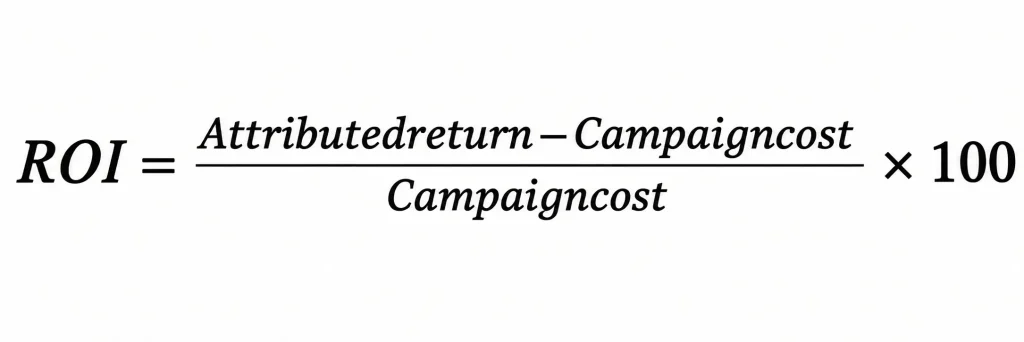
Define “return” before using the formula. Some businesses calculate ROI from revenue. Others use gross profit to reflect the economics of delivery. Either method can work if it is applied consistently.
Four Practical ABM Campaign Examples
ABM can support different commercial goals, from opening new enterprise accounts to expanding relationships with existing customers. The following ABM campaign examples show how account selection, messaging, and outreach can be adapted to the specific outcome a business wants to achieve.
Enterprise Pipeline Generation
A cybersecurity vendor wants to reach 25 financial-services companies. Its team identifies organizations with relevant security needs and maps the people likely to influence the purchase.
LinkedIn campaigns introduce the business risk. Tailored emails lead interested stakeholders toward executive briefings. Technical material addresses implementation concerns, while executive messaging focuses on commercial exposure.
The vendor judges the campaign by the quality of meetings and the opportunities created. Buying-committee coverage shows whether engagement has spread beyond one contact.
Industry-Specific Market Entry
A software provider plans to expand into manufacturing. Rather than adapting a generic product campaign, the company develops its message around production visibility and unplanned downtime.
Industry landing pages establish relevance. Customer stories provide evidence, and a technical webinar allows plant leaders to examine the problem in more depth.
The company watches whether target manufacturers engage and whether those interactions develop into genuine opportunities. High traffic from companies outside the target market would add little value.
Deal Acceleration
A B2B technology company has several opportunities stalled during evaluation. Marketing and sales review what is preventing each account from advancing.
One company receives a financial assessment based on its operating conditions. Another joins a technical workshop involving its IT team. A third speaks with a customer that completed a similar implementation.
The campaign is successful if those interventions resolve concerns and help the opportunities progress. General engagement is secondary to movement within the deal.
Customer Expansion
A SaaS provider wants existing customers to adopt additional products. Its account teams review product use and current business priorities to find credible expansion opportunities.
Marketing prepares relevant customer material while account managers lead the conversations. Recommendations are based on the customer’s situation rather than a general cross-sell offer.
Expansion pipeline shows whether the campaign creates commercial interest. Adoption after the purchase helps confirm whether the additional product is producing value.
What Makes an ABM Campaign Successful?
Strong ABM begins with commercial judgment. A company should not enter the target list simply because someone downloaded a report. It should have a credible need and enough potential value to justify the effort.
Personalization must be grounded in a real business issue. Mentioning a recent company announcement adds little unless the message explains why that development matters. Research should shape the argument rather than decorate the opening sentence.
Sales should remain involved throughout the campaign. Its role is not limited to following up after marketing identifies engagement. Sales representatives can test account assumptions and explain what may be blocking an active opportunity.
The campaign also needs to make sense to the whole buying committee. Finance and IT may require different evidence, but both should encounter a consistent explanation of the solution’s value.
Finally, keep a record of what the team learns. A campaign becomes repeatable when the business understands which accounts responded, what produced serious conversations, and what helped opportunities advance.
Organizations without the internal capacity to manage this work may consider an experienced account based marketing agency. The partner should fill a defined capability gap and work toward agreed commercial outcomes. It should not replace the company’s knowledge of its customers or sales process.
Conclusion
A successful account based marketing campaign begins with a clear decision about which companies are worth pursuing and why they may be ready to buy. Account research then shapes the message, while sales and marketing work together to move the right stakeholders toward a conversation.
Starting with a focused pilot allows the team to test account selection and improve its outreach before committing to a larger program. The lessons from that pilot can then support a more repeatable and scalable approach.
Beyond Codes helps B2B companies plan and execute account based marketing programs built around relevant accounts, coordinated outreach, and measurable pipeline goals. With the right strategy and execution model, account insight can become a practical route to stronger sales conversations and revenue growth.
Ready to Turn High-Value Accounts Into Sales Conversations?
FAQs
A CRM and marketing automation platform provide the basic foundation. Larger programs may also use account intelligence, intent data, advertising, personalization, and attribution tools. Technology should solve a defined operational problem rather than add unnecessary complexity.
A small ABM pilot typically costs 15,000–30,000 over three months, while an established program may require $10,000–$25,000 per month. Enterprise one-to-one campaigns can exceed $50,000 per month. The final budget depends on the number of accounts, personalization level, paid media, technology, content, and internal or agency support.
Yes. Demand generation can build awareness across the wider market, while ABM focuses resources on priority companies. Insights from broader campaigns may identify accounts worth pursuing, and ABM engagement can help sales determine where direct outreach is justified.
An account may be removed when it no longer fits the customer profile, lacks a relevant business need, or repeatedly shows no realistic path to purchase. Accounts should also be reconsidered after major changes in budget, leadership, strategy, or ownership.
Use relevant business information from legitimate sources and follow applicable privacy rules. Personalization should focus on the company’s operating priorities and the recipient’s professional responsibilities. Avoid using sensitive personal information or making claims based on unverified assumptions.
A first pilot should test the quality of the account list and the relevance of the campaign message. It should also reveal whether sales and marketing can coordinate their work effectively. Keep the scope manageable so the team can identify what influenced meaningful conversations before expanding the program.
Author
-
Engineer-turned-marketer passionate about transforming complex ideas into impactful B2B marketing strategies. I blend technical insight with creative vision to build brands, generate demand, and drive revenue growth. With deep expertise in brand strategy, marketing automation, and integrated campaigns, I’ve crafted high-performing assets—from websites and ebooks to sales enablement materials and digital experiences—that empower Sales and CS teams to convert faster.