

Beyond Codes Inc.

[gtranslate]

Artificial Intelligence and Marketing Automation- Difference & Application in Demand Generation

B2B marketing automation

Artificial intelligence and B2B marketing automation are often used together in modern marketing conversations, but they serve different purposes. For companies focused on pipeline growth, especially in SaaS, IT services, and enterprise sales, understanding this difference is critical.

Marketing automation helps execute campaigns at scale, while artificial intelligence improves the design, targeting, and optimization of those campaigns. In today’s environment—where buyers are informed, sales cycles are longer, and decisions involve multiple stakeholders—execution alone is not enough. This is where AI in demand generation becomes essential.

Businesses that combine both technologies can move beyond activity-driven marketing and build systems focused on outcomes such as pipeline quality, conversion rates, and revenue predictability.

Businesses that combine both technologies can move beyond activity-driven marketing. They build systems focused on outcomes such as pipeline quality, conversion rates, and revenue predictability.

What is B2B Marketing Automation?


B2B marketing automation refers to the use of software platforms to automate marketing activities across channels such as email, websites, and social media. These tools are designed to handle repetitive tasks and ensure consistent communication throughout the buyer journey.

In a B2B environment, marketing automation plays a key role in managing long and complex sales cycles. It helps businesses stay engaged with prospects over time through structured workflows and campaigns.

Common use cases include:

Most marketing automation tools for B2B operate based on predefined rules. Marketers define triggers and conditions, and the system executes actions when those conditions are met. While this improves efficiency, it does not allow for dynamic decision-making.

What is Artificial Intelligence in Demand Generation?


AI in demand generation refers to the use of machine learning and data analysis to improve how businesses identify, engage, and convert potential customers.

Unlike traditional automation, AI can analyze large datasets, identify patterns, and generate insights that help marketers make better decisions. This allows companies to shift from reactive marketing to proactive, data-driven strategies.

AI is commonly applied in:

For B2B organizations, this means better targeting, improved lead quality, and more efficient pipeline generation. AI helps marketing teams focus on the accounts most likely to convert, rather than relying on broad outreach.

Key Difference Between B2B Marketing Automation and AI in Demand Generation


Although both technologies are essential, their core functions are different.

B2B marketing automation focuses on execution, while AI-driven marketing focuses on intelligence and optimization.

Core Differences

In simple terms, marketing automation helps you scale operations, while AI in demand generation helps you improve results.

How AI Enhances B2B Marketing Automation


Artificial intelligence does not replace
b2b marketing automation—it strengthens it. When both are integrated, businesses can move from static workflows to adaptive, intelligent systems.

For example, in a traditional b2b lead generation automation setup, all leads may receive the same sequence of emails. With AI, that process becomes dynamic. Messaging, timing, and content can change based on how each prospect interacts with previous touchpoints.

AI also helps identify high-intent accounts, recommend next-best actions, and improve engagement strategies across channels. This is especially valuable in account-based marketing automation, where precision and timing directly influence deal progression.

Applications of AI in B2B Demand Generation


Artificial intelligence is transforming how companies approach
B2B demand generation, particularly in enterprise environments where buying decisions are complex and data-driven.

Traditional b2b marketing automation ensures campaigns run efficiently, but AI adds the intelligence needed to improve outcomes. It enables businesses to align marketing efforts with real buyer intent, engagement signals, and pipeline priorities.
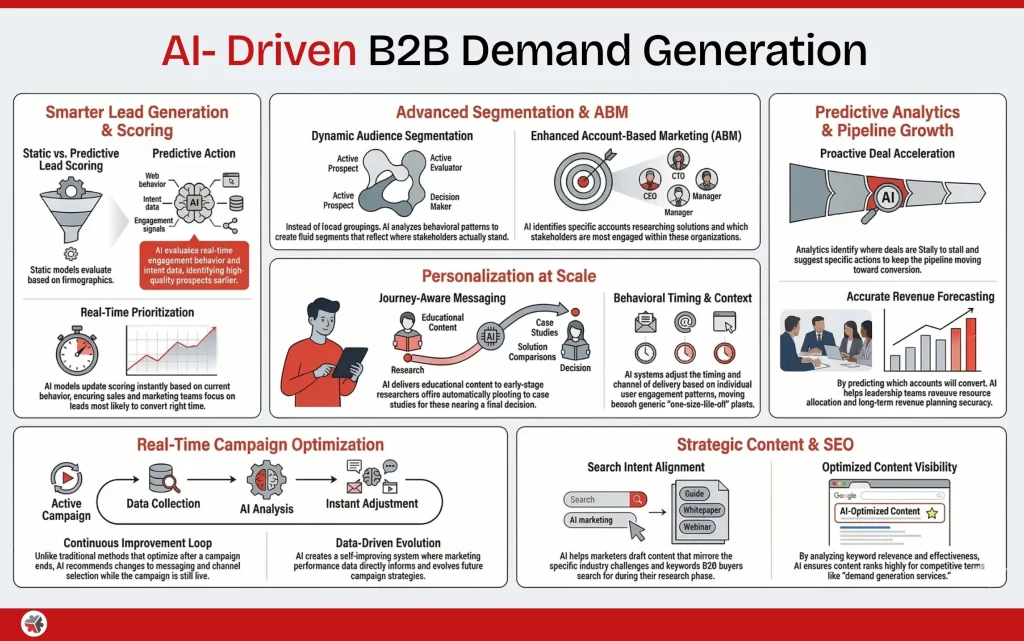
B2B Demand Generation

1. Smarter Lead Generation and Predictive Lead Scoring


AI enhances
b2b lead generation automation by identifying high-quality prospects early in the buying journey. Instead of relying on static scoring models, AI evaluates multiple data points, including engagement behavior, firmographics, and buyer-intent data.

This allows businesses to prioritize leads that are more likely to convert. For companies using enterprise marketing automation, this reduces wasted effort and improves alignment between marketing and sales teams.

Predictive lead scoring also updates in real time, ensuring that lead prioritization reflects current behavior rather than outdated assumptions.

2. Advanced Audience Segmentation and Account-Based Targeting


Segmentation is a core feature of
marketing automation platforms, but AI takes it further by enabling dynamic segmentation.

Instead of grouping audiences based only on static data, AI analyzes behavioral patterns and intent signals to create more meaningful segments. This is critical in account-based marketing automation, where multiple stakeholders influence buying decisions.

AI helps identify which accounts are actively researching solutions, which stakeholders are engaged, and where each account stands in the buying journey. This allows businesses to run more effective automated demand generation campaigns.

3. Personalization at Scale Across the Buyer Journey


Personalization is no longer optional in B2B marketing. Buyers expect relevant communication that reflects their needs and context.

AI enables AI marketing automation systems to deliver personalized experiences at scale. It adjusts messaging, content, and timing based on user behavior and engagement patterns.

For example, prospects in early stages of research may receive educational content, while those closer to decision-making receive case studies or product-focused messaging.

This improves engagement and ensures that b2b marketing automation campaigns are aligned with buyer intent rather than generic messaging.

4. Predictive Analytics for Pipeline Growth and Forecasting


AI-driven predictive analytics helps businesses anticipate outcomes rather than react to past performance.

It can identify which accounts are likely to convert, where deals may stall, and what actions can accelerate pipeline movement. For companies focused on b2b demand generation services, this level of insight is critical.

Predictive analytics also improves forecasting accuracy, helping leadership teams make better decisions around resource allocation and revenue planning.

5. Campaign Optimization and Continuous Improvement


In traditional
sales and marketing automation, campaigns are often optimized after execution. AI changes this by enabling continuous improvement.

AI analyzes campaign performance in real time and recommends changes to improve results. This includes optimizing messaging, timing, and channel selection.

For businesses investing in AI-driven marketing, this creates a system where campaigns evolve based on performance data, leading to better outcomes over time.

6. AI in Content Strategy and SEO for Demand Generation


Content plays a key role in
AI in demand generation, especially as B2B buyers conduct extensive research before engaging with vendors.

AI helps marketers create content that aligns with search intent, buyer journey stages, and industry-specific challenges. It also improves SEO performance by analyzing keyword relevance and content effectiveness.

This is particularly important for ranking on terms like b2b marketing automation, AI in lead generation, and demand generation services, where competition is high, and content quality determines visibility.

Role of Marketing Automation in B2B Demand Generation


While AI adds intelligence,
B2B marketing automation ensures consistent execution across campaigns.

It remains essential for managing large-scale outreach, maintaining structured workflows, and supporting lead nurturing processes. Without automation, even the best AI insights cannot be implemented effectively.

Marketing automation acts as the operational backbone, while AI acts as the decision-making engine.

Why B2B Companies Need Both AI and Marketing Automation


Using only marketing automation limits adaptability, while relying only on AI creates execution challenges.

The combination allows businesses to:

For companies offering or investing in b2b demand generation services, this integrated approach is essential for driving consistent results.

Challenges in Implementing AI-Driven Marketing Automation


Despite its advantages, implementing
AI marketing automation requires careful planning.

Data quality is everything. If your contact data is outdated or inaccurate, your cold calls and emails won’t land with the right people. And when that happens, even the best AI tools can’t help—your outreach misses, insights go wrong, and campaigns fail to deliver results.

Alignment between marketing, sales, and operations teams is also necessary. Without clear goals and coordination, even advanced tools cannot deliver expected outcomes.

Businesses also ensure compliance with data privacy regulations when using AI-driven systems.

Conclusion


Artificial intelligence and
B2B marketing automation are not interchangeable, but they are closely connected.

Marketing automation provides the structure to execute campaigns efficiently. AI adds the intelligence required to improve targeting, personalization, and decision-making.

For B2B companies focused on pipeline growth, combining both is no longer optional. It is the foundation for effective AI in demand generation, better lead quality, and stronger revenue outcomes.

As competition increases and buyers become more selective, building a pipeline gets harder. Businesses that adopt AI-driven marketing automation will be better positioned to achieve consistent, predictable growth.

Turn AI-driven insights into qualified B2B pipeline—book a strategy call today.

FAQs

What is the difference between AI and B2B marketing automation?

B2B marketing automation handles repetitive tasks like email workflows, lead nurturing, and campaign execution. AI adds intelligence by analyzing data, predicting outcomes, and improving targeting, personalization, and decision-making. In simple terms, automation executes the process, while AI helps improve the results of that process.

How does AI improve B2B marketing automation?

AI improves B2B marketing automation by making campaigns more adaptive and data-driven. It can adjust messaging, timing, audience targeting, and lead prioritization based on real behavior and intent signals. This helps businesses move beyond static workflows and create more effective demand generation programs.

Why do B2B companies need both AI and marketing automation?

B2B companies need both because marketing automation supports consistent campaign execution, while AI improves accuracy, relevance, and performance. Together, they help teams deliver personalized outreach at scale, improve lead quality, align with sales goals, and build a more predictable pipeline in complex buying environments.

Is marketing automation enough for B2B demand generation?

Marketing automation alone is useful for workflow execution, but it is often not enough for modern B2B demand generation. It follows predefined rules and does not adapt well to changing buyer behavior. AI helps fill that gap by adding predictive insights, smarter targeting, and continuous campaign optimization.

How does AI help with lead scoring in B2B marketing?

AI improves lead scoring by evaluating multiple data points such as engagement behavior, firmographics, and buyer-intent signals in real time. Unlike static scoring models, AI updates lead priorities dynamically, helping marketing and sales teams focus on prospects that are more likely to convert into qualified pipeline opportunities.

Can AI personalize B2B marketing campaigns at scale?

Yes, AI can personalize B2B marketing campaigns at scale by adjusting content, messaging, timing, and channel strategy based on individual prospect behavior. This helps companies deliver more relevant communication across the buyer journey, improving engagement and making automation campaigns more closely aligned with real buyer intent.

What are the biggest benefits of AI-driven marketing automation?

The biggest benefits of AI-driven marketing automation include better lead quality, improved targeting, stronger personalization, more accurate forecasting, reduced manual effort, and continuous campaign improvement. For B2B organizations, these benefits translate into better pipeline visibility, stronger sales alignment, and more reliable revenue outcomes.

What challenges come with implementing AI in marketing automation?

The main challenges include poor data quality, weak alignment between marketing and sales teams, unclear goals, and compliance risks. AI performs best when businesses have accurate data, strong process alignment, and a clear plan for how automation and intelligence will support demand generation and revenue growth.

Author

  • Photo

    Engineer-turned-marketer passionate about transforming complex ideas into impactful B2B marketing strategies. I blend technical insight with creative vision to build brands, generate demand, and drive revenue growth.

    With deep expertise in brand strategy, marketing automation, and integrated campaigns, I’ve crafted high-performing assets—from websites and ebooks to sales enablement materials and digital experiences—that empower Sales and CS teams to convert faster.

    I focus on content-driven marketing and smart automation to deliver scalable, results-oriented campaigns with clarity, creativity, and executional precision.

Facebook
Twitter
LinkedIn
Threads
Pinterest

Most Popular

Power your sales pipeline.

Tell us about your growth targets and the markets you’re going after

Get The Latest Updates

Subscribe To Our Monthly Newsletter

No spam, notifications only about new services, blogs, and newsletter updates.

Contact Us Today!