

When you compile this level of detail for your priority accounts, guesswork disappears. You begin making strategic choices grounded in what is actually true about the account. In competitive B2B landscapes such as IT services and SaaS, this transition from assumptions to evidence is the dividing line between teams that hit revenue targets and those that consistently fall short.
Eight Questions That Sharpen IT Consulting Sales Leads and SaaS Sales Lead Generation
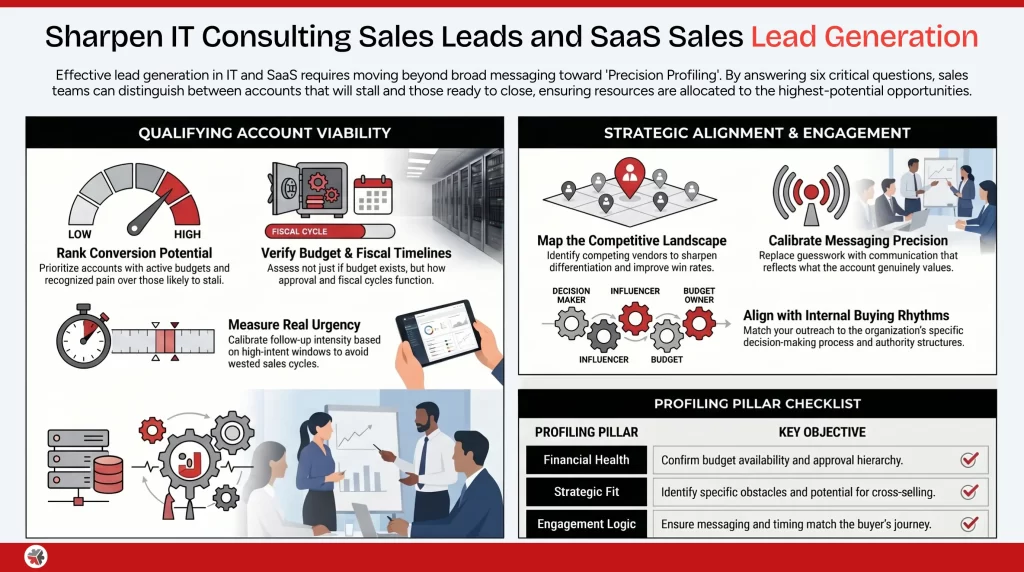
Before you engage any lead generation services or greenlight a new campaign, stress-test your understanding of your accounts. If you can answer these eight questions with real confidence, you’re well positioned. If you can’t, you’ve identified exactly where to begin.
Which accounts carry the highest conversion potential?
Not every account deserves equal attention. Some have active budget, recognized pain, and genuine urgency. Others look attractive but will stall indefinitely. Profiling enables you to rank and prioritize, directing your team’s energy toward accounts most likely to close.What specific challenges are these accounts dealing with right now?
Broad messaging about “innovation” or “digital transformation” won’t cut through. You need to identify the precise obstacle your prospect faces. A SaaS company battling churn requires a different conversation than one expanding into new markets. Your profiling must capture these distinctions.Do they have the budget for a solution at your price point?
A productive conversation with a champion is meaningless if the organization froze spending months ago. Budget awareness prevents months of wasted effort. Profiling helps you assess not only whether a budget exists but also how approval works and what fiscal timelines govern decisions.Is there real urgency driving the need?
A prospect might acknowledge a problem and still postpone action indefinitely. In B2B sales, timing dictates everything. Profiling helps you measure urgency so you can calibrate follow-up intensity — avoiding wasted cycles on low-priority accounts while capitalizing on high-intent windows.Do cross-sell or upsell opportunities exist within the account?
Profiling frequently reveals untapped revenue within accounts you already serve — across teams, departments, or use cases. This is particularly valuable for SaaS and IT services with broad portfolios. Without a complete organizational view, you risk leaving money on the table.Who are you competing against in this account?
Effective positioning demands competitive awareness. Profiling identifies which other vendors are being evaluated and how your strengths compare. In IT consulting sales, where buyers routinely assess multiple providers simultaneously, this intelligence sharpens your differentiation strategy and improves win rates.Is your messaging actually resonating?
Weak open rates, poor conversion metrics, or prospects disengaging after initial contact are symptoms of messaging misalignment. Profiling enables you to recalibrate communication to reflect what the account genuinely values, replacing guesswork with precision and dramatically increasing the likelihood of productive engagement.Are you engaging accounts in a way that matches how they buy?
Every organization operates with its own decision-making rhythm. Some move quickly with top-down authority. Others require broad consensus or a structured RFP process. Profiling maps this buying journey so your outreach aligns with the account’s internal process rather than fighting against it.
How to Build an Account Profile: A Practical B2B Lead Generation Process
Account profiling doesn’t demand enterprise-grade tools or six months of groundwork. It demands discipline, cross-functional collaboration, and honesty about what you know versus what you’re assuming. Here’s a process that works for IT services, SaaS, and consulting teams regardless of size.
Step 1: Mine Your Internal Knowledge First
Your organization already possesses more account intelligence than you realize. Sales representatives, customer success managers, solutions architects, and even support teams hold fragments of insight buried in CRM entries, email threads, call notes, and informal conversations.
Conduct a focused working session — not a routine status update, but a genuine knowledge extraction exercise. Walk through your top-priority accounts one by one and map out everything you collectively know against the profile dimensions above. Be ruthlessly honest about gaps. The objective isn’t to showcase existing knowledge. It’s to expose blind spots so you can prioritize where deeper investigation is needed.
Step 2: Engage the Account Directly
No amount of desktop research replaces direct conversation. Schedule discovery calls, attend industry events where your targets are present, and invest in relationship-building before you pitch.
Ask about their priorities for the upcoming quarter, the projects commanding their budget, the obstacles they’re struggling with, and how purchasing decisions typically unfold internally. Every exchange adds richness to the profile.
For complex enterprise accounts, expect this to be iterative. An IT consulting firm targeting an enterprise client may need seven or eight touchpoints across departments before the profile reaches actionable depth. That’s not inefficiency — it’s thoroughness that pays dividends downstream.
Step 3: Supplement With External Research
Layer direct conversations with publicly available signals. Company websites, annual reports, press releases, job postings, LinkedIn activity, and earnings call transcripts all contain valuable intelligence.
Job postings are particularly revealing. If a SaaS company is aggressively hiring data engineers, that signals a strategic investment direction. Earnings calls for public companies are a goldmine — executives routinely discuss priorities, headwinds, and planned investments. Monitoring social media activity from key stakeholders offers additional texture — a CTO regularly sharing content about cloud migration tells you exactly where their attention is focused.
Step 4: Centralize and Distribute
A profile that lives in one person’s head delivers zero value. Document findings in a shared, continuously updated resource — your CRM, a dedicated platform, or a well-structured shared document.
Make consulting the profile a mandatory step before every call or campaign. When a new team member inherits an account or marketing launches a segment-specific initiative, the profile should be the first asset they review. Without this discipline, critical insights remain siloed and eventually vanish when people change roles.
How Account Profiling Transforms Your B2B Marketing and Lead Generation
Let’s move beyond the abstract claim that profiling improves marketing and get specific about what actually changes in practice.
You stop hemorrhaging budget on accounts that will never close. B2B lead generation for IT companies is capital-intensive. Every dollar directed at an unqualified account represents a missed investment in one that’s genuinely ready to buy. Profiling ensures your spend is concentrated where pipeline generation is most likely to occur. When marketing and sales jointly agree on account prioritization using real data rather than instinct, campaign ROI improves materially.
Your messaging becomes precisely relevant. When you understand the exact pressures facing a VP of Engineering at a mid-market SaaS company, you can create outreach that directly addresses those pressures. That’s categorically different from distributing the same whitepaper to every contact in your database. Profiled accounts receive tailored messaging, and tailored messaging generates responses.
You reach the full buying committee. Most B2B marketing over-indexes on the primary contact — typically whoever filled out a form or attended a webinar. But closing requires influencing multiple stakeholders. Profiling maps the entire buying committee so you can design touchpoints for each participant, not just the most visible one. For IT consulting sales leads, this is critical. A technical champion may endorse your solution enthusiastically, but if you haven’t proactively addressed the CFO’s concerns about implementation risk and total cost, the deal will stall.
Your sales team enters conversations with an advantage. When a rep walks into a meeting with a detailed account profile, the dynamic shifts. Instead of asking broad discovery questions the prospect has answered for five other vendors, your rep demonstrates understanding and moves quickly to value. Prospects notice preparation. It builds trust and positions your team as a strategic partner rather than another vendor in the queue.
You compress the sales cycle. This is the compounding return. When you target the right accounts, deliver the right message, engage the right stakeholders, and time your approach correctly, deals progress faster. Stalled opportunities and “no decisions” cluttering your pipeline drop significantly. For SaaS sales lead generation teams measured on velocity and conversion, this cycle compression is among the most concrete returns on profiling investment.
Common Account Profiling Mistakes That Undermine B2B Lead Generation
Even seasoned teams fall into profiling traps. Here are the most frequent errors — and how to avoid them.
Treating profiling as a one-and-done exercise. Accounts evolve constantly. Stakeholders leave. Priorities shift. Budgets get redirected. A profile from six months ago may already be stale. Establish a cadence of quarterly reviews for top-tier accounts at a minimum, and update immediately following any significant interaction or organizational change.
Spreading profiling efforts too thin. Fifty deeply researched, high-fit profiles will outperform five hundred shallow ones every time. Meaningful profiling demands focused effort. Diluting that focus across too many accounts means none of them receives the depth of insight that actually moves the needle. Concentrate on high-potential accounts first, and expand once the process is mature.
Keeping profiles fragmented across teams. If marketing has one understanding and sales has another, you’re generating contradictions, not profiles. When a rep uncovers a critical insight and fails to update the shared profile, marketing campaigns run on outdated assumptions. Align on a single source of truth and make maintaining it a shared responsibility.
Neglecting the human dimension. Tools and analytics are valuable, but the deepest insights emerge from genuine human interaction. A CRM field tells you someone’s title. A real conversation reveals what keeps them up at night and what outcome would make them a hero internally. Never substitute dashboards for direct engagement.
Mistaking surface research for real profiling. Browsing a company’s LinkedIn page is not profiling — that’s basic due diligence. Genuine profiling involves synthesizing diverse sources, recognizing patterns, mapping relationships, and drawing strategic conclusions. It’s an analytical discipline, not a data-gathering task.
Why IT Consulting and SaaS Companies Cannot Afford to Overlook Account Profiling
Account profiling is not glamorous work. It won’t generate applause in a board meeting the way a high-production campaign will. But it is the foundation upon which every other revenue activity is built.
When your B2B lead generation is rooted in genuine, detailed knowledge of your target accounts — their people, their challenges, their buying process — every subsequent effort becomes more effective. Your SaaS sales lead generation grows more targeted. Your IT consulting sales leads become better qualified. Your marketing campaigns create pipeline, not just vanity metrics.
For companies selling complex solutions into mid-market and enterprise accounts — whether you’re an IT services firm, a SaaS platform, or a software product engineering business — the equation is straightforward. A focused set of deeply profiled, strategically engaged accounts will consistently outperform a sprawling list of poorly understood contacts. Quality wins over quantity, and profiling is what makes quality achievable.
The investment is not massive. It’s principally time, attention, and discipline — resources always scarce but always worth protecting. Begin with your top twenty accounts. Work through the eight questions. Fill the gaps. Share what you discover. Build the habit.
For CEOs, CMOs, and growth leaders at IT services firms, SaaS companies, and consulting businesses, account profiling is not optional. It is a compounding competitive advantage. The teams that commit to it close more business, waste less spend, and build stronger relationships with the accounts that matter most.