

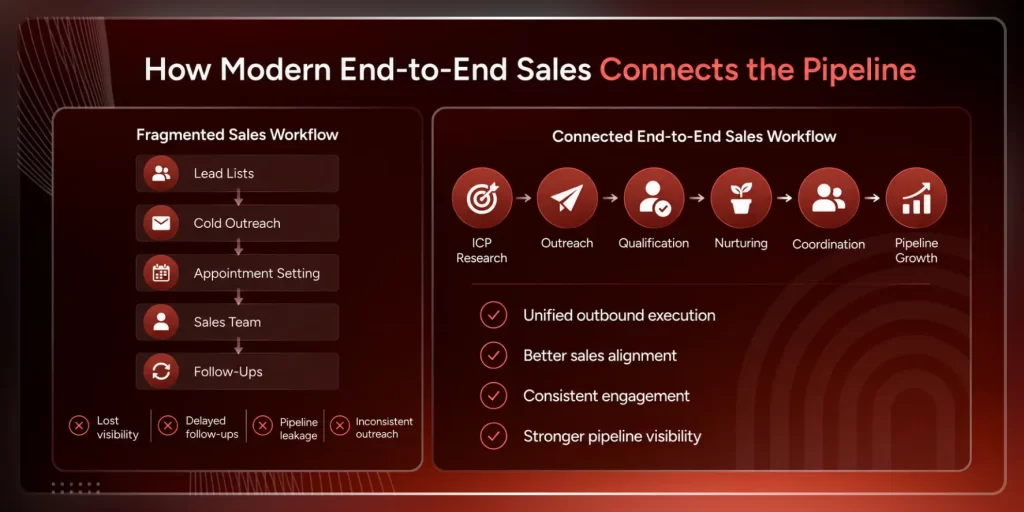
A Typical End-to-End Sales Workflow
To understand how modern sales execution operates, it helps to examine how each stage contributes to overall pipeline development.
| Stage | Action | Business Outcome |
|---|---|---|
| ICP Research | Account targeting and buyer profiling | Better-fit opportunities |
| Prospecting | Contact sourcing and enrichment | Accurate outreach lists |
| Outreach Execution | Email, LinkedIn, and calling sequences | Higher engagement |
| Qualification | Buyer intent and need validation | Improved meeting quality |
| Pipeline Nurturing | Follow-ups and stakeholder engagement | Reduced drop-offs |
| Sales Coordination | Handoffs and CRM tracking | Pipeline visibility |
| Optimization | Reporting and process refinement | Better conversion efficiency |
What Does End-to-End Sales Actually Cover?
1. Prospect Research and ICP Mapping
Every successful outbound strategy starts with identifying the right accounts and decision-makers. A strong end-to-end sales strategy focuses on defining ideal customer profiles, understanding buyer intent, and prioritizing accounts that align with business goals.
Many businesses also use structured end to end sales support to improve targeting accuracy and outbound efficiency. Without proper ICP mapping, campaigns often target the wrong accounts, resulting in lower engagement and inconsistent pipeline quality.
2. Outbound Outreach and Engagement
Modern outbound sales involve much more than sending cold emails. Businesses today use email outreach, LinkedIn engagement, cold calling, and multi-touch follow-up sequences to connect with prospects across different channels.
Connected sales execution helps maintain consistency throughout the outreach process. This is especially important in modern B2B sales environments, where multiple touchpoints are often required before buyers respond.
3. Lead Qualification and Buyer Validation
This stage focuses on validating buyer intent, business needs, budget alignment, and purchase readiness. Strong end-to-end sales services help businesses prioritize higher-quality opportunities and improve sales efficiency throughout the pipeline.
Effective qualification also reduces the burden on internal sales teams by filtering out low-intent prospects earlier in the process. This allows sales representatives to spend more time on opportunities with stronger conversion potential.
4. Follow-Ups and Pipeline Nurturing
Many outbound opportunities are lost due to inconsistent follow-ups and poor stakeholder engagement. Complete sales lifecycle management helps maintain engagement, nurture conversations, and reduce pipeline drop-offs over time.
As mentioned earlier, modern B2B buying journeys often involve multiple stakeholders, extended evaluation periods, and ongoing follow-up requirements. A structured pipeline nurturing approach helps businesses maintain momentum throughout the sales process while strengthening relationships with potential buyers.
5. Sales Coordination and CRM Management
As sales cycles become more complex, businesses need better coordination between SDRs, sales teams, and pipeline management processes. Integrated sales operations help improve CRM visibility, sales handoffs, reporting accuracy, and overall outbound workflow management.
Clear sales coordination also helps organizations reduce communication gaps between teams. Better CRM management improves visibility into prospect activity, follow-up status, and overall pipeline progression across different sales stages.
6. Reporting and Sales Optimization
Modern outbound sales require continuous analysis and refinement. Businesses investing in end-to-end sales services often track engagement trends, conversion performance, outreach effectiveness, and pipeline movement to improve outbound efficiency and support long-term growth.
Regular reporting and optimization identify performance gaps earlier and improve decision-making over time. This creates a more data-driven approach to sales execution and long-term pipeline management.
Why End-to-End Sales Matters in Modern B2B Growth
B2B sales environments have become far more complex than traditional outbound models. Enterprise buying decisions now involve multiple stakeholders, longer evaluation cycles, and higher expectations around personalization and follow-up consistency. As a result, businesses can no longer rely on disconnected sales activities to maintain predictable pipeline growth.
This is one of the main reasons companies are increasingly investing in full-cycle sales outsourcing models that bring prospecting, outreach, qualification, nurturing, and pipeline management together into a single, coordinated system.
1. Better Pipeline Visibility
One of the biggest advantages of end-to-end sales services is improved visibility across the sales pipeline. Businesses gain a clearer understanding of prospect engagement, outreach performance, follow-up status, and opportunity progression, helping sales leaders make more informed decisions.
2. Stronger Outbound Consistency
Inconsistent outreach and delayed follow-ups often lead to pipeline drop-offs and missed opportunities. A connected end-to-end sales execution process helps businesses maintain continuity across every stage of the buyer journey while improving overall prospect engagement.
3. Improved Sales Team Efficiency
Many internal sales teams spend significant time on prospecting and administrative tasks rather than focusing on active opportunities. Full-funnel outbound execution helps reduce operational pressure by aligning SDR activities, outreach workflows, and sales coordination.
4. Scalable Sales Growth
As businesses expand into new markets or target larger strategic accounts, outbound sales operations become more resource-intensive. This is where scalable end to end sales solutions help organizations grow pipeline generation without rapidly increasing internal sales overhead.
5. Better Alignment Across Sales Operations
Modern outbound growth requires stronger collaboration between prospecting teams, SDRs, sales representatives, and pipeline managers. Well-integrated end-to-end sales help businesses improve communication, reporting accuracy, CRM visibility, and overall sales process coordination.
6. Support for Longer B2B Buying Cycles
Modern B2B sales cycles often require ongoing engagement across multiple touchpoints before buyers are ready to move forward. Businesses investing in enterprise end-to-end sales services are often better positioned to maintain consistent stakeholder engagement and reduce momentum loss throughout the sales cycle.
Click Here:- Top 10 End-to-End Sales Outsourcing Companies for B2B Growth
How Different B2B Industries Use End-to-End Sales
Different industries use end-to-end sales services in different ways depending on their sales cycles, buyer complexity, and outbound growth goals. While operational structures may vary, businesses across sectors increasingly rely on connected outbound execution to improve pipeline consistency and sales coordination.
1. SaaS and Technology Companies
SaaS businesses often use coordinated pipeline management to maintain consistent prospect engagement across longer buying cycles involving multiple decision-makers. Coordinated outreach and pipeline nurturing also help support expansion into new accounts and markets.
2. IT Services and Consulting Firms
IT service providers and consulting companies frequently manage highly relationship-driven sales processes across different industries and stakeholders. End-to-end sales help improve outbound consistency while maintaining better visibility across complex sales conversations.
3. BPO and BPM Organizations
BPO and BPM firms typically depend heavily on outbound prospecting and account-based engagement strategies. Many organizations invest in full-cycle sales outsourcing to maintain follow-up consistency and improve outbound scalability across larger target account lists.
4. Product Engineering Companies
Product engineering companies often operate within highly consultative sales environments where buyer journeys involve technical evaluations, stakeholder alignment, and longer decision-making cycles. End-to-end sales help maintain consistent outbound engagement while improving pipeline visibility across complex engineering conversations.
How Businesses Evaluate an End-to-End Sales Partner
Choosing the right end to end sales partner often goes beyond comparing service lists or outreach capabilities. Most businesses evaluate whether a provider can support long-term outbound execution while aligning with their sales goals, target markets, and operational workflows.
Before selecting an end-to-end sales outsourcing company, organizations typically assess a few important factors:
| Evaluation Area | What Businesses Usually Look For |
|---|---|
| Industry Understanding | Experience working with B2B companies across industries such as SaaS, IT services, consulting, product engineering, etc. |
| Outbound Execution | Structured outreach processes, SDR coordination, and follow-up consistency |
| Pipeline Visibility | CRM transparency, reporting accuracy, and pipeline tracking support |
| Scalability | Ability to support outbound growth across larger markets and sales teams |
| Sales Coordination | Clear communication between SDRs, sales teams, and account stakeholders |
Many businesses also prefer working with an end to end sales provider that can adapt outbound workflows based on changing sales priorities and market conditions. As sales cycles become increasingly relationship-driven, flexibility and consistent execution often play a major role in long-term sales performance.
Bottom Line
Modern B2B sales are no longer limited to isolated outreach or disconnected lead-generation efforts. As buying journeys become more complex, businesses increasingly require a connected outbound system that supports prospecting, qualification, nurturing, sales coordination, and pipeline management together.
This is why structured end-to-end sales services continue to gain importance among modern B2B organizations. Businesses investing in end-to-end sales are often better positioned to maintain pipeline consistency, improve sales visibility, and support long-term growth.