
Why Most IT Services and Consulting Firms Struggle to Build a Predictable Global Pipeline
Key Notes:
- Enterprise buyers today expect relevance, business understanding, and meaningful conversations rather than generic outreach and volume-driven sales motions.
- Many IT services and consulting firms struggle to generate a predictable global pipeline because traditional outreach strategies no longer resonate with modern enterprise buyers.
- Effective personalization now depends on account research, stakeholder understanding, timing, and messaging that reflects genuine business context.
- AI is helping sales teams improve research, targeting, and operational efficiency, but human-led conversations and relationship-building still remain critical in enterprise sales.
- The most successful global sales teams focus on precision, high-value accounts, and AI-assisted engagement rather than large-scale repetitive outreach.
Enterprise sales have changed dramatically over the last few years. Buyers are more informed, competition is global, budgets are scrutinized harder than ever, and generic outreach no longer works. Yet many IT services and consulting firms continue to rely on outdated sales motions while expecting predictable growth across multiple regions.
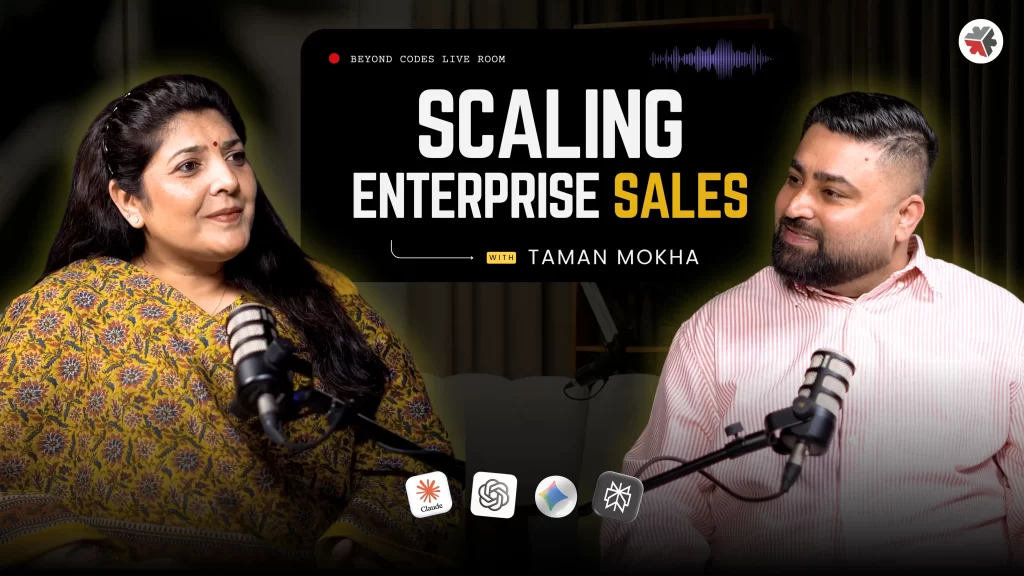
That gap between expectation and execution is exactly what Taman Mokha, VP of Global Sales and Customer Success at Beyond Codes, explored in our first podcast: Scaling Enterprise Sales Globally
About Taman Mokha and the Perspective Behind the Podcast
The podcast featured Taman Mokha, Vice President of Global Sales and Customer Success at Beyond Codes, who brings over 15 years of experience across IT services, products, outsourcing, and sales growth.
Having worked closely with global IT services firms, product engineering companies, and enterprise technology organizations, Taman has spent years helping businesses build scalable sales motions, strengthen customer relationships, and build more predictable pipelines across international markets.
Based in Vancouver, Canada, he has worked with enterprise buyers and sales teams across North America, Europe, the UK, and APAC, giving him a practical understanding of how modern B2B sales dynamics differ across regions.
The Enterprise Buyer Has Changed Everywhere
For many organizations, especially those focused on enterprise technology services, the challenge is no longer visibility alone. The real challenge is relevance. Generic outreach, broad messaging, and capability-heavy conversations no longer create engagement with decision-makers.
That is why many firms struggle to generate a consistent pipeline across regions. Taman highlighted that winning in today’s market is no longer about simply explaining services or showcasing revenue. Enterprise buyers want partners who understand:
- Operational challenges
- Industry pressures
- Growth goals
- Technology landscape
- Market dynamics
That shift in buyer behavior is also one of the biggest reasons many IT services firms still struggle to build a predictable global pipeline today.
Why Most IT Services Firms Struggle to Build a Predictable Global Pipeline
The challenge today is not simply about reaching more prospects. The real challenge is creating enough relevance and value for enterprise buyers to actually pay attention. Enterprise leaders today are under constant pressure to prove ROI and drive measurable business outcomes. That pressure directly impacts how they evaluate vendors, partners, and sales conversations.
As Taman explained during the podcast:
“The end customer right now wants to understand what value this company is bringing to us. Why should they give us time when they get 20 calls or 30 emails in a day?”
That shift is exactly why many organizations struggle with modern pipeline generation and appointment setting efforts across global markets. He emphasized that successful enterprise outreach is not about picking up the phone and talking about company revenue or service lines. Instead, it is about ensuring every interaction strengthens the client’s brand positioning and creates meaningful business relevance.
What Makes Personalization at Scale More Than a Buzzword
One of the most relevant insights from the podcast was about personalization and why most enterprise outreach still fails to drive engagement.
According to Taman, fake personalization simply no longer works. Generic introductions, templated emails, or surface-level customization are easy for enterprise buyers to identify, especially when they receive dozens of sales emails and calls every day.
He explained that meaningful personalization comes from genuinely understanding the prospect’s role, business priorities, industry conversations, and even the type of events they engage with. Timing, relevance, and messaging tone all play a critical role in making outreach feel authentic rather than transactional.
The Difference Between Messaging That Works and Messaging That Gets Ignored
“It has to be AI and human. We have to make sure our sales teams understand the automation that is required, how much is required, and where it is required.”
As discussed during the podcast, companies today are rapidly adopting AI tools to scale outreach, automate workflows, and reduce manual effort. But when it comes to B2B sales, especially large global deals, automation alone is not enough.
Messaging that works is built on the right balance between AI-driven efficiency and genuine human engagement. AI can support research, improve personalization, and help sales teams operate at scale, but relationship-building, timing, and business understanding still require a human touch.
Practical Advice for Sales Teams Targeting Global Enterprise Buyers
Enterprise outreach today is less about contacting every account on a list and more about identifying the right accounts, understanding their priorities, and making outreach genuinely relevant.
1. Prioritize Relevance Over Outreach Volume
As Taman mentioned during the podcast, enterprise buyers today expect SDRs and sales teams to understand their business environment, ROI expectations, and current priorities before initiating conversations.
2. Persistence Matters — But So Does Timing
He also emphasized the importance of balancing persistence with respect for the buyer’s time. Following up consistently matters, but enterprise outreach should never feel intrusive or repetitive to the point where prospects no longer want to engage.
3. Phone Conversations Still Create Real Engagement
Another key insight from the discussion was the growing hesitation among SDRs to take phone calls. While many teams today rely heavily on emails and LinkedIn outreach, real conversations still play a major role in B2B sales success.
“Phone calls made at the right time and in the right manner still help sales teams build stronger engagement, better understand customer priorities, and create more meaningful enterprise conversations.”
How AI is Changing B2B Sales
From AI SDRs and predictive intelligence tools to automated outreach platforms, AI is rapidly transforming how B2B sales teams operate. As highlighted on the podcast, there is no denying that AI is disrupting the market, especially in repetitive tasks and large-scale research.
Whether it is identifying high-value target accounts, researching prospects, or gathering account intelligence, AI is helping sales teams move faster and operate more efficiently.
However, one of the biggest takeaways was that enterprise sales cannot rely solely on automation. While many organizations are aggressively adopting AI across their sales functions, the discussion reinforced that not everything in sales can or should be automated.
That balance between AI-driven efficiency and human-led conversations is becoming increasingly important for companies looking to build a stronger enterprise pipeline and create more meaningful customer relationships globally.
Is the Traditional Sales Team Model Changing?
Yes, the traditional body-shop SDR model, where large teams focus heavily on repetitive outreach and activity volume, is gradually losing relevance. Companies today are moving toward smaller, smarter, and more AI-enabled sales teams that can focus on higher-quality engagement and more strategic conversations.
1. AI Is Changing How Sales Teams Operate
Modern sales teams are increasingly using AI to improve research, account intelligence, outreach preparation, and workflow efficiency. Instead of spending time on repetitive manual tasks, SDRs and account executives can now focus more on strategic engagement and relationship-building.
2. Human Trust Still Remains Critical
At the same time, human trust, relationship-building, and business understanding still remain essential, especially in IT services and consulting sales, where buyers expect meaningful conversations rather than automated interactions.
This newer AI-powered model should be viewed as an enhancement layer for SDRs and sales teams rather than a complete replacement for human engagement.
3. Enterprise Sales Now Requires a Different Mindset
Taman also highlighted the importance of a mindset shift within modern sales organizations. Enterprise outreach today requires preparation, research, and the ability to craft conversations that genuinely resonate with key influencers and decision-makers.
The Mindset Shift That Separates Global Growth From Stagnation
Companies looking to scale globally can no longer operate with sales and marketing working in silos. As AI continues to reshape outreach, research, and messaging, alignment between teams becomes even more important.
AI can help organizations research accounts faster, build messaging frameworks, identify insights, and improve targeting efficiency. But as discussed throughout the conversation, automation alone cannot drive meaningful enterprise relationships.
The real value comes when sales and marketing teams work together to ensure AI-generated messaging and outreach still feel relevant, human, and aligned with buyer priorities.
For sales teams, SDRs, and account executives, AI should be viewed as the starting point for account research and sales execution, while human understanding remains the final layer that makes enterprise conversations truly resonate.
Where Sales Leaders Should Focus Right Now
Enterprise pipeline growth today comes from precision, relevance, and deeper account understanding rather than reaching out to hundreds of prospects without context.
Sales teams, SDRs, and account executives should focus on identifying a small set of high-value global accounts, understanding the key stakeholders within those organizations, and aligning outreach around their biggest business challenges.
The discussion also reinforced the importance of hyper-personalized messaging supported by meaningful conversations rather than generic outreach sequences. That level of focused outreach can create more meaningful enterprise pipeline momentum than the high-volume outreach strategies many organizations still rely on today.
Bottom Line
Companies building stronger global pipelines are those that combine AI-driven efficiency with genuine human engagement. From personalization and messaging to SDR outreach and enterprise relationship-building, the future of B2B sales belongs to organizations that focus on precision, timing, and meaningful conversations rather than generic sales activity.
For IT services and consulting firms looking to scale globally, the biggest opportunity lies in building smarter, more aligned, and more customer-focused sales motions that create long-term pipeline growth.
Ready to build a more predictable enterprise pipeline with smarter lead generation and appointment setting?
FAQs
Enterprise buyers today are more informed and more selective, and they expect personalized, insight-driven conversations rather than generic outreach. Businesses now need stronger messaging, better targeting, and more strategic engagement to generate an effective pipeline.
Many firms still rely on volume-first outreach strategies, failing to prioritize personalization, account research, and stakeholder-specific messaging. Building a predictable enterprise pipeline now requires relevance, timing, and a deeper understanding of B2B buyers.
AI is transforming research, automation, and account intelligence, but human conversations and relationship-building still remain critical in sales. The most successful organizations are combining AI efficiency with human engagement.
Enterprise buyers receive dozens of emails and calls every day. Personalized outreach that reflects a genuine understanding of the buyer’s business priorities, industry challenges, and timing creates far stronger engagement than templated messaging.
Sales teams should focus on high-value target accounts, identify key stakeholders, understand their business challenges, and create highly relevant outreach supported by meaningful conversations and timely follow-ups.
Author
-

With over 7 years of experience in content marketing, he specializes in creating SEO-driven content strategies for enterprise-focused organizations. Having worked extensively across the B2B landscape, he understands how strategic content, thought leadership, and demand-generation storytelling help companies build visibility, engage decision-makers, and drive scalable business growth. His expertise lies in crafting content that connects business challenges with meaningful conversations, stronger market positioning, and measurable growth.