
Your message isn’t wrong — it’s just not landing in the right place.
Shocking but true: Nearly 80% of B2B cold emails are never opened—and most of the ones that are opened fail to get a reply.
By the end of 2025, an estimated 376 billion emails will be sent and received every single day. That means your email is competing with industry reports, meeting invitations, LinkedIn alerts, and endless sales pitches—all vying for the same click.
And yet cold emailing isn’t dead. In fact, for top-performing SDRs and B2B sales teams, it’s one of the highest-converting lead generation channels when done right.
Why? Because it combines the personal touch of a call, the speed of social media, and the professionalism of business communication—without being overly intrusive.
But here’s the reality: drafting a cold email that actually gets a response is harder than ever. Most SDRs stop at catchy subject lines and light personalization. The real winners? They dig deep into pain points, deliver instant value, and make relevance crystal clear in seconds.
Let’s break down how SDRs can turn cold emails into pipeline gold.
What is Cold Emailing in B2B Lead Generation?
Cold emailing is not just sending a message to a stranger. It’s the art and science of starting a business conversation with people you’ve never interacted with before—without sounding like spam.
In the B2B world, it’s not just about sending an email; it’s about crafting a relevant, personalized message that earns attention in an overcrowded inbox. Think of it as the digital equivalent of meeting a decision-maker at a conference and saying something so relevant that they stop, shake your hand, and keep talking.
A great cold email does three things in the first few seconds:
- Captures attention before they scroll away.
- Builds trust without you being in the room.
- Opens the door to a conversation that can turn into revenue.
Why Cold Emailing Still Works (When Done Right)
Cold emailing continues to be a B2B powerhouse because it lets you do what few other channels can:
- Scale your outreach without borders – Whether your perfect buyer is in the USA, Canada, or Singapore, a relevant cold email lands instantly in their inbox.
- Go straight to the decision-maker – Skip the gatekeepers, skip the event networking dance, and an eye-catching email with a strong sales pitch hits the person who can actually say “yes.”
- Spend less, close more – Compared to paid ads, events, or sponsorships, cold emailing requires minimal investment while offering a high ROI when done strategically.
- Track, tweak, and optimize – Every open, click, and reply is measurable, showing how your prospects engage. This allows you to refine your sales approach until your response rates increase.
Click Here:- SDR Survival Guide: Mastering Multi-Channel Outreach
How SDRs Can Master the Cold Email Game
When done strategically, it can be your highest-performing channel for B2B lead generation, giving you direct access to decision-makers without the noise of crowded ad platforms.
The key is to stop thinking of cold emails as “spray and pray” strategy. Here’s the step-by-step playbook to make your cold email game a win-win:
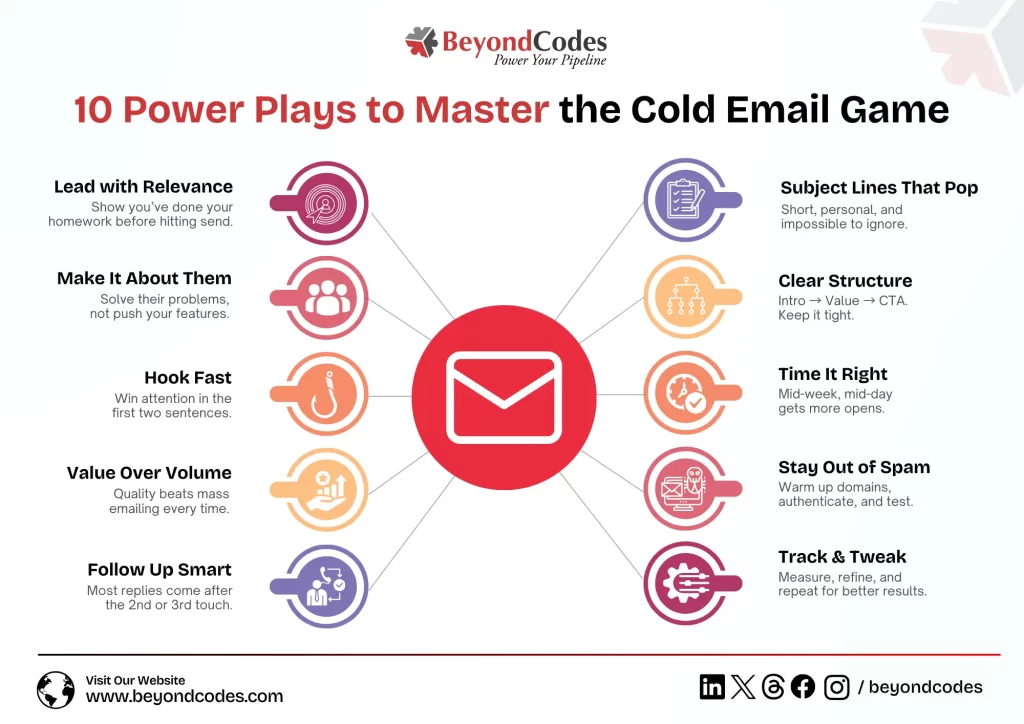
1. Lead with Relevance
Your prospect doesn’t care about your company until they know you understand their world. SDRs who skip research are essentially walking into a networking event, distributing generic flyers, and expecting deals to close.
What to do:
- Reference something specific—a funding round, product launch, industry change, or keynote they gave.
- Show you’ve done the work to understand their pain points.
- Use tools like LinkedIn Sales Navigator, Crunchbase, and Google Alerts to gather insider context before you write.
- When they see you’ve invested time in them, they’re more likely to invest time in you.
When they see you’ve invested time in them, they’re more likely to invest time in you.
2. Make It About Them, Not You
Nobody wakes up thinking, “I can’t wait to read about another product’s features today.” Prospects care about solving problems and hitting goals.
What to do:
- Focus on outcomes: “We helped companies like yours reduce churn by 15%” beats “We have an AI-powered CRM.”
- Tie your solution to measurable results they already care about.
- Avoid self-focused jargon; if every sentence starts with “we” or “our,” rewrite it.
3. Hook Them in Seconds
With hundreds of daily emails competing for their attention, you’ve got two sentences to win the click.
Ways to grab attention fast:
- Open with a thought-provoking question.
- Share a surprising data/stats that is relevant to their role.
- Use curiosity-driven framing: “I noticed something in your Q2 strategy you might want to address…”
If your opener doesn’t make them think, it won’t make them reply.
4. Value > Volume
Sending 500 generic emails isn’t outreach — it’s spam. Sending 50 highly targeted, deeply relevant messages is where the wins happen.
What to do:
- Focus on high-quality prospecting lists.
- Spend more time per lead, but increase your response rate per send.
- Track which personalization points actually generate replies and double down.
5. Follow Up Like a Pro
Most deals don’t happen in the first email. In fact, 70% of responses come after the 2nd or 3rd touch.
What to do:
- Add value in follow-ups by sharing relevant articles, case studies, or insights.
- Space follow-ups 3–5 days apart.
- Keep follow-ups short (1–3 sentences).
Persistence wins more deals than perfection.
6. Write Subject Lines That Demand Opens
Your subject line is your only chance to get the email read — make it count.
What to do:
- Keep it under 10 words (mobile-friendly).
- Personalize with their name, company, or event.
- Avoid spammy words like “Free,” “Buy now,” or “Guarantee.”
- A/B test every week to see what resonates with your audience.
Click Here:- How to Nail the First 30 Seconds of Every Sales Call (Without Sounding Scripted)
7. Perfect the Structure
A cold email that gets responses is tight, focused, and easy to read:
Things to take care of:
- Intro: A quick connection point or observation.
- Value Proposition: Why you’re reaching out and what’s in it for them.
- CTA: A low-friction, specific next step (“Open to a quick 10-min chat next week?”).
8. Nail the Timing
Timing affects open rates more than most SDRs realize.
Things to take care of:
- Best days: Tuesday–Thursday.
- Best times: 9–11 AM or 1–3 PM local time.
- Avoid Mondays (inbox chaos) and Fridays (mental checkout).
9. Avoid the Spam Trap
Even the best cold emails fail if they never land in the inbox.
What to do:
- Warm up your sending domain before any big campaign.
- Authenticate with SPF, DKIM, and DMARC.
- Test your emails with deliverability tools before launching.
10. Measure, Refine, Repeat
Cold emailing is a living strategy, not a one-off campaign. SDRs should track:
- Open rates by subject line type.
- Reply rates by personalization angle.
- Meeting conversion rates from replies.
- Which follow-up touch triggers the most engagement.
Conclusion: Turning Cold Emails into Revenue
Cold emailing isn’t dead—it’s evolving. The SDRs who research deeply, personalize relentlessly, and follow up intelligently are the ones who consistently book meetings, while others are stuck refreshing their CRM.
In a noisy, automated digital world, your edge is showing up with the right message, in the right place, at exactly the right time—and doing it better than anyone else in your space.
If your cold emails aren’t getting responses, the message probably isn’t wrong. It’s just not landing where it will be heard. Fix the placement, sharpen the relevance, and you’ll watch cold outreach turn into warm, qualified opportunities.
Your next big deal could be one cold email away—let’s craft it together. Book a 30-minute
Author
-

With 7+ years of experience and a background in media & communication, she brings stories to life that fuel lead generation success. She transforms complex B2B ideas into content that is clear, engaging, and results-driven—helping key decision-makers take action. A good cup of coffee fuels her writing ideas, and when off the clock, she enjoys unwinding with her dog by her side.