

Common Challenges in Outbound Lead Generation
Many businesses struggle with outreach consistency, low engagement, and difficulty reaching the right decision-makers despite investing heavily in outbound campaigns. Let’s address some of these challenges, followed by the best strategies that work to tackle them.
1. Reaching the Right Decision-Makers
In an enterprise sales environment, multiple stakeholders are involved in the buying decisions. It means identifying and targeting the right contacts is always tricky, since different stakeholders influence buying decisions at different stages.
2. Low Response Rates
B2B buyers receive countless emails and sales messages every week. As generic outreach and poor personalization fill their inboxes, engagement often drops, making it difficult for businesses to create meaningful conversations.
Also read, The Power of Personalization in B2B Appointment Setting
3. Inconsistent Follow-Ups
Since the B2B sales journey is longer and more complex, many opportunities are lost because the sales team simply stops following up. This inconsistency often results in weak pipeline generation and poor brand visibility.
4. Poor Data Quality
Outbound campaign performance often depends heavily on data quality and targeting accuracy. Outdated databases with incorrect prospect information can significantly affect prospecting and impact overall performance and campaign efficiency.
How Outbound Lead Generation Works
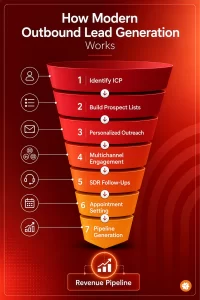
No successful outbound lead generation agency builds its strategy around generic outreach or high email volume. Instead, their outreach plans follow a well-planned process that helps the sales team identify the right accounts, understand their pain points, and engage decision-makers accordingly to create value-driven relationships.
1. Define Your Ideal Customer Profile (ICP)
The foundation of your entire lead generation strategy starts with identifying the companies most likely to benefit from your product or services. Defining your ICP generally involves factors such as company size, revenue range, business challenges, and buying intent signals.
2. Build Targeted Prospect Lists
After your ICP is defined, your outbound team will begin building a prospect database that includes the stakeholders and decision-makers to target. This precise segmentation helps improve personalization and keeps campaigns valuable for potential buyers.
3. Create Personalized Messaging
As discussed already, buyers today demand relevance and value before jumping into a sales conversation. This is why your outbound campaign needs to have personalized tailored messaging that focuses on their business needs, operational challenges, and how you can solve them.
4. Multichannel Outreach
Your outbound B2B lead generation strategy must include a multi-channel approach to engage prospects across platforms and maintain consistent visibility. It should combine email outreach, LinkedIn prospecting, cold calling, and timely follow-ups to increase the response rate over time.
5. Converting Engagement into Appointments
The final stage focuses on nurturing conversations and converting engagement into sales meetings. This is where SDR-led follow-ups and structured appointment setting programs help create consistent opportunities and improve pipeline generation.
Outbound Lead Generation Strategies That Work
Not every outbound campaign delivers meaningful results. Many businesses still rely on generic messaging, outdated databases, or excessive outreach volume, which often leads to poor response rates and inconsistent pipeline growth.
Here are a few industry-led strategies that B2B sales teams use to improve outreach effectiveness and generate stronger sales conversations.
1. Focus on High-Intent Accounts
Prioritizing quantity over quality is a common mistake B2B firms make when running an outbound campaign. Modern enterprises focus on accounts with a higher likelihood of converting, rather than targeting a large, unverified database with a generic approach.
It not only improves personalization but also increases engagement rates and helps SDR teams spend more time on accounts with stronger conversion potential.
2. Multichannel Outreach to Improve Engagement
Relying on a single channel of contact limits visibility and leads to poor engagement, which is one reason traditional lead generation services have become less effective. The latest campaigns also engage prospects through email, LinkedIn, and direct calls.
According to Salesforce, iIt takes multiple touchpoints to move prospects through the B2B buying journey, especially when multiple stakeholders are involved in the decision-making process.
3. Personalize Around Challenges, Not Solutions
You only get a few chances to grab a potential buyer’s attention, and companies have been wasting them with generic sales messaging. Instead, businesses should personalize outreach around the operational challenges and business gaps their buyers are trying to solve.
This way, you grab their interest straightaway and position yourself as a strategic partner rather than a vendor trying to sell a solution. This is the make-or-break stage for any sales team.
4. Optimize Outreach Using Data
Even after creating and running a campaign by the book and following all the right strategies, your campaign might not do as well as you expected. As a result, your next step should always be to continuously evolve based on the performance insights from ongoing campaigns.
Analyzing metrics in real-time lets you understand the problem area, whether it’s the messaging, your target audience, or anything else, and fix them right away to improve performance over time.
How Different B2B Companies Use Outbound Lead Generation
Different B2B businesses use outbound lead generation services in different ways. While their outreach expectations may differ, the overall goal remains the same: to build relevant relationships with key influencers and keep creating a stronger sales pipeline.
Check out how different companies approach outbound B2B lead generation to support pipeline growth and customer acquisition.
| Business Type | Outbound Goals | Outreach Channels | Key Focus Area |
|---|---|---|---|
| SaaS Companies | Build an enterprise pipeline and accelerate product conversations | Email outreach, LinkedIn prospecting, SDR engagement | Appointment setting and product discovery calls |
| IT Services Companies | Expand into new markets and generate sales opportunities | Multichannel outreach, cold email campaigns, and cold calling | Decision-maker engagement and pipeline generation |
| Product Engineering Firms | Reach C-level and innovation leaders | Personalized outreach, account-based prospecting, and SDR follow-ups | High-value enterprise conversations |
| BPO/BPM Companies | Create a predictable flow of outbound opportunities | Email campaigns, SDR-led outreach, follow-up sequences | Consistent lead flow and sales visibility |
| Technology Companies | Improve outbound engagement across target accounts | LinkedIn outreach, strategic follow-ups, and appointment setting | Relationship-building and sales pipeline growth |
Conclusion
Outbound lead generation is no longer about mass prospecting and hoping for something to happen. Modern strategies are more action-driven, relying on targeted prospecting, personalized engagement, SDR-led outreach, and consistent multichannel communication.
Companies that combine the right outreach plan with strong execution are experiencing better long-term sales growth and stronger pipeline visibility. Whether you are a SaaS business, IT services firm, or enterprise technology company, remember that understanding the challenges and implementing modern strategies is the way forward.