

Reaching $10M ARR is a milestone. And, it feels amazing. Staying there—and growing beyond it? That’s quite hard.
Nearly 80% of B2B leads never become customers. Scaling teams chase lead quantity over quality, losing the coordinated approach for enterprise-level success.
To break through $10M ARR, companies must shift from random execution to organized, multi-channel strategies. This means focusing on:
- Expanding into new markets
- Enterprise sales motions
- Technical systems that unify data, acquisition, and outreach
The transition is simple: scattered → sophisticated. Quantity → quality. Tactics → systems.
The dilemma for CMOs and sales & marketing growth heads is: “How do we build a reliable revenue pipeline without losing trust, budget, or sales teams?” rather than “How do we get more leads?”
Let’s examine what SaaS companies that generate more than $10 million in revenue actually do.
Why Lead Generation for SaaS Breaks After $10M ARR
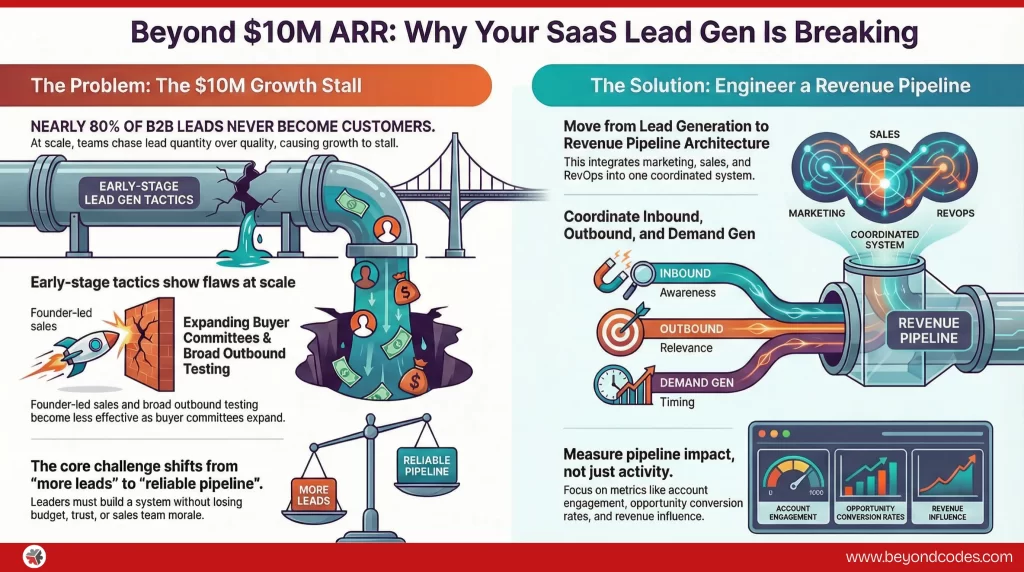
The point at which SaaS companies cross $10M ARR is often where lead generation quietly starts to underperform—despite increased spend, more channels, and larger teams. What once felt like momentum is becoming harder to sustain, not because demand has disappeared, but because the buying environment has fundamentally changed.
Early-stage SaaS growth is frequently driven by:
- Sales led by the founder
- Product-led inbound
- Extensive outbound testing
However, those lead gen strategies begin to show flaws when used at scale.
Buyer committees expand. Readiness for risk decreases. Internal alignment is necessary for deals. Lead readiness suddenly becomes more valuable than lead volume. Moreover, sales growth teams understand that B2B SaaS leads are only worthwhile if they lead to actual revenue conversations.
This is where SaaS lead generation must evolve—from activity-driven to pipeline-driven.
The Real Shift: From Lead Generation to Revenue Pipeline Architecture
Once a SaaS company crosses $10M ARR, lead generation can no longer live in isolation within marketing. It becomes a revenue architecture decision that touches sales, RevOps, and leadership.
Here are the three strategic changes that high-performing SaaS companies prefer:
- From discrete campaigns to interconnected journeys
- From intent interpretation to lead scoring
- From pipeline contribution to channel performance
CThis shift reframes how success is defined. It’s not about which channel performs best—but how consistently the system converts intent into revenue.
Click Here:- B2B Demand Generation for Enterprise & SaaS Companies
Inbound SaaS: Still Effective, But Not Enough
Although it plays a different role, inbound SaaS lead generation is still crucial. Webinars, content, SEO, and product education all continue to:
- Foster trust
- Educate purchasing committees
- Impact long-term demand
However, the sales pipeline is rarely filled at scale solely by inbound. Why?
When the prospects interact, most buyers are researching rather than making a purchase. Lead quality problems are exacerbated, and friction is created, when incoming inquiries are treated as immediate sales intent.
How top SaaS teams use inbound effectively:
- Prioritize emphasizing problem education over feature promotion
- Track account-level engagement rather than filling forms
- Use inbound to enhance SaaS demand gen instead of replacing outbound
Inbound fuels awareness. It doesn’t close deals on its own.
Outbound SaaS: Accuracy Outpaces Volume
Outbound SaaS strategies frequently get blamed for poor results—but the real issue is execution, not the channel. At $10M+ ARR, outbound fails when it prioritizes reach over relevance. Broad targeting, early demo pushes, and context-free messaging create noise instead of momentum.
Outbound is redesigned by high-performing teams based on timing and relevance.
Effective outbound SaaS at scale looks like this:
- Narrow ICPs with clear problem relevance
- Contextual messaging aligned to buyer stage
- SDRs interacting with knowledgeable, not cold prospects
Outbound is most effective when it stimulates demand rather than when it tries to generate urgency in the absence of any.
Demand Generation for SaaS is About Timing, Not Pressure
One of the biggest challenges SaaS companies face is conflating interest with readiness. The majority of B2B buyers do not say “sell to me.” Though they say, “Help me decide.”
Modern SaaS demand gen respects this reality by:
- Distinguishing between active evaluation and early-stage interest
- Nurturing accounts until they show signs of purchase
- Matching intent maturity with sales participation
This strategy stabilizes the revenue funnel, lowers friction, and shortens sales cycles.
Designing a Predictable Revenue Pipeline
The goal for CMOs and growth leaders is pipeline consistency, not more leads. This necessitates integrating demand generation, outbound SaaS, and inbound SaaS into a connected system.
These are the following characteristics of high-performing SaaS pipelines:
- Clear changes between sales and marketing
- Clearly defined signals for sales interaction
- Measurement based on the opportunities generation instead of lead volume
When lead generation is designed around pipeline contribution, forecasting becomes easier—and growth becomes repeatable.
Measuring What Actually Matters
As SaaS companies scale beyond $10M in ARR, the way success is measured must evolve along with the strategy. Metrics that worked during early growth often fail to surface the risks that emerge in longer sales cycles and enterprise buying motions.
High-performing SaaS teams shift their focus to metrics that reflect buyer movement and revenue impact, including:
- Account engagement velocity, to know whether interest is building over time
- Opportunity conversion rates, to measure how effectively intent turns into a real pipeline
- Revenue pipeline influence, to connect demand efforts directly to results
Click Here:- 11 B2B Lead Generation Mistakes That Kill High-Value Enterprise Deals
This shift in measurement allows leaders to identify risk early, course-correct faster, and maintain confidence in pipeline predictability—before pressure begins to cascade across sales and marketing teams.
Instead of responding after transactions stall, this change enables leaders to understand what’s working before they do.
The Role of Trust in Lead Generation for SaaS
Most teams are unaware of how important trust is to SaaS success. That’s why referral leads convert far better than cold outreach—because they come with credibility built in. When the majority of B2B leads never result in meetings, trust is the deciding factor between being ignored and receiving a response.
Before responding to outbound calls or setting appointments, buyers:
- Review your website
- Scan your messaging
- Validate credibility through content and social proof
Even effective inbound and outbound SaaS initiatives fall short if your brand doesn’t foster confidence.
Brand doesn’t replace lead generation. It multiplies it.
What SaaS Leaders Need to Remember
It is not necessary to add more channels or increase the budget to scale SaaS lead generation beyond $10M ARR.
At this stage, growth stops being about experimentation and becomes a discipline. The decisions leaders make now—how demand is created, how buyer intent is interpreted, and how pipeline performance is measured—determine whether growth compounds or stalls.
There’s less room for inefficiency, fewer shortcuts, and higher consequences for misalignment.
Success comes down to three fundamentals:
- Designing journeys around buyer intent
- Coordinating inbound and outbound SaaS strategies
- Measuring sales pipeline impact—not activity
The SaaS companies that win don’t chase more leads.
They build systems that consistently convert the right leads into revenue.
Ending Note
When demand declines, SaaS growth doesn’t stop.
When lead generation no longer reflects buyer reality, it stalls.
Building a lead generation system that respects timing, builds trust, and feeds a steady revenue pipeline is the true potential for CMOs and Heads of Growth.
That’s how SaaS companies move confidently beyond $10M ARR.
Align SaaS lead generation with buyer intent to improve pipeline quality and predictability.
Observing activity but insufficient revenue growth?
It might not be your work, but rather the way your SaaS lead generation engine is built.
Start a strategic conversation to strengthen pipeline quality and predictability.
FAQs
At this stage, buyers are no longer single decision-makers. Deals involve committees, longer cycles, and higher scrutiny. Tactics that worked earlier focus on volume, not readiness, which causes pipeline friction and stalled deals.
Yes, but inbound alone rarely fills an enterprise pipeline. Inbound works best for education and trust-building, while outbound and demand generation drive timing and conversion into real revenue conversations.
Lead generation captures interest. Demand generation manages when that interest is sales-ready. Beyond $10M ARR, success depends on nurturing intent over time rather than pushing early demos.
Lead quality drops when teams treat all engagement as buying intent. Without clear readiness signals and account-level tracking, sales teams waste time requalifying instead of progressing deals.
Outbound must shift from volume-based outreach to relevance-driven engagement. Narrow ICPs, contextual messaging, and timing aligned with buyer research stages make outbound effective again.
Vanity metrics fade in importance. High-growth SaaS teams track opportunity conversion rates, account engagement velocity, and revenue pipeline influence instead of raw lead counts.
Yes. Most scaling issues come from disconnected systems, not lack of spend. Aligning inbound, outbound, and demand generation into one pipeline-focused system improves results without higher costs.
Because interest is mistaken for intent. Buyers often want guidance, not sales pressure. When conversations start too early, trust breaks and engagement stalls.
Author
-

With 7+ years of experience and a background in media & communication, she brings stories to life that fuel lead generation success. She transforms complex B2B ideas into content that is clear, engaging, and results-driven—helping key decision-makers take action. A good cup of coffee fuels her writing ideas, and when off the clock, she enjoys unwinding with her dog by her side.