

TL;DR (Executive Overview)
End to end sales services don’t fail because of execution gaps; instead, they fail because no one takes revenue ownership. The end-to-end sales approach offers everything—prospecting, lead generation, appointment setting, and deal closure. Many firms report more activity but decreased predictability. Without a clearly defined revenue owner, accountability deteriorates, pipeline velocity slows, buyer momentum declines, and ROI drops—often with no immediate visibility to leadership.
Introduction
End-to-end sales services have gained popularity as businesses seek to reduce complexity and move faster in competitive markets. The goal is to simplify execution, shorten sales cycles, and improve team coordination.
However, the breakdown occurs when responsibilities are spread rather than centralized. Outbound sales services, sales process outsourcing, internal sales teams, and marketing all play crucial roles throughout the sales cycle. While the intention is to collaborate, the result is the dispersal of accountability.
Everyone is involved in the process, yet no one function owns the revenue result. As a result, revenue becomes a collective goal without a single point of control, leading to structural inefficiency rather than scale.
The Promise of End-to-End Sales Services—and Where It Breaks
End-to-end sales services outsourcing is becoming more popular as people seek speed and efficiency. Businesses aim to boost pipeline generation, make better use of resources, and strengthen alignment between sales activity and revenue.
Most B2B companies eventually adopt a hybrid model. Outbound sales services manage prospecting and discovery calls. Outsourcing the sales process is beneficial in some phases. Internal teams maintain control over opportunities, forecasts, and transaction closing. Marketing continues to handle top-of-funnel metrics.
Each role works nicely on its own. However, revenue ownership is distributed across teams rather than centralized. The sales process appears to be complete, but it actually breaks down into silos. “End-to-end” exists in name but not in actuality.
Revenue does not function well in silos. It demands stability, uniform standards, and a single line of accountability.
Why Shared Revenue Ownership Creates Hidden Friction
When revenue ownership is broken down, failure does not occur instantly. Instead, friction builds softly.
Meetings are scheduled, but deals do not progress forward. Leads look qualified, but conversion rates fall short. Forecasts are initially strong but then decline over time. These flaws are frequently blamed on execution, whereas the real issue is ambiguous ownership.
As ownership fragments, each team focuses on its own metrics, like:
- Outbound teams monitor activity and response rates
- Sales outsourcing services keep track of the number of meetings delivered
- Internal sales teams prioritize late-stage control
- Marketing team monitors attribution, engagement, and influence.
From the buyer’s perspective, this appears unclear. Conversations restart instead of progressing. Context is lost in between stages. Urgency feels forced rather than natural. What appears to be internal coordination feels like external breakdown.
Revenue Ownership Is Not Modular
Execution can be shared. But, it is not possible to own revenue.
Revenue accountability is clearly defined in high-performing sales teams. One operating owner is responsible for pipeline health, conversion velocity, and forecast accuracy, regardless of how many teams contribute to execution.
When end-to-end sales services are introduced to shared ownership models, responsibility is distributed rather than focused. Deals stall due to a lack of obvious escalation paths. Root causes are discussed rather than resolved. Missed targets become explanations.
Revenue becomes everyone’s job—but no one’s responsibility.
The Buyer Pays the Price First
The first impact of fragmented revenue ownership is a decline in the buyer experience, not internal inefficiencies.
Complex B2B buying depends on continuity. Buyers expect conversations to move forward, messaging to be consistent, and follow-ups to reflect previous discussions. When ownership changes mid-journey, continuity breaks. Momentum slows. Trust drops.
Even strong outbound sales services cannot recover a contract deal after it has entered the evaluation process without a clear owner who maintains context and urgency. Buyer confidence has already fallen by the time the revenue impact becomes clear.
Why Most “End-to-End” Sales Offers Fall Short
Many sales service providers present themselves as end-to-end sales partners while delegating early-stage execution to others. They generate leads, set appointments, and qualify prospects before passing them on to others.
This strategy gives a false perception of pipeline health. Activity appears to be strong at the top of the funnel, but revenue outcomes degrade as you move down. Outsourced teams are assessed on volume rather than impact, which weakens feedback loops and slows down optimization.
The outsourced end-to-end sales services do not end with a handoff. It must extend to revenue ownership, which includes conversion, deal momentum, and outcome accountability.
What Really Works: Outcome-Owned Sales Systems
Businesses that succeed with end-to-end sales strategies follow a distinct operational principle. They build obvious revenue ownership, regardless of organizational boundaries.
This process offers a single accountable owner for pipeline quality, clear qualifying criteria, and ongoing feedback from prospecting to deal closures and outreach sales strategies.
In such systems, end-to-end sales services serve as an extension of the revenue-generating business, not a parallel effort.
Redefining “End-to-End” the Right Way
End-to-end sales is sometimes misinterpreted as adding extra coverage or outsourcing additional steps. In reality, it is a structural design decision centered on ownership and results. It is not about doing more; it is about connecting each stage of the sales process with a single revenue target.
End-to-end sales involve achieving:
- A single revenue goal across the whole sales funnel
- Clear and centralized accountability
- Direct relationship between activity and revenue
- Shared measurements centered on outcomes rather than effort
- Continuous optimization is driven by closed deals
- Minimal handoffs and a consistent buying experience
Anything that functions outside of these standards may appear coordinated, but it lacks actual ownership. And, Alignment comes from ownership, not coordination. Without a consistent accountability framework, “end-to-end” becomes a term rather than a revenue strategy.
How Beyond Codes Can Help
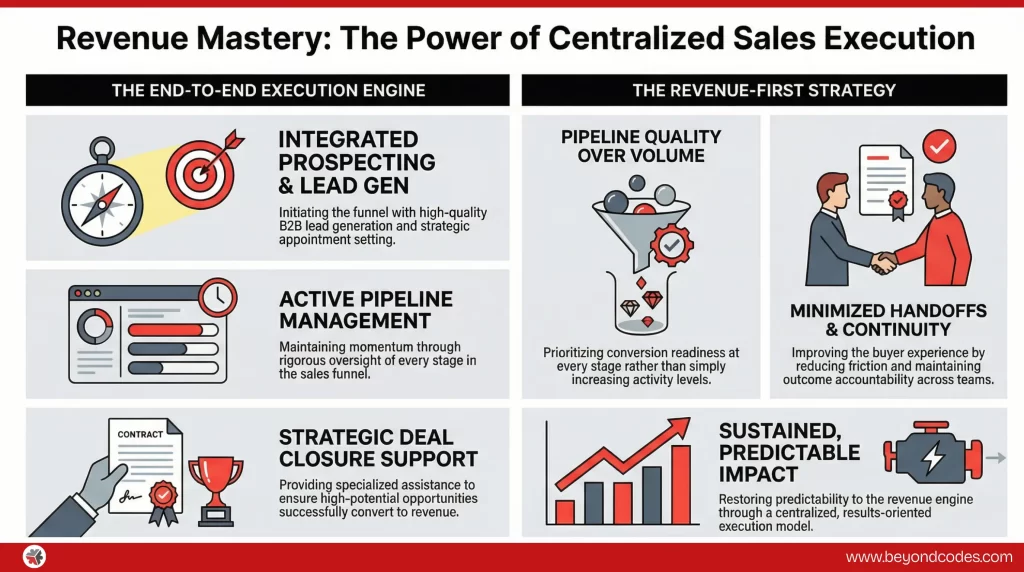
Beyond Codes approaches end-to-end sales services with a simple principle: execution only works when ownership is centralized. Our end-to-end sales process addresses all stages with a revenue-first mindset:
- Prospecting and B2B lead generation
- Appointment setting
- Pipeline Management
- Deal Closure Support
We focus on:
- Pipeline quality over volume
- Conversion readiness at every stage
- Outcome accountability across teams
- Minimizing handoffs and improving buyer continuity
- Restoring predictability across the revenue engine
The goal is not to do more activities—it is to achieve sustained, measurable revenue impact.
What Should Senior Leaders Ask?
When analyzing or executing an end-to-end sales model for leadership teams, structural questions are more significant than tactical ones.
Leaders need to understand—
- Who owns revenue outcomes?
- Where does accountability sit when deals stall?
- Are partners measured on results or on activity alone?
If these answers are unclear, the model will eventually fail, regardless of how powerful the early indicators are.
Final Thought: Revenue Needs One Owner
End-to-end sales services do not fail because sales outsourcing is inefficient. They fail when revenue ownership becomes diluted.
Even in the most complex sales scenarios, revenue requires a single line of accountability. When ownership is apparent, execution synchronizes and compounds. When shared, activity replaces progress.
For businesses committed to consistent growth, the essential question is not whether to implement end-to-end sales services, but how ownership is structured within them. That decision impacts whether the sales engine grows or quietly fails.
Is your end-to-end sales motion busy, but revenue feels uncertain? Fix ownership—not activity.
FAQs
End-to-end sales services cover the entire revenue lifecycle, including prospecting and lead generation, appointment setting, deal progression, and revenue closure. Unlike fragmented sales models, this method integrates each stage of the buyer journey into a single operating framework, boosting accountability, consistency, and revenue predictability.
End-to-end sales services often fail when revenue ownership is split among internal teams and external vendors. As activity levels rise, accountability declines, handoffs increase, and pipeline velocity slows. Without a single revenue owner, execution stays active, but results are uneven.
Traditional sales outsourcing often focuses on specific functions, such as outbound sales or meeting development. End-to-end sales services outsourcing goes beyond task execution by combining outreach, qualifying, deal closure, and revenue outcomes under a single ownership model, focusing on conversion quality and pipeline momentum rather than just activity.
Sales process outsourcing can be effective in complex B2B situations when it is based on revenue ownership rather than operational support. Success depends on continuity, context retention, and accountability throughout the sales funnel. Broken outsourcing models frequently fail to maintain transaction momentum and forecasting accuracy.
Organizations should evaluate partners on their capacity to own revenue outcomes rather than just pipeline inputs. The suitable partner integrates outbound sales services with rigorous qualification, conversion strategy, and ongoing feedback loops, ensuring accountability from the initial buyer experience through to closed revenue.
Author
-

With 7+ years of experience and a background in media & communication, she brings stories to life that fuel lead generation success. She transforms complex B2B ideas into content that is clear, engaging, and results-driven—helping key decision-makers take action. A good cup of coffee fuels her writing ideas, and when off the clock, she enjoys unwinding with her dog by her side.