

Enterprise sales don’t suffer from a lack of activity—it suffers from a lack of continuity.
Deals can look healthy and still fail.
Data is accurate. Outreach gets responses. Meetings happen. Yet between the first cold outreachand the final commercial discussion, momentum slows, and deals quietly disappear.
Not because teams didn’t work hard, but because no one owned the journey end-to-end.
One team researches accounts. Another runs outreach. A third qualifies leads. A fourth step in to close. Each handoff removes context, weakens momentum, and delays decisions.
This problem intensifies in enterprise sales. Industry studies show nearly 70% of B2B buying decisions involve multiple stakeholders and long buying cycles, making every disconnect harder and more expensive to recover from.
That is why end-to-end sales is now a boardroom priority. It connects data, prospecting, qualification, engagement, and closing into one accountable system.
For leaders, this is a decision.
Rethinking End-to-End Sales to Drive Enterprise Growth
At the enterprise level, end-to-end sales is best viewed as a unified revenue stream. Instead of treating lead generation, sales development, and closing as separate operations, end-to-end sales combines them into a single strategy, operating rhythm, and result: predictable revenue.
A well-designed, end-to-end sales plan provides:
- Clear ownership across the entire funnel.
- Consistent messaging at all buyer touch points
- High-quality, sales-ready opportunities
- Reduced friction in long buying cycles
- More dependable forecasting
In complicated enterprise environments, alignment isn’t just a “nice to have.” It is what keeps transactions flowing.
Why Fragmented Sales Models Struggle in Enterprise Markets
Enterprise buyers do not move in straight lines. They evaluate risk, involve multiple stakeholders, pause to align internally, and expect sellers to add value well before a commercial discussion begins.
They assess risk, include multiple stakeholders, take time to align internally, and expect vendors to offer value before engaging in commercial discussions.
Fragmented sales procedures fail in this scenario because:
- Early outreach lacks a strategic context.
- Qualification occurs too late, or not at all.
- Discovery talks repeat rather than deepening.
- Closing teams inherit a weak internal alignment.
The end result is a pipeline that appears healthy on paper but collapses under investigation. End-to-end sales services address this by ensuring continuity—each conversation builds on the previous one rather than restarting the engagement.
How End-to-End Sales Works in Practice: The Core Stages
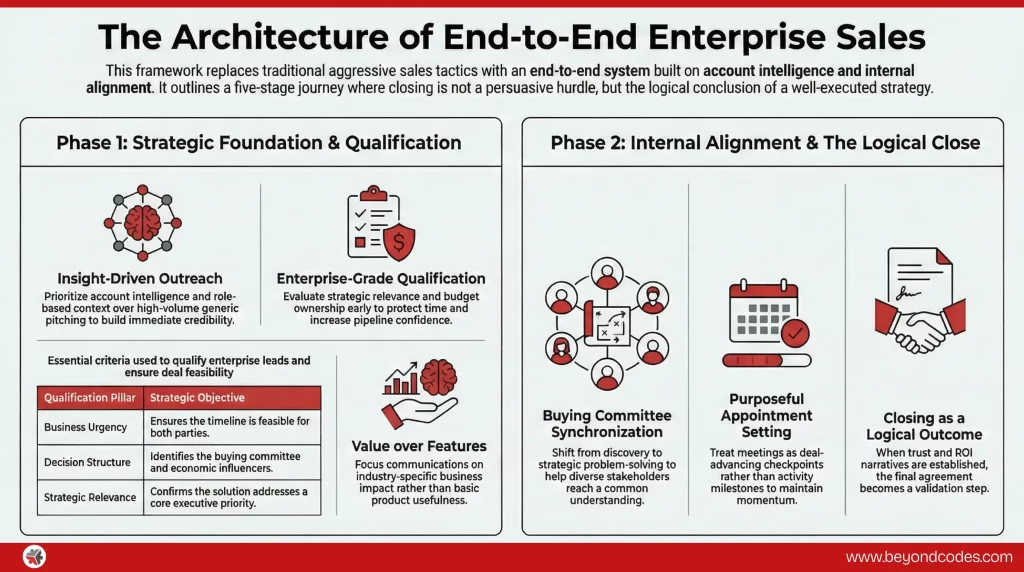
Stage 1: Cold Outreach That Generates Attention, Not Resistance
Cold acquisition is still relevant in enterprise sales—but only when driven by insights and not volume.
In an end-to-end sales system, outreach is grounded in account intelligence and role-based context. The goal is not to pitch, but to initiate a conversation worth continuing.
Effective enterprise outreach relies on:
- Detailed account and persona research
- Industry- and role-specific business context
- Value-driven communications, not feature promotion
For example:
Outreach to a healthcare enterprise prioritizes compliance exposure, operational efficiency, and scalability over product usefulness. When sales outreach respects the buyer’s reality, it builds credibility. Credibility fosters engagement.
Stage 2: Qualification to Protect Time and Revenue
Interest alone does not justify investment, particularly in enterprise sales. This is where a structured qualification framework becomes essential for end-to-end sales services.
The enterprise-grade qualification evaluates:
- Strategic relevance
- Business urgency
- Budget ownership.
- Decision-making Structure
- Timeline feasibility
This prevents teams from advancing conversations that have no actual chance of conversion. For revenue executives, high qualifying means fewer surprises late in the cycle and more pipeline confidence.
Stage 3: Creating Alignment Across the Buying Committee
Persuasion is rarely used to close enterprise negotiations. They are won through alignment. Conversations at this point in the sales process shift from surface-level discovery to strategic problem-solving. The focus switches to assisting buyers with internal alignment.
This requires:
- Deep discovery among stakeholder groups.
- Industry-related insights
- Clear articulation of business impact.
Rather than selling a solution, sellers lead stakeholders toward a common understanding. When internal alignment occurs early, deals move faster and close more smoothly.
Stage 4: Appointment Setting That Advances the Deal
In corporate sales, a meeting serves as a checkpoint rather than a milestone. Too many sales motions use meetings as proof of progress. In practice, poorly organized meetings often slow deals by creating context, repeating discovery, or involving the wrong stakeholders.
Appointment setup, as part of an end-to-end sales strategy, is intended to move the offer forward rather than inflate activity numbers or calendars. Sales- ready meetings happen after careful planning.
This includes:
- Validating the account using enterprise fit criteria
- Stakeholders understand the business problem
- Aligning the meeting agenda based on the buying stage
Meetings that are purposefully designed generate momentum. Conversations move forward instead of backward. Time spent with key stakeholders adds value rather than resetting the context.
Stage 5: Closing as a Logical Outcome
In an end-to-end sales approach, closing is not stressful. It is the logical result of constant execution throughout the previous stages of the sales process.
Enterprise buyers do not respond to urgency built around the final stage of the buying cycle. They respond to the clarity that comes with experience. By the time business negotiations start, most decisions have already been made internally.
Effective enterprise deal closure is supported by:
- Clear and credible ROI narratives tied to business outcomes
- Alignment across economic buyers, influencers, and end users
- Transparent discussion of risk mitigation and change impact
- Data-driven decision support that boosts confidence
End-to-end sales services treat closing as a validation step rather than a persuasive exercise. When trust is earned, value is understood, and stakeholders are aligned, decisions come naturally.
Click Here:- Why End-to-End Sales Break When Revenue Ownership is Shared
Why Companies Are Turning to Sales Outsourcing Services
Many companies adopt sales outsourcing services not to replace internal teams, but to improve sales execution.
The reasons are strategic.
Faster Pipeline Velocity
Building enterprise sales teams is time-consuming due to lengthy hiring processes. End-to-end sales services ensure speedy pipeline wins with no recruitment delays.
Proven Enterprise Sales Expertise
Outsourced partners bring proven frameworks, extensive market expertise, and rigorous execution discipline.
Revenue Ownership
Unlike siloed vendors who monitor tasks, end-to-end sales partners are evaluated on outcomes rather than discrete actions.
How Beyond Codes Delivers End-to-End Sales
An end-to-end sales approach integrates all stages—from cold outreach and B2B lead generation to qualification, relationship management, and deal closure—into a unified operating system.
Beyond Codes drives enterprise growth by operationalizing end-to-end sales through a clearly defined, execution-ready approach:
Account Intelligence First
Every engagement starts with extensive account research and ICP alignment. Decision-makers, buying committees, and enterprise priorities are identified in advance to ensure that outreach is relevant from the start.
Enterprise Ready Outreach
Outreach is adapted to the industry, its role, and the business context. Messaging focuses on enterprise challenges and results rather than product details, which ensures confidence with key stakeholders.
Revenue-Based Qualification
Leads are vetted against clear enterprise standards, including business impact, decision authority, urgency, and deal viability. This keeps weak opportunities from entering the pipeline.
Message Continuity
Initial conversations offer insights that inform discovery, meetings, and negotiations. Buyers never feel like they’re starting a new conversation with each interaction.
Sales-Ready Meetings
Meetings are scheduled only after accounts have been validated and stakeholders are aligned. Each appointment has a clear goal aligned with a specific stage of the buying process.
Confident Deal Closure
ROI clarity, stakeholder alignment, and risk reduction drive deal momentum, ensuring that closing interactions are educated, confident, and outcome-driven.
Beyond Codes helps organizations replace fragmented selling with predictable growth by integrating data analysis, tailored outreach, structured qualifying, and revenue-focused execution.
Closing Perspective
Enterprise growth does not result from doing more. It comes from doing things in alignment. A well-executed end-to-end sales strategy reduces friction, increases clarity, and ensures consistency throughout the buyer journey.
Leaders assessing end-to-end sales services or sales outsourcing services should consider who owns the outcome rather than who executes particular steps.
An end-to-end sales strategy streamlines each stage within a single operating system, from cold outreach and B2B lead generation and qualifying to relationship management and deal closure.
Looking to turn your sales process into a revenue engine?
FAQs
End-to-end sales is a single, accountable system that manages the entire enterprise sales journey—from cold outreach to deal closure. It connects prospecting, qualification, stakeholder alignment, meetings, and closing into one continuous process to maintain momentum and reduce deal risk.
Fragmented sales processes fail because enterprise buying involves multiple stakeholders and long decision cycles. When teams operate in silos, context is lost, discovery is repeated, and momentum slows, causing deals to stall or collapse despite strong activity metrics.
An end-to-end sales strategy improves revenue predictability by enforcing clear ownership, consistent messaging, and structured qualification across the funnel. This reduces late-stage surprises, improves pipeline quality, and enables more accurate forecasting in complex enterprise sales environments.
Cold outreach is effective in enterprise sales when it is insight-led rather than volume-driven. Outreach based on account intelligence, role-specific context, and business relevance builds credibility and initiates conversations that enterprise buyers are willing to continue.
Enterprise-grade sales qualification evaluates strategic relevance, business urgency, decision authority, budget ownership, and timeline feasibility. Its purpose is to prevent low-probability deals from advancing, protecting sales resources and improving overall pipeline confidence.
In end-to-end sales, appointment setting is a deal-advancement mechanism, not a scheduling activity. Meetings are set only after account validation and stakeholder readiness, ensuring each conversation builds forward momentum instead of restarting discovery.
End-to-end sales services deliver continuity, faster pipeline velocity, higher-quality opportunities, and stronger forecast reliability. Enterprises benefit from fewer stalled deals, reduced friction across buying stages, and consistent buyer experiences throughout long sales cycles.
Author
-

With 7+ years of experience and a background in media & communication, she brings stories to life that fuel lead generation success. She transforms complex B2B ideas into content that is clear, engaging, and results-driven—helping key decision-makers take action. A good cup of coffee fuels her writing ideas, and when off the clock, she enjoys unwinding with her dog by her side.