

According to Gartner, more than 75% of B2B buying paths involve multiple stakeholders, while Forrester reports that over 60% of pipelines end before entering a formal sales conversation. However, most lead generation agencies continue to focus on volume rather than velocity—or trust.
For enterprise sales & marketing leaders, selecting a B2B lead generation agency is often seen as a tactical decision: enhance the pipeline, accelerate sales, and increase activity. In truth, it is a strategic revenue decision that directly impacts pipeline quality, forecast confidence, and team alignment for growth.
At the enterprise level, lead generation is more than just filling calendars. It’s about generating demand, qualifying intent, and maintaining momentum throughout long, complex buying journeys. That is why leaders must evaluate lead generation partners through a different lens.
Here’s how business leaders figure out whether a lead generation agency is a valuable growth partner or just another vendor reporting activity.
Start With Accountability, Not Activity
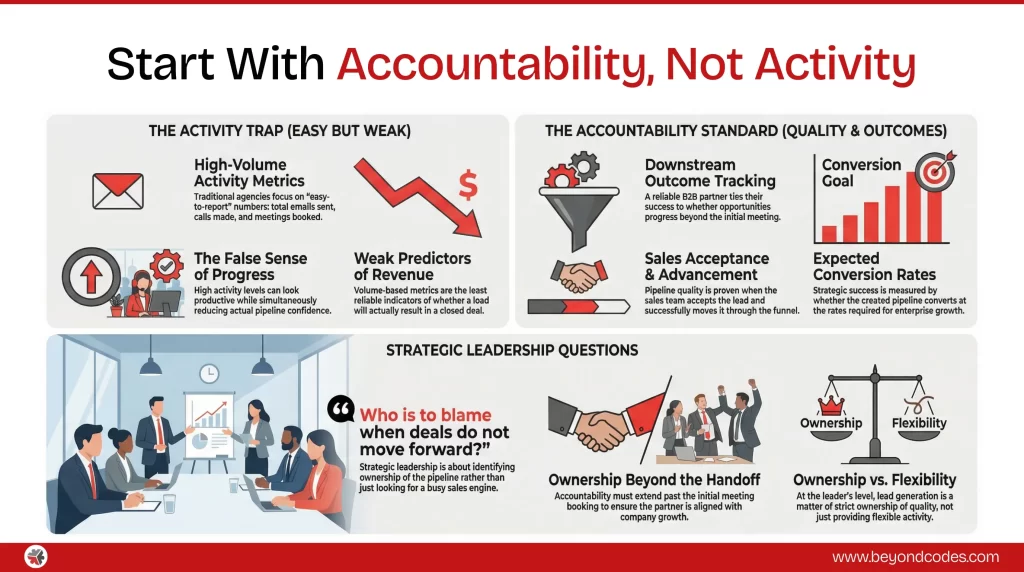
At the leader’s level, lead generation is about ownership rather than flexibility. Activity without accountability provides a false sense of progress while reducing pipeline confidence. The important question is not how active the sales engine looks, but who is to blame when deals do not move forward.
Most lead generation agencies will proudly show you:

- Emails sent
- Calls made
- Meetings booked
These metrics are easy to produce and easy to report. They are also the weakest predictors of revenue impact.
At the strategic level, the question is not how much activity occurred, but what quality of pipeline was created.
A reliable B2B lead generation partner ties their work to downstream outcomes:
- Do opportunities progress beyond first meetings?
- Do sales accept and advance what’s delivered?
- Does the pipeline created convert at the expected rates?
The most important question to ask is simple:
Who owns the quality of the pipeline—not just the handoff?
If accountability ends once a meeting is booked, the agency is not aligned with enterprise growth.
Evaluate How They Think About Buyers, Not Channels
Reviewing a lead generation agency begins with how well they understand buyer behavior, not the number of channels they use. Enterprise buying is complex. Several stakeholders. Long cycles. Risk management. Internal alignment.
Strong demand generation vendors build programs around buyer behavior—not channels. They can clearly explain:
- How can they differentiate between early-stage interest and real buying intent
- How interactions evolve along the journey.
- How can they avoid premature sales engagement
Agencies that prioritize sales strategies or processes above a buyer strategy are more likely to optimize for motion rather than progress. Enterprise leaders should look for partners who possess buyer-stage awareness rather than operational eagerness.
Look for Revenue Context, Not Generic Messaging
In enterprise sales, generic messaging is not only unsuccessful but also costly. Every irrelevant outreach lowers credibility and hinders genuine interaction. Sales leaders should view message quality as a key measure of pipeline health. Generic outreach is one of the most obvious signs of a poor lead generation service.
Enterprise buyers quickly disengage when the message is lacking:
- Industry relevance
- Role-specific context
- Clear business outcomes
High-quality enterprise sales outsourcing partners engage heavily in knowing your ICP, value drivers, and deal structure. Their outreach does not “introduce services.” It initiates conversations that buyers wish to continue.
For revenue leaders, this is a key signal:
If the agency can’t explain why a buyer should engage, it’s unlikely to generate revenue momentum.
Test Their Definition of “Qualified”
Pipeline issues rarely appear at the top; they emerge later, when transactions halt, or forecasts slide. Most sales agencies fail silently in the qualification stage. Revenue leaders must view qualification standards as a direct indicator of revenue predictability.
Find out how they define a qualified lead. If the response is based on forms, titles, or surface-level interest, expect downstream pipeline concerns. Enterprise qualification should include:
- Business urgency
- Decision authority
- Internal alignment
- Economic viability
Strong qualification discipline saves sales time, improves forecasting, and avoids last-minute surprises. Weak qualifying boosts pipeline early on—and lowers confidence later.
Evaluate Continuity Across the Funnel
Business deals are not won through solo conversations. They are gained through continuity, with each engagement increasing trust, context, and momentum. When lead generation is done in silos, growth declines even when activity appears to be high.
Enterprise growth suffers when lead generation is done in isolation. A strong lead generation agency understands how its work is related to:
- Sales discovery
- Opportunity progression
- Deal closure
They build multifaceted conversations, meaning each interaction builds on the previous one rather than resetting context. Such consistency distinguishes legitimate sales agencies from appointment factories.
At the organizational level, continuity is a key indicator of pipeline predictability.
Click Here:- End-to-End Sales: Building a Complete Revenue Engine From Cold Outreach to Closed Deals
Demand Transparency in Feedback Loops
At the enterprise level, visibility is more crucial than volume. Leaders don’t need more dashboards; they need to know what’s working, what’s not, and why. Transparency is the clearest indicator of accountability.
Enterprise leaders should insist on visibility, instead of just reports.
The right partner is proactive:
- Share what is not converting.
- Adapts strategy based on closed-loop feedback.
- Consistently aligns with sales leadership.
They reveal hard truths early on—because accountability matters more than appearances. Agencies that avoid difficult conversations often also dodge their responsibilities.
Final Perspective for Enterprise Leaders
At the enterprise level, assessing a lead generation agency is not part of the procurement process. It is a decision for growth.
The right partner serves as a revenue extension of your business, aligned with outcomes, grounded in buyer realities, and accountable for pipeline quality.
The wrong one raises noise, instills false confidence, and delays what is real until growth stops.
For leaders, the right question is not “Who can generate leads?”
It’s “Who can help us build a predictable, trustworthy pipeline?”
The difference defines whether a lead generation agency becomes a strategic asset or a hidden liability.
Can you build a pipeline you can forecast—not just meetings you can report?
FAQs
Enterprise leaders should evaluate a B2B lead generation agency based on pipeline quality, accountability, buyer understanding, and revenue impact—not just meetings booked. The right agency aligns with sales outcomes, qualifies real buying intent, and supports predictable forecasting across long enterprise sales cycles.
The most important metrics are opportunity progression, sales acceptance rates, conversion to pipeline, and revenue contribution. Vanity metrics like emails sent or meetings booked do not predict revenue. Enterprise leaders should prioritize downstream outcomes and pipeline predictability over surface-level activity reports.
What is the difference between a lead generation vendor and a growth partner?
If an agency highlights calls made, emails sent, or meetings booked without discussing conversion rates or sales progression, it is likely volume-driven. Quality-focused agencies define qualification standards, measure pipeline movement, and take responsibility for whether opportunities advance.
In enterprise sales, a qualified lead includes business urgency, decision authority, internal stakeholder alignment, and economic viability. Qualification should go beyond job titles or form fills. Strong qualification improves forecast accuracy and prevents late-stage deal drop-offs.
Enterprise buying journeys involve multiple stakeholders and long evaluation cycles. Agencies that prioritize buyer intent over channels create better engagement and timing. Understanding where buyers are in their decision process ensures sales conversations happen when real interest exists—not prematurely.
Messaging must be industry-relevant, role-specific, and outcome-driven. Generic outreach reduces credibility and engagement. High-performing sales agencies invest in understanding the ICP, business drivers, and deal structure to create conversations that enterprise buyers want to continue.
Author
-
With 7+ years of experience and a background in media & communication, she brings stories to life that fuel lead generation success. She transforms complex B2B ideas into content that is clear, engaging, and results-driven—helping key decision-makers take action. A good cup of coffee fuels her writing ideas, and when off the clock, she enjoys unwinding with her dog by her side.