
Summary
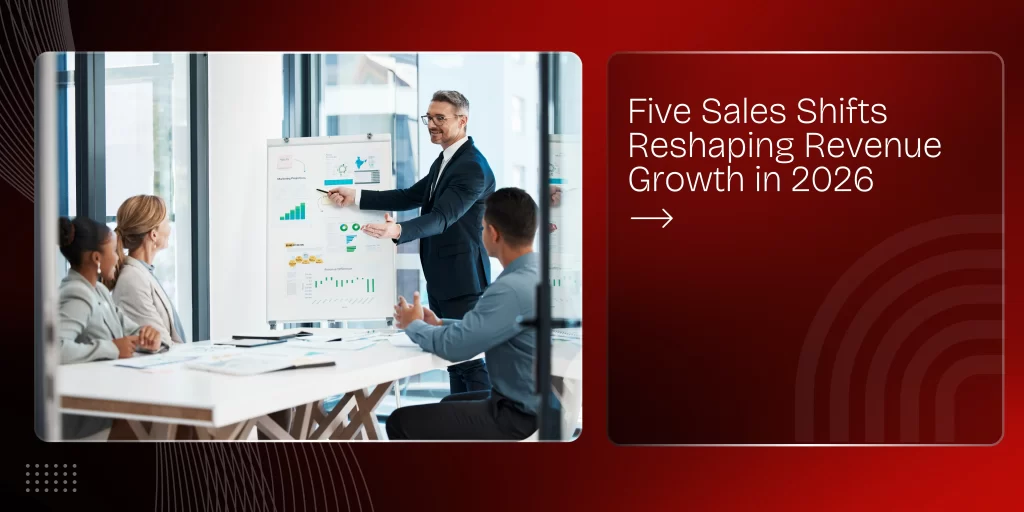
B2B sales revenue is evolving faster than at any point in the last decade. Buying committees now average 11 stakeholders, AI-powered sales teams are achieving nearly 2x greater pipeline velocity, and signal-led outreach is outperforming traditional cold prospecting. Meanwhile, 74% of B2B buyers prefer to complete part of the buying journey without interacting with sales, while leading companies are driving Net Revenue Retention above 130% through customer expansion strategies. These are not temporary trends—they represent a fundamental shift in how buyers evaluate and purchase solutions. This blog explores five critical sales shifts shaping B2B growth in 2026 and what CROs can do to stay ahead.
The B2B Revenue Environment Has Not Slowed Down — It Has Shifted
If you are a CRO, your core objective remains the same: grow revenue, build a predictable pipeline, and deliver quarter after quarter.
What has changed is the way companies go about achieving those goals.
B2B sales is undergoing more structural transformation right now than it did in the entire previous decade. The buying journey is more complex, more self-directed, and increasingly resistant to the outbound strategies that used to move the needle. Demand generation has shifted from a volume game to a precision game. And AI-enabled selling is creating a real, widening performance gap between teams that have adapted their revenue strategy and those still running legacy playbooks.
The companies pulling ahead in 2026 share one thing in common: they spotted these shifts early — and they moved first.
Here are the five shifts that separate the leaders from the rest, and what each one demands from the people responsible for revenue.
Shift 01 — Buying Committees Have grown, and So Has the Noise
The average B2B deal now involves 11+ stakeholders. If you’re only talking to one of them, you’re already behind.
In today’s B2B sales environment, winning a deal requires much more than convincing a single decision-maker. By 2026, the average B2B buying is expected to involve more than 11 stakeholders. In large enterprise deals, that number often rises to 13 internal stakeholders and 9 influencers. Successful sales teams are increasingly engaging anywhere from 5 to 25 people within a single buying committee.
This shift has changed how deals are won. A single champion is no longer enough to move a deal forward. Stakeholders who are not engaged early can become late-stage blockers. Departments that are left out of conversations often create friction when approvals are required. Similarly, SDRs who rely on one contact within an account risk losing momentum if that individual becomes unresponsive or leaves the organization.
For CROs, this is not simply a sales strategy issue, it is a structural one. Outreach initiatives, SDR playbooks, and account coverage models built around a single point of contact are becoming less effective.
The companies that grow in this environment are also redefining B2B appointment setting. The goal is no longer to book any available meeting, but rather to get the right meeting with the right stakeholders in the right account.
What to do: Audit your pipeline today. Flag every single-threaded account, one where a single contact represents your entire relationship. Those deals are at risk. Make multi-stakeholder mapping standard practice across all accounts, not just your top-tier ones.
Shift 02 — AI-Assisted Reps Are Outperforming Unassisted Ones by 2x
89% of revenue teams use AI in some form. The ones actually winning have embedded it into how they work — not just what tools they own.
Here’s the uncomfortable truth: buying an AI tool isn’t the same as gaining an AI advantage.
The CROs seeing real results, nearly 2x pipeline velocity, are the ones who’ve redesigned their workflows around AI. Account prioritization, intent scoring, outreach personalization at scale, call intelligence, pipeline forecasting. These aren’t AI experiments for them. They’re daily operating standards.
The problem AI is solving is real. Around 70% of CRM data is inaccurate. Data degrades by roughly 22% every year. Sales reps spend close to 70% of their time on non-selling activity. AI doesn’t just improve performance it clears the path so your team can actually sell.
The 2x gap between AI-enabled teams and the rest isn’t about technology budget. It’s about workflow design.
What to do: Identify the three biggest friction points in your current sales process — account research, outreach personalization, and pipeline planning are the most common culprits. Then ask honestly: is AI genuinely embedded in those workflows, or is it a tool that’s available but rarely used? That gap in usage is where you’re losing pipeline velocity.
Shift 03 — Cold Outbound Is Not Dead. Untargeted Outbound Is.
Cold email open rates have dropped by 62%, making traditional volume-based outbound less effective than it once was.
Let’s put the “outbound is dead” debate to rest. Outbound isn’t dead. Generic outbound is.
Buyers today filter, ignore, and delete irrelevant messages faster than ever. Email sequences sent to large lists with no targeting, no context, and no relevance to what the buyer is actually experiencing right now — those don’t work. Response rates have declined across every industry.
What is working instead is signal-led outreach. High-performing sales teams use intent data and buying signals to identify accounts that are actively researching solutions. They even track trigger events such as leadership changes, funding announcements, technology migrations, hiring activity, and expansion plans. Outreach based on these signals feels relevant because it aligns with what is happening inside the prospect’s business.
Businesses that consistently shorten sales cycles by 30–40% typically do two things well:
- Engage prospects earlier using intent and buying signals.
- Build relationships with multiple stakeholders instead of relying on a single contact.
These are not simply outreach methods. They are strategic pipeline building decisions.
What to do: Review your outbound strategy and analyze how much outreach is triggered by real signals versus cold prospect lists. If more than half of your outreach is going to accounts with no intent data or trigger events, improving email copy alone will not solve the problem.
Shift 04 — Buyers Are Deciding Before They Ever Talk to Your Team
74% of B2B buyers prefer to complete part of the purchase online without speaking to a sales rep.
The idea that sales reps are the primary interface between buyers and vendors is no longer accurate. Today, 83% of B2B buyers have already created a shortlist before engaging sales, while 60% make purchase decisions largely based on digital content. Additionally, 74% prefer to complete part of the buying journey without rep involvement.
This changes where revenue is won or lost. Research, vendor comparisons, and shortlisting now happen long before a sales conversation begins.
Companies that treat thought leadership, peer reviews, case studies, and digital buying experiences as branding activities rather than revenue assets risk losing early-stage influence to competitors.
As a result, businesses need to focus on creating a strong digital buying experience. Helpful content, customer success stories, ROI frameworks, industry insights, and a strong presence on platforms where buyers research solutions can all influence purchase decisions before the first sales meeting.
What to do: Review your buyer’s digital journey from the moment they recognize a problem to the point they contact sales. Identify where prospects may struggle to find information and where competitors are providing better resources. Improving these touchpoints can have a significant impact on pipeline and revenue growth.
Shift 05 — Revenue Retention Is the New Growth Lever
Net Revenue Retention above 130% is the benchmark separating top-performing B2B companies from the rest. The most efficient revenue growth in 2026 isn’t coming from new logos – it’s coming from existing customers.
Top-performing B2B companies are achieving Net Revenue Retention above 130%. That means they’re generating more than 30% additional revenue each year from their existing customer base, through upsells, cross-sells, and account expansion, even after accounting for churn.
The economics are straightforward. Expansion revenue costs a fraction of new logo acquisition, and it comes with a relationship that’s already been earned. Meanwhile, Customer Acquisition Cost has risen 222% over the past eight years, making new logo pursuit a significantly less efficient growth strategy than it once was.
But here’s where most companies get it wrong: they treat expansion as something that happens at renewal. The highest-NRR companies treat it as something designed into the deal from day one. Expansion milestones, adoption plans, and upsell paths are scoped during pre-sales — not discovered later by customer success.
What to do: Ask yourself one honest question: are expansion opportunities built into your deal structure from the beginning, or do they only surface at renewal? If it’s the latter, the issue isn’t in how your CS team follows up. It’s in how your AEs are scoping and selling deals.
What These Five Shifts Have in Common
While each shift focuses on a different aspect of B2B sales, they all point to the same reality: in 2026, success will be determined by precision, intelligence, and alignment rather than volume.
The highest-performing sales revenue teams are:
- Engaging multiple stakeholders instead of relying on one key stakeholder.
- Embedding AI into daily workflows rather than simply purchasing AI tools.
- Using intent data and buying signals to prioritize the right accounts at the right time.
- Supporting self-service buyers with strong digital experiences, content, and social proof.
- Building expansion opportunities into customer relationships from day one to drive long-term growth.
- Focusing on revenue quality and efficiency rather than activity volume alone.
- Designing scalable systems and processes instead of relying on reactive execution.
Click Here:- How to Build Consistent Sales Engagement Across Fragmented European Markets
The connecting thread is clear: successful companies are becoming more coordinated, data-driven, and Buyer-centric.
These are not incremental enhancements to existing sales playbooks. They represent fundamental shifts in pipeline generation, opportunity conversion, and revenue growth. Companies that adapt early will be better positioned to generate long-term growth and outperform competitors.
How Beyond Codes Helps Revenue Leaders Navigate These Shifts
At Beyond Codes, we work with B2B enterprise sales teams that are serious about building pipelines that actually convert — not just filling CRMs with contacts that go nowhere.
Our strategy aligns with the same revenue shifts that will shape B2B growth in 2026:
- ICP-Driven Account Selection - Instead of using static prospect lists, we prioritize accounts based on ideal customer profile fit, intent signals, and purchase triggers.
- Multi-Stakeholder Engagement - Our appointment setting initiatives are designed to target buying committees, not just individual contacts, with messages customized to each stakeholder's specific needs.
- Signal-Led Outreach - We use intent data, market triggers, and account analytics to engage prospects when they are most likely to buy.
- AI-Assisted Sales Development - Our SDR teams leverage AI-powered research, prioritizing, and workflow support to increase efficiency and focus on high-value opportunities.
- Enterprise-Focused Qualification - Our primary goal is to generate qualified B2B sales discussions that are consistent with your ICP, buying signals, and pipeline objectives.
- Pipeline-Centric Execution - Every outreach campaign is designed to generate meaningful meetings, improve pipeline quality, and promote consistent revenue development.
For CROs and sales leaders, Beyond Codes delivers more than appointment setting. We help turn modern B2B revenue strategies into qualified opportunities, stronger pipelines, and measurable business outcomes.
Ready to build a pipeline that's designed for how B2B buyers actually buy in 2026?
FAQs
Longer sales cycles are driven by buying complexity rather than technological limitations. Nowadays, organizational buying decisions frequently involve 11or more stakeholders from several departments, each with distinct goals, concerns, and approval needs.
Sales technology can improve B2B prospecting, personalization, and efficiency, but it cannot accelerate internal decision-making. Companies that reduce sales cycles prioritize engaging numerous stakeholders early in the buying path over depending on a single contact or boosting outreach volume.
Signal-led outreach aims to engage prospects when there is a signal that they are actively considering solutions. Instead of relying primarily on cold prospect lists, sales teams use buying signals such as intent data, leadership changes, funding announcements, recruiting activities, technological investments, and website interaction.
Because the outreach is linked to a meaningful business event or buying signal, interactions are more timely, relevant, and effective than traditional cold outreach.
The AI performance difference is usually not determined by which tools a corporation possesses. It’s about how well AI is integrated into everyday sales workflows.
The most significant advantages are often observed in account prioritizing, intent scoring, outreach customization, and pipeline forecasting. Businesses that integrate AI into these workflows experience higher pipeline velocity and sales efficiency than those who use AI tools in isolation.
Improving Net Revenue Retention (NRR) starts before the customer is onboarded. High-performing businesses include expansion potential into their sales processes by structuring agreements, onboarding programs, and success milestones with long-term development in mind.
While customer success is vital, long-term NRR growth requires planning chances for upsells, cross-sells, and account expansion from the very start, rather than depending just on renewal conversations.
Many buyers today conduct their own research before speaking with a salesperson. Many have already identified possible vendors and studied solutions prior to the initial cold call.
As a result, salespeople’s roles have moved from providing information to helping buyers in making decisions. Modern sales teams bring value by building trust, addressing business challenges, overcoming stakeholder concerns, and helping buying committees in reaching a deal closure agreement.
Author
-

With 7+ years of experience and a background in media & communication, she brings stories to life that fuel lead generation success. She transforms complex B2B ideas into content that is clear, engaging, and results-driven—helping key decision-makers take action. A good cup of coffee fuels her writing ideas, and when off the clock, she enjoys unwinding with her dog by her side.