
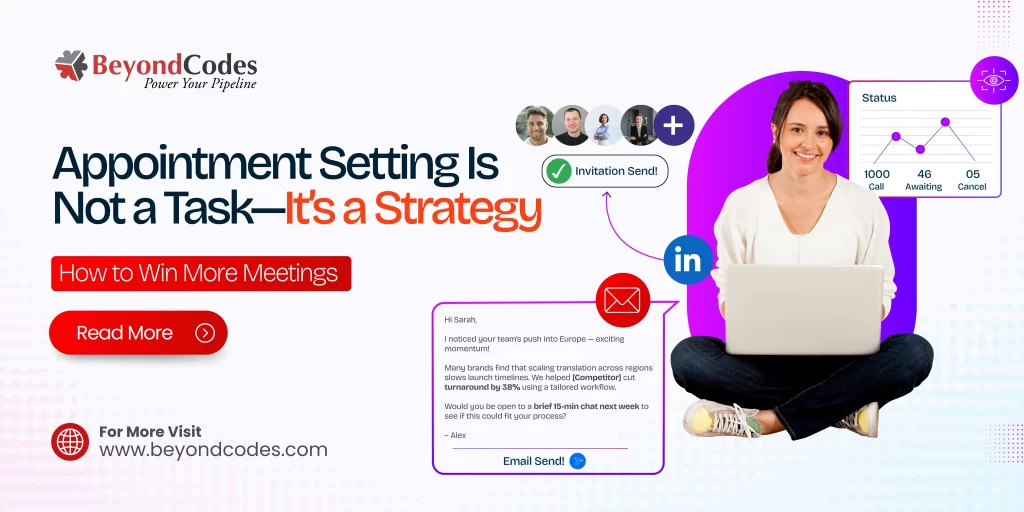
In B2B sales, appointment setting is often misunderstood as a simple admin task—a quick email or phone call to fix a meeting. But the truth? It’s a strategy. A data-driven, insight-led approach that bridges marketing and sales, generating consistent, high-quality opportunities.
When done right, appointment setting becomes a growth engine, driving qualified meetings, filling pipelines, and fostering lasting customer relationships.
Let’s break down why appointment setting is strategic, how to structure it effectively, and how to win more meaningful meetings.
Why Appointment Setting Is More Than a Task
At first glance, appointment setting seems simple: identify a lead, make contact, set a meeting. But simplicity here is deceptive. Every successful appointment requires planning, timing, and a deep understanding of buyer behavior.
Strategic appointment setting rests on four pillars:
- Quality over quantity: Focus on meaningful, sales-ready meetings—not just calendar fillers.
- Consistent outreach: Build repeatable, measurable outreach systems.
- Personalization and timing: Engage with the right message at the right moment.
- Skilled SDRs: Well-trained SDRs bring communication expertise that engages decision-makers effectively.
Treating appointment setting as a core strategy turns outreach into tangible revenue growth.
The Strategic Role of Appointment Setting in B2B Sales
1. Bridging Marketing and Sales
Appointment setting connects marketing’s lead generation activities with sales’ closing efforts. Marketing may drive awareness and traffic, but appointment setting converts those touchpoints into qualified meetings with buying intent.
This bridge ensures:
- Leads are validated before being passed to sales.
- SDRs qualify prospects based on fit and readiness.
- Sales teams focus only on high-potential opportunities.
When these steps are synchronized, your pipeline becomes both predictable and scalable.
2. Building Trust with Prospects
Effective appointment setting starts conversations, not just calendar invites. Buyers expect personalized engagement, and they respond best to outreach that shows understanding and relevance.
A strategic SDR:
- Does background research before outreach.
- Addresses specific pain points.
- Positions the meeting as an opportunity to discuss solutions, not a sales pitch.
This trust-first approach transforms initial conversations into valuable business discussions.
3. Bringing Predictability to the Pipeline
A well-structured appointment setting framework keeps your sales engine running — consistently and predictably. Instead of waiting for inbound leads, SDRs take charge by creating outbound opportunities that drive steady growth.
Here’s what it leads to:
- No more dry spells — maintain a steady flow of qualified opportunities.
- Reliable data helps teams plan and prioritize effectively.
- Transparent processes reduce guesswork and increase focus.
- Every effort is tracked, ensuring outcomes are visible and scalable.
Predictable pipeline leads to more accurate forecasting, improved productivity, and measurable ROI.
Click Here:- Outbound Lead Generation KPIs That Matter for SDRs and BDMs in 2026
How to Build a Winning Appointment Setting Strategy
1. Define Your Ideal Customer Profile (ICP)
A well-defined ICP is the foundation of effective appointment setting. It ensures your outreach is targeted, efficient, and relevant.
Elements of an effective ICP:
- Industry: Which sectors see the most value in your product.
- Company size: Revenue or employee count that matches your solution scope.
- Decision-makers: Who signs off on purchases — C-suite, directors, or managers.
- Pain points: What specific business problems you can help solve.
2. Use Intent Data to Target Ready-to-Buy Prospects
Intent data helps you prioritize prospects already in the market for your solution. By tracking digital behavior — such as page visits, content downloads, and search terms — SDRs can engage companies showing real buying intent.
Combining ICP filters with intent signals ensures your team focuses only on prospects most likely to convert.
3. Personalize Outreach with Context and Value
Generic cold emails don’t work. Buyers engage when outreach feels relevant and valuable.
Tips for effective personalization:
- Mention specific challenges based on the prospect’s industry.
- Reference company news or funding announcements.
- Share short, insightful content like a case study or industry stat.
- Use a multichannel approach combining email, LinkedIn, and calls.
4. Train and Empower SDRs
When you hire SDRs for appointment setting, training and enablement determine your success.
Critical SDR skills include:
- Active listening and thoughtful questioning.
- Handling objections calmly and logically.
- Clear communication that focuses on value.
- CRM hygiene — accurately recording every interaction.
Regular coaching, shadow sessions, and feedback improve confidence and consistency across your SDR team.
5. Use the Right Tech Stack
The right tools simplify outreach and tracking. Your appointment setting technology should streamline workflows, reduce manual tasks, and provide visibility into performance.
Recommended tools:
- CRM: Salesforce, HubSpot, or Pipedrive.
- Engagement platforms: Outreach, Salesloft, or Apollo.
- Data enrichment: ZoomInfo or Clearbit.
- Scheduling tools: Calendly or Chili Piper.
- Analytics: Built-in dashboards for monitoring performance.
These tools make it easier for SDRs to manage large-scale outreach while keeping the process personalized.
6. Track and Optimize Metrics
You can’t improve what you don’t measure. Regularly tracking metrics allows you to refine your strategy.
Important metrics include:
- Response rates (email and call).
- Meeting acceptance and attendance rates.
- Conversion from meeting to opportunity.
- Number of meetings per SDR.
- Pipeline growth from SDR efforts.
Continuous measurement ensures improvement and prevents wasted effort.
7. Maintain Strong Post-Meeting Follow-Ups
Your job doesn’t end once the meeting is booked. The follow-up process is just as critical.
Best practices:
- Send a summary email immediately after the meeting.
- Share relevant follow-up content.
- Reconfirm next steps clearly.
- Maintain light touchpoints even if timing isn’t right yet.
Consistent nurturing turns one-time meetings into long-term opportunities.
Common Appointment Setting Mistakes—and How to Fix Them
Even well-intentioned appointment setting teams can stumble if their strategy lacks structure or focus. Here’s a deeper look at the most common pitfalls and actionable ways to fix them.
1. Prioritizing Volume Over Quality
Many teams equate success with the number of meetings booked, not their quality. But irrelevant or unqualified meetings waste valuable sales time.
Why it happen?
Pressure to hit weekly or monthly meeting quotas often pushes SDRs to book any meeting, even if it’s not a fit.
How to fix it:
- Revisit your ICP and qualification criteria regularly.
- Reward SDRs for qualified meetings, not just booked ones.
- Implement lead scoring to prioritize high-potential prospects.
Focusing on fewer, higher-quality meetings ensures stronger pipelines and better close rates.
2. Inconsistent or Weak Follow-Ups
A single outreach rarely secures a meeting. Most conversions happen after 5–8 touchpoints, yet many SDRs stop after one or two attempts.
Why it happen?
Manual tracking leads to missed follow-ups or inconsistent outreach cadence.
How to fix it:
- Automate follow-ups with CRM and engagement tools.
- Create multichannel outreach sequences.
- Track timing and frequency to avoid overcommunication.
Consistent follow-ups show persistence and professionalism, improving your overall response rate.
3. Lack of Personalization
Sending cookie-cutter messages can damage credibility and reduce engagement. Prospects can instantly tell if your outreach is templated.
Why it happen?
SDRs under time pressure rely too heavily on templates or mass email tools.
How to fix it:
- Personalize 20–30% of every message with relevant context.
- Mention the prospect’s pain points or recent achievements.
- Use short, conversational messages instead of scripts.
A small effort in personalization can lead to a major boost in reply and meeting rates.
4. Neglecting Data Tracking
Without tracking data, you can’t improve. Many teams fail to analyze their activity or conversion metrics, leading to inefficient campaigns.
Why it happen?
SDRs may lack proper dashboards or training in data interpretation.
How to fix it:
- Centralize all data in one CRM.
- Use reports to identify which messages and channels perform best.
- Review metrics weekly to guide decisions.
- Data-driven appointment setting is more efficient and scalable.
5. Poor Alignment Between Sales and SDR Teams
When sales and SDRs aren’t aligned, qualified leads can fall through the cracks.
Why it happen?
Lack of communication, unclear qualification criteria, or disconnected goals.
How to fix it:
- Schedule weekly syncs between SDRs and sales reps.
- Agree on qualification parameters.
- Collect feedback from sales on meeting quality.
- This alignment ensures that appointment setting directly supports revenue growth.
6. Not Following Up on No-Shows
Prospects missing scheduled meetings is common — but failing to follow up afterward is a missed opportunity. Many “no-shows” aren’t rejections; they’re just delays waiting for the right nudge.
Why it happen?
Lack of follow-up processes or reminders to re-engage no-shows.
How to fix it:
- Send a polite message acknowledging the missed meeting and offer flexible rescheduling options.
- Share a short summary of what was to be discussed to rekindle interest.
- Automate no-show reminders within your CRM to ensure consistent follow-up.
- Reconnecting after a missed meeting can turn a cold prospect into a revived opportunity.
7. Ignoring Intent Data
Reaching out blindly wastes time and effort. Intent data reveals which companies are actively researching solutions like yours — turning cold outreach into warm engagement.
Why it happen?
Teams rely solely on basic demographic targeting instead of behavioral insights.
How to fix it:
- Leverage intent data platforms (like Bombora or 6sense) to identify accounts showing purchase intent.
- Prioritize outreach to those showing active research signals.
- Combine intent insights with personalization for maximum impact.
- Using intent data transforms outreach from guesswork into precise, high-probability targeting.
When to Hire SDRs for Appointment Setting
Hiring dedicated SDRs makes sense when:
- Your internal team lacks time for consistent outreach.
- Sales reps are overburdened with prospecting tasks.
- You want predictable meeting flow and higher-quality leads.
- You need expertise in reaching decision-makers and managing objections.
Experienced SDRs help maintain consistent activity, identify buying intent, and nurture leads into qualified appointments.
Click Here:- The 2026 Guide to B2B Appointment Setting: Strategies, Tools, and Trends
Aligning Appointment Setting with Sales Goals
For appointment setting to drive growth:
- Define what constitutes a “qualified meeting.”
- Ensure constant communication between marketing, SDRs, and sales.
- Measure shared KPIs like meeting quality and pipeline contribution.
- Maintain a feedback loop for continuous improvement.
Alignment guarantees appointment setting supports your broader revenue strategy.
Emerging Trends in Appointment Setting
- AI-driven outreach: Predictive tools identify high-intent buyers.
- Video prospecting: Personalized videos build trust quickly.
- Hyper-personalized sequences: Tailored messaging across multiple channels.
- Integrated analytics: Marketing and sales data converge in unified dashboards.
- Human + AI collaboration: AI handles research, SDRs focus on relationships.
Conclusion: Appointment Setting as a Growth Engine
Appointment setting isn’t a task—it’s a strategy. A structured, personalized, and data-driven approach fuels predictable sales pipeline growth and enables sales teams to focus on high-value conversations.
Whether you build your own team or hire SDRs for appointment setting, success lies in strategy, alignment, and continuous improvement. Done right, appointment setting doesn’t just fill calendars—it builds meaningful relationships that convert into long-term business growth.
Get personalized appointment setting strategies that drive results and ROI!
FAQs
When you hire SDRs for appointment setting, you gain specialized professionals focused solely on identifying prospects and booking qualified meetings. Experienced SDRs understand how to research target accounts, engage decision-makers effectively, and nurture prospects until they are sales-ready. By outsourcing or hiring dedicated SDRs, your core sales team can focus on closing deals.
Cold calling is transactional, while strategic appointment setting is relationship-driven. Instead of randomly calling a list, SDRs use buyer intent data, personalization, and multi-channel outreach to connect with prospects who are more likely to convert. This method aligns sales efforts with prospect needs, creating more valuable conversations and higher-quality meetings.
Effective SDRs need:
- Strong communication and listening skills
- Research and analytical abilities
- Knowledge of CRM tools and sales engagement platforms
- Persistence and resilience
- Understanding of the buyer’s industry and challenges
These skills enable SDRs to connect with the right prospects, tailor their messaging, and schedule meetings that move deals forward.
It depends on your goals, budget, and bandwidth. Outsourcing appointment setting to an experienced agency or hiring dedicated SDRs can deliver faster results and cost efficiency, especially for startups or growing B2B companies. However, building an in-house team offers greater control and direct alignment with internal sales strategies. Many businesses adopt a hybrid model—outsourcing initial prospecting while keeping key accounts in-house.
Beyond Codes specializes in B2B appointment setting and sales development services that help businesses connect with the right decision-makers. With a team of trained SDRs, data-backed outreach methods, and proven appointment-setting frameworks, Beyond Codes helps clients book qualified meetings that turn into revenue opportunities. Whether you want to hire SDRs for appointment setting or outsource your entire process, Beyond Codes ensures measurable results and consistent pipeline growth.
Author
-

With 7+ years of experience and a background in media & communication, she brings stories to life that fuel lead generation success. She transforms complex B2B ideas into content that is clear, engaging, and results-driven—helping key decision-makers take action. A good cup of coffee fuels her writing ideas, and when off the clock, she enjoys unwinding with her dog by her side.