


Beyond Codes Inc.

The Executive Guide to Discovery Calls That Drive Real Pipeline in 2026

The Executive Guide to Discovery Calls

Did you know that most discovery calls in B2B sales today are a waste of executive time? Not because sellers are incapable. Not because solutions lack quality. However, the structure of the discovery call has not kept pace with modern B2B buyers.

At the same time, 40–60% of B2B deals end in “no decision.” Executive attention is fragmented. Buying committees are larger. Risk tolerance is lower.

The margin for ineffective conversations has never been smaller.

Today’s executives are informed before the first call ever takes place. They have reviewed your website, compared alternatives, evaluated competitors, and often debated internally whether change is even necessary.

So when a seller opens with, “Tell me about your business,” the altitude drops instantly. Discovery is no longer a qualifying ritual. It is a strategic inflection point.

This blog explains a practical system for running effective discovery calls in 2026—especially for B2B SaaS, IT, and enterprise sales.

What a Discovery Call Means in B2B Appointment Setting


In complex B2B sales environments, discovery shapes everything downstream:
deal velocity, forecast accuracy, stakeholder alignment, and ultimately win rate.

Research consistently shows that sales professionals who conduct thorough discovery conversations achieve significantly higher win rates than those who do not. The difference is not marginal. It is structural.

Yet many teams still treat discovery as a formality — a stage to “get through” before demo, proposal, or pricing discussions begin.

That mindset is outdated.

In outbound-led growth models, discovery is much more important. The meeting was not requested; it was initiated. This indicates that the call starts without a sense of urgency or genuine trust. If the discovery discourse does not swiftly elevate the debate, momentum fades as quickly as it appeared.

Discovery today has one main goal: to determine whether a real business challenge exists and whether it is strategically important enough to warrant change.

Anything less results in pipeline noise rather than pipeline quality.

Click Here:- Why Consistency Is the Key to Successful B2B Cold Calling

Why Most Discovery Calls Fail in 2026


Sales executives, nowadays, do not avoid discovery calls because they dislike conversations. They hate them because they’ve sat through too many that were predictable, superficial, and self-serving.

In 2026, key decision-makers have developed their own pattern recognition. Within minutes, they can figure out whether a call will be beneficial or simply another vendor-led inquiry disguised as interest. Unfortunately, most discovery calls follow the same pattern.

Buyers expect:

When a discovery call feels more like a performance than a conversation, engagement declines quickly.

Outbound-led strategies, especially in B2B appointment setting and lead generation, have no margin for mistakes. The meeting was secured through outreach. It can either be lost or won within the first few minutes.

Here’s what our sales head says—

“In outbound sales, you don’t earn trust over 30 minutes— you earn it in the first 30 seconds. If you don’t establish relevance immediately, the meeting you worked so hard to book is already slipping away.”

Five Discovery Call Mistakes That Destroy Pipeline Quality


Most discovery calls don’t fail because of one major flaw — they unravel due to small, avoidable mistakes. Here are five common mistakes that slowly destroy confidence in modern B2B sales conversations:

Opening with Vague, Overused Questions


In real B2B sales calls, starting with “What keeps you up at night?” or “What are your biggest challenges?” rarely works. Senior leaders hear these constantly. Instead of sounding consultative, it shows weak preparations. Executives expect informed perspectives, not generic prompts or sales pitches that diminish the conversation’s strategic value.

Asking Lazy Questions That Lead To Vague Answers


Broad queries such as “How’s your sales process?” shift the responsibility of clarification to the buyer. The end result usually surface-level responses that keep the conversation shallow. Effective discovery is based on targeted, organized questions that guide thinking rather than unclear prompts.

Jumping into the Product Too Early


When salespeople jump to their solution at the first sign of trouble, the conversation turns transactional. Premature positioning lowers trust and shows impatience. Discovery should start with a better understanding; once alignment is achieved, product relevance becomes more important.

Overuse of Scripted “Upfront Contracts”


Overly scripted introductions feel unnatural, especially with key stakeholders. While structure is important, reading from a script makes the conversation feel forced. Executives prefer spontaneous, relevant communication over a scheduled sales routine.

Ending Without Clarity or Alignment


Discovery frequently loses momentum toward the close. The conversation ends without a clear next step or a summary of priorities. Strong discovery concludes with synthesis and direction, making progression seem logical rather than optional.

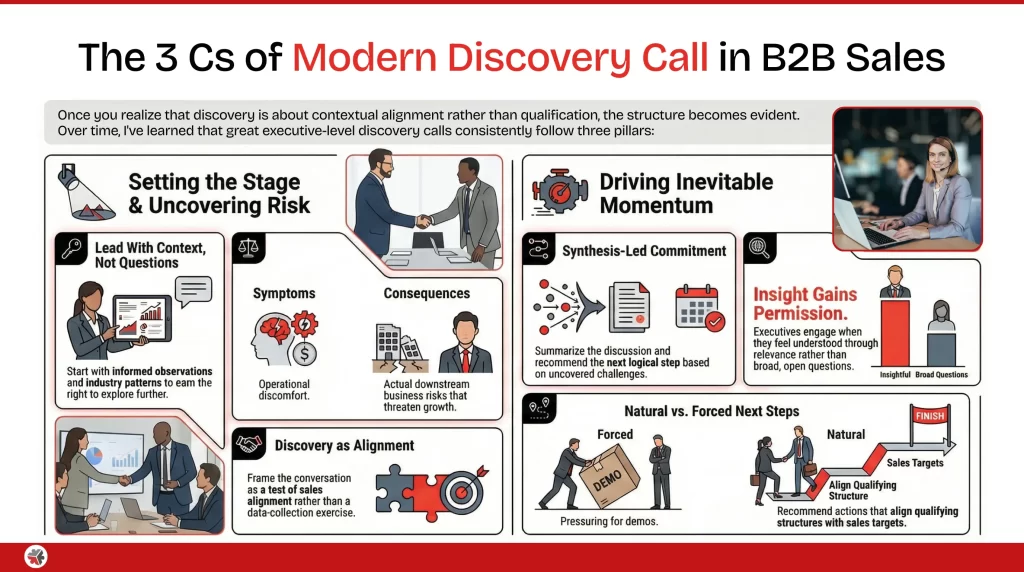
The 3 Cs of Modern Discovery Call in B2B Sales
B2B discovery calls
Once you realize that discovery is about contextual alignment rather than qualification, the structure becomes evident. Over time, I’ve learned that great executive-level discovery calls consistently follow three pillars:

Context. Consequence. Commitment.

Let’s unpack them

1. Context: Lead With Insight, Not Questions


The first five minutes of a discovery call set the tone for all that follows. Most sales reps start by asking questions because that is what they have been taught: “ask open-ended questions,” “let the buyer talk.”

However, business leaders do not want to teach you from scratch. They want to know if you bring perspective. Strong discovery call starts with understanding, pattern recognition, and informed observations from the field.

Instead of asking broad questions, use context to enrich the context, like —

“We’re seeing an ongoing challenge among growth-stage SaaS companies: high top-of-funnel volume, but inconsistent conversion owing to qualifying gaps and fragmented reporting. I’m curious how that relates to your experience.”

That framing transforms the dynamics immediately. You are no longer collecting information. You’re testing sales alignment.

Executives respond to relevance. They engage when they feel understood. Insight gains permission to explore further.

2. Consequence: Move Beyond Surface-Level Pain


Identifying an issue is very easy. Every business includes inefficiencies. Every team experiences friction. But challenges alone don’t create urgency — consequences do.

A weak discovery call ends with symptoms:

A strong discovery call goes deeper. It clarifies the actual impact of these challenges. When productivity falls, does revenue suffer? How can unclear forecasting affect recruiting or board confidence? When handoffs fail, does pipeline velocity suffer?

Instead of asking “What is the impact?” the topic is naturally led by asking, “When that bottleneck appears, what effect does it have downstream?”

That single shift moves the focus from operational discomfort to business risk.

Senior executives do not take action because something is somewhat frustrating. They take action when there is a threat to growth, predictability, or competitiveness. Discovery must find that level of consequence to generate real momentum.

Click Here:- How Enterprise Leaders Should Evaluate a B2B Lead Generation Agency

3. Commitment: Make the Next Step Feel Inevitable


The way discovery call ends is equally crucial as how it begins.

Many calls end with the question, “Would you like to see a demo?”

That wording conveys ambiguity. It puts the buyer under pressure to determine whether to continue the conversation. Instead, strong discovery concludes with synthesis and recommendations.

Instead of asking for permission, the seller summarizes what was discussed and recommends a logical next step. For example, after discussing the buyer’s challenges, the seller might say:

“From our discussion, it seems that the real challenge isn’t meeting volume, but conversion predictability and executive visibility. If that’s correct, the next natural step would be to align your current qualifying and reporting structure with sales targets.”

The sales rep is not pushing a demo. The seller is guiding progress based on what was uncovered. When discovery has been structured and thoughtful, the next step feels natural — not forced.

What Needs to Change in 2026


If you’re looking to improve your revenue engine this year, one of the most critical aspects to consider is discovery.

Ask yourself:

Are interactions based on insights or questions?

Do sales reps explore the impacts, or do they focus only on the surface-level issues?

Are the next steps confidently suggested, or cautiously requested?

Is the discovery call supporting pipeline quality?

Today’s buyers want context, competence, and transparency. If people do not feel those emotions within the first few minutes, the interaction becomes transactional. In complex B2B sales situations, transactional discussions are rarely concluded. Strategic sales team do.

Final Perspective


Is your discovery strategy collecting information or influencing your buyer’s thinking?

Discovery is not about gathering data. It’s about helping the buyer see their situation more clearly. Key decision makers don’t act because a product sounds exciting. They move forward when they clearly see the risk of doing nothing, the urgency of the opportunity, and the real business impact.

Everything that follows benefits from discovery because it consistently elevates the conversation, reveals strategic implications, aligns with real priorities, and defines a clear next step. Calls become more targeted. The sales pipeline gets cleaner. Forecasts become more reliable. Revenue momentum shifts from unpredictable to intentional.

And in 2026, this is what distinguishes companies that lead their numbers from those that are constantly chasing them.

Ready to transform your discovery calls into revenue-driving conversations?

FAQs

What is a discovery call in B2B sales?

A discovery call in B2B sales is an initial strategic conversation designed to determine whether a real business problem exists and whether it is important enough to justify change. In modern B2B appointment setting, discovery shapes pipeline quality, deal velocity, stakeholder alignment, and win rates.

How should a discovery call be structured in 2026?

A modern discovery call should follow three pillars: Context, Consequence, and Commitment. Start with insight, not generic questions. Explore business impact, not just symptoms. End with a logical next step based on alignment. This structure builds executive trust and drives meaningful sales progression.

What is the goal of a discovery call in B2B appointment setting?

The goal of a discovery call is to validate whether a strategic business challenge exists and assess if it warrants change. In outbound-led B2B sales, discovery determines whether the meeting turns into qualified pipeline or fades into “no decision.”

What questions should you avoid in a discovery call?

Avoid vague questions like “What keeps you up at night?” or “Tell me about your business.” Senior decision-makers expect preparation and perspective. Generic prompts weaken credibility. Instead, use informed observations and targeted follow-up questions that guide strategic thinking.

How long should a B2B discovery call be?

A B2B discovery call typically lasts 20–30 minutes, but impact is determined in the first few minutes. Executives quickly assess relevance and value. Establishing context early is critical; without immediate alignment, engagement drops regardless of meeting length.

What is the difference between qualification and discovery in B2B sales?

Qualification focuses on checking criteria like budget, authority, need, and timeline. Discovery goes deeper by clarifying strategic impact and business consequences. While qualification filters deals, discovery influences buying decisions and determines whether change feels urgent and necessary.

How do discovery calls improve pipeline quality?

Strong discovery calls clarify real business impact, align stakeholders, and define clear next steps. This reduces unqualified opportunities and prevents stalled deals. When discovery surfaces true consequence, pipeline becomes cleaner, forecasting improves, and revenue predictability increases.

When should you introduce your product during a discovery call?

You should introduce your product only after confirming alignment on business challenges and consequences. Jumping into features too early shifts the conversation into transactional mode. In modern B2B sales, product relevance earns attention only after strategic clarity is established.

Author

  • Poonam

    With 7+ years of experience and a background in media & communication, she brings stories to life that fuel lead generation success. She transforms complex B2B ideas into content that is clear, engaging, and results-driven—helping key decision-makers take action. A good cup of coffee fuels her writing ideas, and when off the clock, she enjoys unwinding with her dog by her side.

Facebook
Twitter
LinkedIn
Threads
Pinterest

Most Popular

Get The Latest Updates

Subscribe To Our Monthly Newsletter

No spam, notifications only about new services, blogs, and newsletter updates.

Contact Us Today!