

Initially, let’s begin with an uncomfortable but very important question.
If you stop all your demand generation initiatives today, would revenue slow down tomorrow?
Most sales executives hesitate before answering. There is demand generation, but its direct connection to revenue is unclear. For many years, demand generation was considered a marketing function—campaigns launched, leads generated, dashboards filled, reports circulated. But revenue attribution? That was harder to prove.
Today, that gap is no longer acceptable. In enterprise sales, demand generation is no longer considered a marketing activity. This is a capital allocation decision. Not just campaigns, but demand generation services must deliver measurable results.
According to Forrester, over 60% of B2B marketing leaders fail to clearly show revenue impact. At the same time, Gartner reports that buyers spend only 17% of their buying journey with suppliers.
That means influence builds quietly— and, without disciplined measurement, it cannot be managed.
This is where the real challenge begins.
Why Measuring ROI in Enterprise Demand Generation Is More Complex
Enterprise demand generation works as a coordinated system, not as a linear funnel.
Buying cycles last for months. According to McKinsey, Buying decisions involve an average of 6 to 10 stakeholders, each conducting independent research and applying their own risk criteria.
Marketing affects awareness levels. Outbound sales teams activate target accounts and secure qualified conversations. Sales validates fit, builds consensus, and drives negotiation.
Revenue does not come from a single campaign. It is the product of cumulative, disciplined involvement. This multilayer engagement renders simple ROI measurement worthless. First-touch attribution is an oversimplification of reality. Last-touch attribution disregards the build-up. Even single-channel reporting ignores cross-functional influence.
Enterprise demand generation must be evaluated as an integrated revenue engine. And revenue engines necessitate operational discipline.
What Does ROI Mean at the Enterprise Level
At its core, ROI measures efficiency. It answers one executive question:
For every dollar invested, how much predictable revenue is created?
The formula is simple:
ROI = (Revenue – Investment) ÷ Investment × 100%
But in enterprise sales, applying that formula requires depth. It is not enough to measure campaign performance. Or cost per lead.
But in enterprise sales environments, ROI must be evaluated across four layers:
- Campaign impact
- Channel performance
- Pipeline contribution
- Revenue influence
At the enterprise level, ROI visibility comes from understanding pipeline ROI — how effectively an investment converts into a qualified, revenue-ready pipeline. Most organizations overestimate campaign performance while underestimating pipeline and revenue contribution—where actual strategic clarity exists.
Demand generation is not intended to drive activities. It is intended to drive capital-efficient revenue growth.
Click Here:- The Executive Guide to Discovery Calls That Drive Real Pipeline in 2026
Five Demand Generation Metrics That Matter
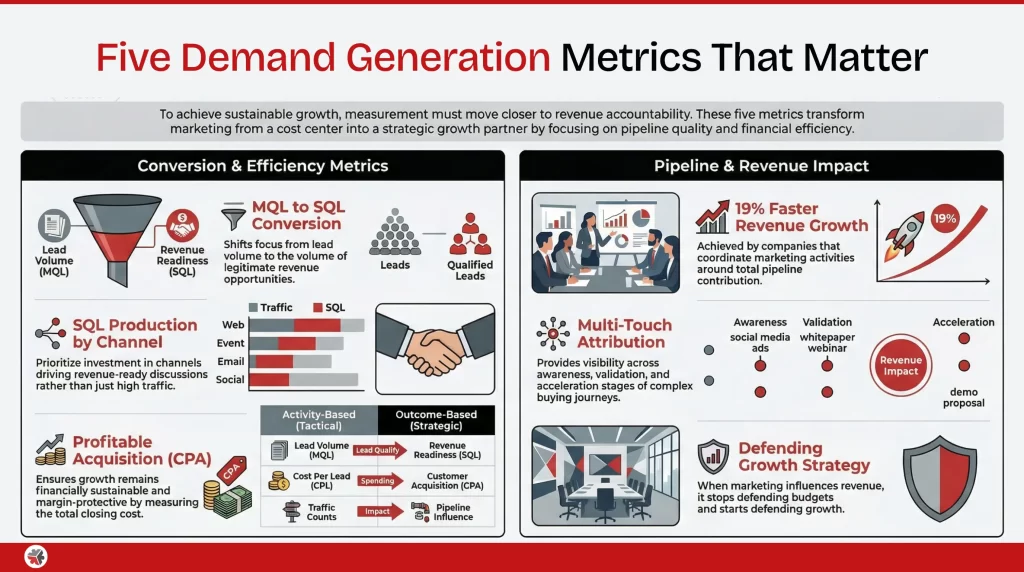
If ROI is about accountability, then measurement must move closer to revenue. That requires focusing on the right B2B KPIs — the ones that influence pipeline quality and revenue outcomes, not just marketing activity.
There are five demand gen metrics that bring that clarity and connect activity directly to revenue impact—
1. MQLto SQL Conversion: Is Interest Turning Into Opportunity?
Generating leads is easy. Generating the right leads is not.
A Marketing Qualified Lead (MQL) shows engagement and alignment with your ideal customer profile. A Sales Qualified Lead (SQL) confirms business readiness — budget alignment, authority, urgency, and relevance. The gap between MQL and SQL indicates whether targeting and messaging align with real buying intent.
A low conversion rate indicates misaligned targeting, incorrect qualification standards, or premature handoffs to sales. A high conversion rate shows a match between marketing intent signals and sales readiness levels.
This metric shifts the focus from “How many leads?” to “How many legitimate revenue opportunities?” For business leaders, that difference is important.
2. SQLs by Channel: Where Is Revenue Readiness Coming From?
Not every acquisition channel has the same impact.
Some campaigns generate high traffic and impressive lead counts. Others create fewer qualified B2B leads but achieve higher SQL conversion rates. Tracking SQL production by campaign or channel enables investment decisions to prioritize revenue readiness above vanity metrics.
Instead of asking, “Which channel drives the most traffic?”
You begin asking, “Which channel drives revenue-ready discussions?”
Without SQL-level visibility, budget allocation decisions are tactical rather than strategic. ROI becomes operational when executives shift their spending to revenue-generating channels.
3. Pipeline Value Influenced: Are We Building Real Probability?
Leads represent possibility. The sales pipeline represents probability. Enterprise revenue teams are increasingly asking more strategic questions:
How much qualified pipeline does marketing help generate or accelerate?
Influences on the sales pipeline include:

- Opportunities directly sourced by marketing
- Deals accelerated through nurture engagement
- Appointments that convert into real sales cycles
According to Forrester, companies that coordinate marketing around pipeline contribution achieve up to 19% faster revenue growth than peers.
Pipeline influence is the metric that connects awareness activity to financial accountability. It transforms marketing from a cost center to a growth partner.
4. Customer Per Acquisition (CPA): Is Growth Profitable?
Growth without efficiency is unstable. While Cost Per Lead (CPL) measures early-stage efficiency, Customer Per Acquisition (CPA) reveals the true cost of turning prospects into paying customers.
CPA includes marketing spend, outbound efforts, sales time, and operational resources invested to close a deal. A low CPL may look attractive, but if conversion rates are weak, CPA quietly increases, impacting profitability. On the other hand, a higher upfront investment can be justified when qualification is strong, and the deal value supports it.
For CVD-level leaders, CPA ensures growth is not just scalable — but financially sustainable and margin-protective.
5. Revenue Influenced: The Final Accountability Layer
Revenue influence is where marketing earns executive credibility. However, enterprise sales deals are complex. It takes several months to complete. Multiple stakeholders engage. Sales interactions are intertwined with digital nurture.
First- and last-touch models simplify reality. Modern revenue attribution models — especially multi-touch attribution — provide visibility across awareness, validation, and acceleration stages of the buying journey.
But when leadership can clearly see:
- Revenue influenced by demand generation
- Percentage of total revenue touched by outreach
- Improved deal velocity linked to structured engagement
- Conversion from qualified appointments to closed deals
It alters perception. Marketing is no longer defending its budget. It is defending growth strategy.
Transforming Metrics into Predictable Performance
To capture these KPIs, enterprise analytics systems, CRM platforms, and closed-loop reporting must work together as one connected revenue infrastructure. Behavioral tracking and revenue dashboards convert data into directional intelligence. But data alone does not generate ROI. Alignment does.
Enterprise demand generation becomes predictable when:
- MQL and SQL definitions are clearly aligned
- Sales and marketing share pipeline accountability
- Attribution models are agreed upon
- Revenue dashboards are transparent
- Performance reviews focus on pipeline contribution—not just activity
Technology supports the process through lead scoring, intent tracking, segmentation, and velocity monitoring. But tools are not a strategy. Discipline is.
This is where real-time optimization comes into play. Instead of waiting for quarterly assessments, teams can quickly identify underperforming areas, pause wasteful spending, and confidently scale winning campaigns.
Final Perspective: From Activity to Accountability
Enterprise demand generation is not about filling dashboards with impressions or lead counts. At the executive level, those numbers only matter when they translate into a qualified pipeline and predictable revenue. Awareness creates interest, outbound drives conversations, and sales closes deals — but unless these stages operate as a single, connected revenue motion, growth remains inconsistent and hard to forecast.
When ROI is measured from first engagement to qualified meetings, pipeline creation, and closed revenue, demand generation becomes a disciplined revenue engine. Sustainable enterprise growth is built on alignment, execution, and clear accountability — not activity alone.
Is your demand generation generating qualified sales conversations — or just reporting activity?
FAQs
Demand generation ROI in enterprise sales is measured by connecting marketing investment to qualified pipeline and revenue influence. Instead of focusing only on leads, enterprises evaluate MQL-to-SQL conversion, pipeline value influenced, customer acquisition cost (CPA), and revenue attribution to determine how efficiently campaigns create predictable revenue growth.
The five most important demand generation metrics are MQL-to-SQL conversion rate, SQLs by channel, pipeline value influenced, customer acquisition cost (CPA), and revenue influenced. These metrics move measurement beyond lead volume and directly connect marketing activity to pipeline quality, deal velocity, and revenue impact.
Pipeline ROI measures how effectively marketing and sales investments convert into qualified, revenue-ready pipeline. It matters because revenue doesn’t come from campaigns alone—it comes from pipeline probability. Strong pipeline ROI shows whether demand generation is creating real sales opportunities, not just engagement or traffic.
An MQL (Marketing Qualified Lead) shows engagement and alignment with the ideal customer profile. An SQL (Sales Qualified Lead) confirms buying readiness, including budget, authority, need, and timeline. The MQL-to-SQL conversion rate reveals whether marketing targeting aligns with real purchasing intent.
Demand generation influences the sales pipeline by sourcing new opportunities, accelerating existing deals through nurture engagement, and converting qualified appointments into active sales cycles. When measured properly, pipeline influence shows how marketing contributes to revenue probability—not just awareness.
Customer acquisition cost (CPA) is the total investment required to convert a prospect into a paying customer. It includes marketing spend, outbound efforts, sales time, and operational resources. CPA reveals whether growth is financially sustainable, not just scalable.
Many B2B companies struggle because they measure activity metrics—such as impressions, clicks, or cost per lead—without linking them to pipeline and revenue outcomes. Without aligned MQL definitions, shared pipeline accountability, and integrated CRM reporting, revenue impact remains unclear.
Enterprises make demand generation ROI predictable by aligning sales and marketing around shared pipeline goals, defining clear MQL and SQL criteria, implementing multi-touch attribution, and using real-time revenue dashboards. Predictability comes from disciplined measurement, not campaign volume.
Author
-
With 7+ years of experience and a background in media & communication, she brings stories to life that fuel lead generation success. She transforms complex B2B ideas into content that is clear, engaging, and results-driven—helping key decision-makers take action. A good cup of coffee fuels her writing ideas, and when off the clock, she enjoys unwinding with her dog by her side.