

There’s a moment most B2B sales teams recognize. A strategy that worked perfectly for landing mid-market clients suddenly stops delivering results when aimed at enterprise accounts. The emails go unanswered. The demo requests dry up. The pipeline looks full on paper, but nothing moves.
The instinct is to push harder — more outreach, more ads, more content. But the problem isn’t volume. The problem is that the entire approach was built for a different buyer.
Enterprise lead generation follows a completely different set of rules. And understanding that difference is not optional. It is the line between building a real enterprise pipeline and wasting months chasing accounts that will never close.
The Fundamental Difference Nobody Talks About
When a small business buys a software product or a service, the decision is often made by one person. They identify a problem, find a solution, check the pricing page, and sign up. The whole journey takes a week.
In B2B enterprise sales, you’re rarely selling to one person. You aren’t selling to just one person. You’re collaborating with a buying committee that includes legal, finance, IT, operations, and end users. Each group has unique concerns, priorities, and definitions of success.
Here’s why enterprise buying committees are so complex to manage:
- Legal and compliance teams evaluate vendor risk, contract terms, and data security — concerns that rarely come up in SMB deals
- Finance stakeholders want to see a clear ROI model and need to justify the spend against competing budget priorities
- IT and security teams have their own checklist of technical requirements that can stall or kill a deal entirely
- End users care about usability and adoption, and their resistance can undermine a deal even after leadership has signed off
- Executive sponsors need a compelling business case, not a product pitch
The long sales cycle isn’t a bug in enterprise buying — it’s a feature. Large organizations move carefully because the stakes are high. A bad vendor relationship at the enterprise level doesn’t just cost money; it disrupts operations, affects hundreds of employees, and can take years to unwind. So when your SMB-tuned lead generation tactics treat enterprise buyers as impatient consumers who need nudging toward a quick decision, you’re fundamentally misreading the room.
Click Here:- How to Measure Demand Generation ROI in Enterprise Sales
Why High-Volume Outreach Backfires
The backbone of most SMB lead generation is volume. Send enough cold emails, run enough LinkedIn ads, publish enough content, and the numbers will eventually work in your favor. For smaller deals, that logic holds. The cost of acquisition is low enough that a 1-2% conversion rate still makes the math work.
Enterprise lead generation flips this logic on its head. Enterprise accounts are finite. There are only so many companies that fit your ideal customer profile. If you approach them with generic, high-volume outreach, you do not just lose opportunities — you damage your reputation.
Enterprise buyers can spot templated outreach immediately. A message that simply inserts a name and company does not feel personalized. It feels automated.
Signs that your outreach strategy is still tuned for SMB, not enterprise:
- Measuring success by open rates and reply rates instead of meaningful conversation quality
- Pushing for demos within the first two or three touchpoints
- Personalization starts and ends with inserting the prospect's name and company
- Reaching out to a single contact rather than multiple stakeholders.
Effective enterprise pipeline building requires depth over breadth. That means researching accounts thoroughly before making contact, understanding the specific pressures and priorities the organization is facing, and leading with insight rather than a pitch. It’s slower upfront, but it produces conversations that actually go somewhere.
The Content Problem: Awareness Isn’t Enough
Content marketing is a staple of SMB lead generation for good reason — it drives organic traffic, builds brand awareness, and generates inbound interest at a manageable cost. For enterprise lead generation, content still matters, but its role fundamentally changes.
An SMB buyer might read a blog post, download a guide, and request a demo within days. An enterprise buyer reads your content as part of a research process. They’re not downloading your white paper because they’re ready to buy. They’re learning, comparing vendors, and building an internal business case. This often happens long before your team knows they exist. By the time they actually reach out, they’ve already formed strong opinions about which vendors understand their business.
Generic thought leadership content or top-of-funnel blog posts have their place, but they rarely deliver a qualified enterprise pipeline on their own. Enterprise buyers look for:
- Industry-specific case studies that reflect comparable scale, complexity, and organizational structure — not generic success stories
- Technical documentation and integration guides that give IT and security teams the details they need to evaluate risk early
- ROI and business case frameworks that help internal champions justify the investment to finance stakeholders
- Executive-level insights that speak to strategic priorities, not product features
- Competitive comparison content helps buyers make a confident final decision
The goal is not clicks. The goal is credibility throughout a long evaluation process.
Decision Makers Don’t Fill Out Lead Forms
One of the biggest myths in enterprise lead generation is that senior decision makers convert through inbound forms. They rarely do. A CTO at a Fortune 500 company is not going to fill out a contact form after reading your blog post. A Chief Procurement Officer is not going to respond to a retargeting ad.
Channels that consistently create real enterprise access include:
- Executive peer networks and industry roundtables where decision makers learn, not sold
- Referrals from enterprise accounts carry a level of trust that outbound motion can't
- Establish strategic partnerships with consulting firms, system integrators, or complementary vendors
- Sponsorships and speaking opportunities to position your leadership team as credible voices
This is why enterprise lead generation services that rely entirely on digital inbound miss the point. Digital channels can support enterprise sales, but they rarely originate. The companies that consistently build strong enterprise pipelines invest heavily in relationship development, not just demand generation. True account-based execution means treating each high-value account as its own market, with dedicated research, customized messaging, and coordinated outreach across multiple channels and multiple contacts within the same organization simultaneously.
The Qualification Problem: Not All Interest Is Equal
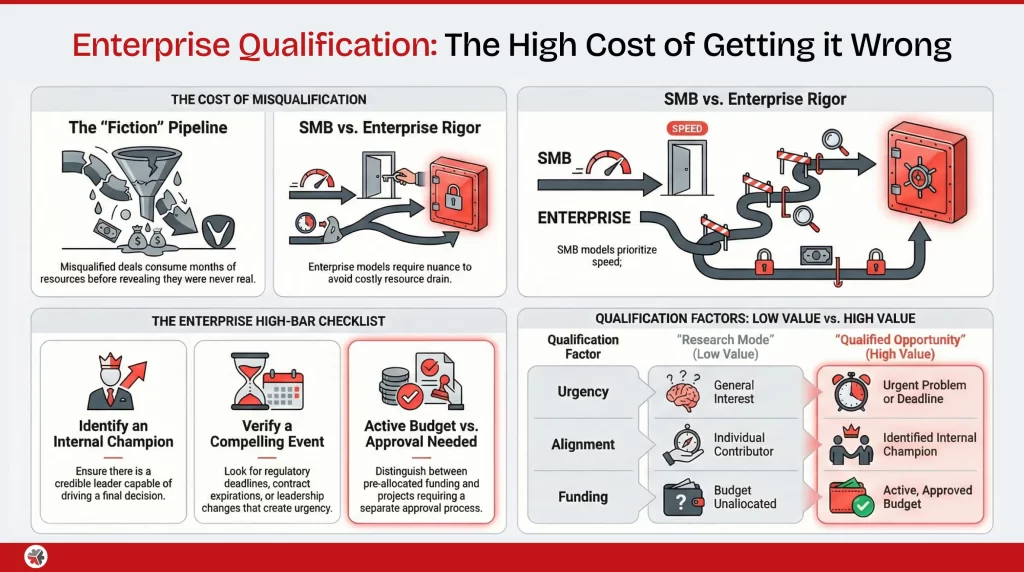
SMB lead generation systems are optimized to quickly capture and qualify interest. A lead comes in, is scored based on demographic and behavioral signals, and is routed to sales. The model is built for speed, which makes sense when deal sizes are small and cycles are short.
Enterprise pipeline qualification is more nuanced and more expensive to get wrong. Chasing an enterprise account that lacks budget authority, organizational alignment, or an actual active need is one of the most costly mistakes in B2B enterprise sales. Enterprise sales cycles are long enough that misqualified opportunities don’t reveal themselves quickly — they consume months of resources before it becomes clear the deal was never real.
For complex enterprise-level sales, a qualified opportunity should meet a much higher bar than standard frameworks require. Before committing significant sales resources to an account, you need clear answers to questions like:
- Is there an identified internal champion with enough organizational credibility to drive a decision?
- Does the organization have a genuine, urgent problem — or are they just in research mode with no real timeline?
- Is there an active budget allocated, or does funding need to be approved through a separate process?
- What competing priorities inside the organization could delay or derail a decision?
- Is there a compelling event — a regulatory deadline, a contract expiration, a leadership change — that creates urgency?
Without that depth of qualification, your enterprise pipeline becomes a fiction — full of accounts that feel promising but never close.
Long Sales Cycles Need Human Nurture
In SMB sales, nurture is mostly automated. A lead enters a sequence, receives a series of emails over a few weeks, and either converts or falls out of the funnel. The economics of smaller deals make human-touch nurture prohibitive at scale.
Enterprise lead generation requires an entirely different nurture model. When a sales cycle runs 9, 12, or 18 months, automated email sequences don’t keep deals warm. What keeps them warm is consistent, meaningful engagement from real people — executives having genuine conversations with their counterparts, sales reps sharing relevant research and industry insights, and customer success stories that reinforce confidence in your ability to deliver at scale.
High-impact nurture activities that actually sustain the enterprise pipeline over a long sales cycle include:
- Executive briefings and strategy sessions that give senior stakeholders a reason to stay engaged beyond the standard sales process
- Relevant industry research and benchmarking data shared proactively, without a sales ask attached
- Invitations to customer advisory events or product roadmap sessions that make prospects feel like partners rather than targets
- Regular check-ins tied to something meaningful — a change in their industry, a relevant news event, a new case study from a similar company
Over the course of a year-long sales cycle, that distinction accumulates into either a trusted relationship or a transactional dynamic — and trusted relationships win enterprise deals.
Click Here:- Why Consistency Is the Key to Successful B2B Cold Calling
What Actually Works in Enterprise Lead Generation
Building an enterprise pipeline that converts means understanding enterprise sales works differently — and planning your strategy accordingly. A few principles that consistently hold up across industries and deal sizes:
- Start with accounts, not leads. Identify ideal organizations. Understand their structure and priorities. Then, build relationships — before you need anything from them.
- Align sales and marketing. Both teams must focus on the same target accounts. Inbound volume and named-account strategy cannot run in different directions.
- Invest in people, not just programs. Enterprise deals close through trust. Skilled sales professionals who understand the buyer’s environment outperform any automation tool.
- Prioritize quality over volume. A few strong opportunities beat a large, weak pipeline. If lead count is the only win, you’re tracking the wrong metric.
- Play the long game. Enterprise deals take 12–24 months. Companies that commit to the timeline win more than those chasing shortcuts.
The Bottom Line
Enterprise lead generation is not a scaled-up version of what works for SMBs. It’s a fundamentally different discipline that requires different thinking, tactics, and a genuine willingness to operate on a longer time horizon. The companies that treat it like a volume game consistently underperform. The ones that invest in depth — in account research, relationship development, multi-stakeholder engagement, and rigorous qualification — build pipelines that convert and partnerships that last.
If your enterprise pipeline isn’t performing the way you expect, the first question to ask isn’t how to do more. It’s whether you’re doing the right things at all.
Ready to win enterprise accounts? Build a pipeline designed for enterprise — not scaled SMB tactics.
FAQs
Enterprise lead generation involves multiple decision makers, longer sales cycles, and higher organizational stakes. SMB tactics rely on volume and speed, which don’t apply when 6–10 stakeholders need to align before any purchase decision is made. Enterprise buying is relationship-driven, research-heavy, and requires a fundamentally different strategy than small business outreach.
The most common mistakes include relying on high-volume cold outreach, targeting only one contact per account, using generic messaging, and measuring success by lead quantity rather than quality. Companies also fail by using automated nurture sequences designed for short sales cycles on enterprise accounts that need months of relationship-building.
Account-based marketing (ABM) treats each high-value target account as its own market with dedicated research, customized messaging, and multi-channel outreach. It works well for enterprise lead generation when executed with depth — meaning coordinated engagement across multiple contacts within the same organization — not just targeted email campaigns with an ABM label attached.
Enterprise buying committees typically include legal, finance, IT, operations, end users, and executive sponsors. Each stakeholder has different priorities — finance wants ROI, IT evaluates security, legal reviews contracts, and end users care about usability. Effective enterprise sales requires engaging all these decision makers, not just one primary contact.
Content that generates enterprise leads includes industry-specific case studies, technical documentation, ROI and business case frameworks, and executive-level strategic insights. Generic thought leadership rarely converts at the enterprise level. The most effective content speaks directly to the buyer’s operational complexity and helps internal champions build a business case for purchase.
A qualified enterprise opportunity requires more than standard BANT criteria. You need a confirmed internal champion with organizational credibility, an urgent and active business problem, allocated or approvable budget, a clear timeline, and no major competing priorities that could derail the decision. Skipping deep qualification is one of the most expensive mistakes in enterprise pipeline management.
Enterprise decision makers are best reached through warm introductions, executive peer networks, industry roundtables, strategic partnerships, and conference speaking opportunities. These channels build trust before a sales conversation begins. Digital ads and cold email sequences rarely generate meaningful access to senior stakeholders at large organizations.
SMB lead generation relies on volume, automation, and short conversion paths — often one buyer, one decision, one week. Enterprise lead generation focuses on depth, relationship development, multi-stakeholder engagement, and long-term pipeline management. The metrics, content, qualification criteria, and nurture strategy are all fundamentally different at the enterprise level.
Author
-

With 7+ years of experience and a background in media & communication, she brings stories to life that fuel lead generation success. She transforms complex B2B ideas into content that is clear, engaging, and results-driven—helping key decision-makers take action. A good cup of coffee fuels her writing ideas, and when off the clock, she enjoys unwinding with her dog by her side.