
Global enterprises are quietly redesigning how they build capability. And, India becomes the center of that transformation. More than 1,500 Global Capability Centers (GCCs) are already operational in India, employing over 1.5 million people, and the number continues to grow year after year. What started as a cost-cutting initiative has turned into a boardroom-level growth mandate.
Today, businesses are no longer asking, “Should we outsource?”
They’re asking, “How do we build global capability at scale?”
That’s where GCCs come in.
Companies such as Microsoft, Goldman Sachs, and Google have transformed their India-based centers into innovation engines—leading corporate AI projects, overseeing product engineering roadmaps, driving cybersecurity frameworks, and powering enterprise analytics.
This is no longer about supporting functions. It’s all about ownership, resiliency, and long-term competitive advantage.
What Is a Global Capability Center (GCC)?
For global enterprises, a Global Capability Center (GCC) is no longer just an offshore delivery center. It is a strategic extension of the organization — designed to build technology capability, accelerate innovation, and create operational resilience.
Unlike traditional outsourcing vendors, a GCC:
- Operates under direct company governance
- Aligns with long-term corporate goals
- Owns intellectual property and strategic initiatives
- Follows global compliance and security requirements
- Increases institutional capability over time
Simply put, a GCC is not an external partner; rather, it is your business working from a different location. This difference substantially alters how value is created, managed, and sustained.
The Evolution of GCCs: From Cost Arbitrage to Strategic Asset
The first wave of GCCs focused on transactional support and labor cost savings. The second wave focused on operational efficiency and shared services. The emphasis turned toward standardization and process maturity.
The following are the core value mandates for GCC 3.0:
- Own end-to-end product lines
- Lead enterprise AI initiatives
- Manage global DevOps and cloud architecture
- Drive automation and digital transformation
- Develop patents and proprietary technologies
India-based GCCs are no longer execution arms—they are innovation engines. In many global enterprises, they now anchor technology strategy, platform upgrades, and digital transformation. This is a structural shift — not a cyclical one.
Why India Has Become the Global Capability Center Hub
India’s rise as the world’s GCC hub is not accidental. It is driven by structural advantages.
1. Deep, Specialized Talent Pool
Talent is at the center of every successful GCC, and India provides it in unprecedented quantities and depth. India produces one of the world’s largest STEM workforces. Cities such as Bengaluru, Hyderabad, and Pune have developed mature ecosystems for technology, healthcare IT, fintech, SaaS, and enterprise engineering.
Enterprises benefit from:
- Faster leadership hiring
- Access to niche AI and cybersecurity talent
- Multi-functional team scalability
- Strong engineering productivity
- Mature enterprise delivery culture
Talent density reduces friction in scaling complex mandates. Also, it enables faster transition from support functions to ownership roles.
2. Cost Efficiency with Quality Output
Cost may have motivated the first wave of GCC expansion, but today’s decision-making is driven by quality-adjusted economics. The modern enterprise compares costs to production, the pace of innovation, and measurable business impact.
Modern GCCs in India deliver a compelling balance:
- Lower cost per engineer compared to Western markets
- High productivity ratios
- Scalable workforce economics
- Strong ROI on R&D investments
- Enterprise-level governance and compliance maturity
The advantage is no longer limited to labor arbitrage. It represents the cost per output, innovation cycle, and scalable capabilities.
3. 24/7 Operational Resilience
In a world defined by disruption, resilience is as important as efficiency. Geopolitical risk, cyber threats, and supply chain disruptions are driving organizations to abandon centralized operational models.
India’s time zone advantage and vast talent ecosystem enable real follow-the-sun operations, allowing businesses to:
- Faster product release cycles
- Continuous security monitoring
- Real-time client operations
- Reduced dependence on a single geography
- Enterprise-level governance and compliance maturity
In a turbulent global environment, distributed capability strengthens enterprise resilience.
4. Innovation & Ownership Mandates
The key transformation in India’s GCC story is not scale, but strategic ownership. What started as execution support has grown into a global mandate for leadership. Enterprises are no longer assigning work to India; instead, they are transferring decision-making authority, innovation charters, and end-to-end accountability.
Increasingly, global corporations award India GCC ownership of:
- AI-powered automation programs
- Enterprise Data Platforms
- Product Modernization Initiatives
- Cybersecurity command centers
- Cloud Transformation Strategy
The directive no longer reads “support headquarters.” It’s “lead globally.” This reflects a fundamental rebalancing of enterprise architecture.
GCC vs Outsourcing: A Strategic Difference
Many leaders still conflate GCCs with traditional outsourcing or Global Business Services (GBS) models. The difference is not operational — it is strategic.
| Dimension | Outsourcing Model | Global Capability Center (GCC) |
|---|---|---|
| Ownership & Control | Vendor-managed delivery | Fully enterprise-owned and governed |
| Performance Metrics | SLA-based, task completion-focused | KPI- and outcome-driven, business impact aligned |
| Strategic Role | Cost optimization lever | Capability and innovation engine |
| Intellectual Property | Limited IP ownership | Full IP control and platform ownership |
| Talent Model | Shared vendor resources | Dedicated, enterprise-aligned teams |
| Value Creation | Efficiency and cost savings | Revenue enablement, transformation, and competitive advantage |
| Long-Term Impact | Transactional support | Strategic, scalable, future-ready infrastructure |
Costs are optimized through outsourcing. GCCs maximize capability, control, and enterprise value.
For enterprises pursuing AI transformation, platform modernization, or digital-first strategies, a GCC model provides stronger governance, deeper integration, and long-term strategic advantage.
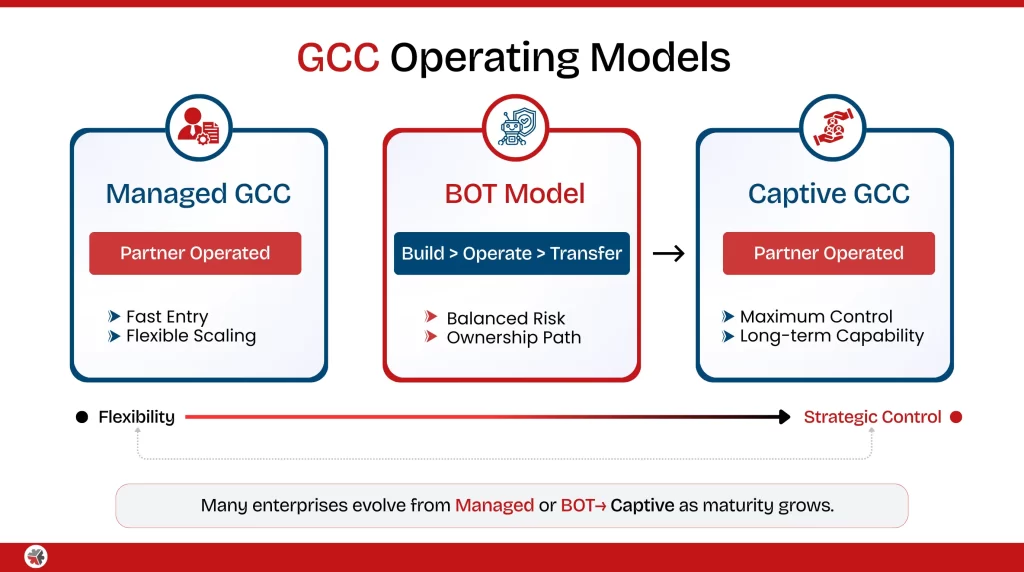
GCC Operating Models: Choosing the Right Structure.
The structure you choose for your Global Capability Center will influence far more than just operational design. It affects governance maturity, capital exposure, execution velocity, cultural integration, and long-term scalability. The right model aligns with your enterprise’s ambition, risk tolerance, and internal leadership bandwidth.
Following is a list of the three dominant operational structures in the GCC, along with how strategic leaders see them.
1. Captive GCC Model
The Captive Model represents full ownership. The enterprise builds, funds, and operates the GCC as a wholly owned subsidiary integrated into the global operating structure.
This model provides maximal strategic control and long-term value development.
Advantages:
- Complete control authority and decision rights
- Strong cultural alignment with the headquarters
- Direct interaction with enterprise KPIs and performance frameworks
- Full intellectual property ownership
- Long-term asset generation
However, full control comes with accountability.
Considerations:
- Higher upfront capital investment
- Longer setup and stabilization timelines
- Requirement for strong internal leadership bandwidth
- Increased compliance and operational accountability
The Captive Model is best suited for companies with a long-term ambition, strong board support, and a clear mandate to build a strategic global hub rather than merely an offshore team.
2. Build-Operate-Transfer (BOT) Model
The BOT Model balances speed with eventual ownership. A strategic partner establishes the GCC, increases operational maturity, hires leadership, and stabilizes governance structures before handing over control to the enterprise.
This strategy minimizes early-stage execution risk while maintaining long-term strategic intent.
Advantages:
- Accelerated market entry
- Reduced initial operational risk
- Structured governance architecture from day one
- Access to local expertise and compliance knowledge
- Reduced the execution burden on headquarters teams
BOT offers a controlled-landing strategy for firms entering India for the first time. It enables leadership teams to validate capabilities, refine scope, and build confidence before taking full ownership.
3. Managed GCC Model
The Managed Model focuses on operational efficiency and scalability. In this model, a trusted partner manages daily operations, compliance, and infrastructure, while the organization provides strategic direction. This model is frequently adopted by businesses wanting agility without increasing internal administrative complexity.
Advantages:
- Lower operational overhead
- Faster talent ramp-up
- Built-in compliance and regulatory frameworks
- Flexible workforce scaling
- Reduced management distraction
The Managed Model is especially useful for businesses that want agility without long-term fixed commitments.
Choosing Strategically, Not Tactically
The decision between Captive, BOT, and Managed models should not be based just on cost. It should reflect:
- Your organization's risk tolerance
- The desired speed of market entry
- Long-term ownership goals
- Internal governance maturity
- Capital allocation priorities
High-performing businesses frequently switch models as confidence and size grow. Finally, the operational model is not a structural formality. It is a proclamation of your GCC’s importance to corporate success.
How Beyond Codes Drives GCC Success in India
Setting up a GCC is not a real estate decision. It is an enterprise transformation initiative.
Beyond Codes approaches GCC development with a disciplined execution, rigorous governance, and a long-term scalability perspective. We partner with global enterprises to develop, launch, operationalize, and grow high-performance capability centers that deliver measurable business impact rather than just operational capacity.
Our engagement model covers the whole GCC lifecycle.
1. Strategic Blueprint & Advisory
Every successful GCC starts with clarity, not hiring. We collaborate closely with CXOs and board stakeholders to define the center’s strategic intent. This includes matching capability design to organizational growth priorities, transformation roadmaps, and risk frameworks.
We collaborate to define:
- Capability scope and function priority
- Phased strategy for offshore growth
- Built-in compliance and regulatory frameworks
- Flexible workforce scaling
- Reduced management distraction
A GCC never starts with recruitment. It must start with the operational design. Without a blueprint, scale is reactive. With one, scale becomes structured.
2. Entity Setup & Operational Launch
Although speed is important, governance is even more important. Beyond Codes controls the operational complexity of starting a GCC, guaranteeing regulatory, legal, and infrastructure preparation from the start.
We coordinate:
- Legal entity incorporation and ensuring regulatory compliance
- Tax structuring support and documentation guidance
- Physical or hybrid infrastructure planning
- IT architecture and cybersecurity environment set up
- SOP documentation and knowledge transfer frameworks
- Operational governance model implementation
Our approach minimizes time to readiness while maintaining compliance integrity. The goal is not only to start operations, but to launch with structural stability.
3. Leadership & Talent Architecture
The first 20-50 hires define the next 500. GCC’s performance is fundamentally dependent on leadership quality and workforce design. Beyond Codes creates talent architecture that is aligned with long-term capability ownership, not short-term staffing goals.
We support:
- Recruitment for the GCC's founding head and leadership team
- Workforce planning models are tied to expansion phases.
- Scalable and data-driven hiring methods
- Competency mapping and role architecture design.
- Performance management frameworks are linked to enterprise KPIs.
- Retention and engagement strategy design
India provides scale, but without a defined talent architecture, scale breeds instability. We ensure the correct leaders, sequencing, and cultural integration from the start.
4. Governance & Performance Management Systems
A GCC must prove value consistently. Beyond Codes embeds governance frameworks that position the center as a strategic contributor rather than a cost center.
We implement:
- SLA and KPI frameworks aligned with global business outcomes
- Real-time reporting dashboards for HQ visibility
- Risk mitigation and business continuity protocols
- Audit-ready compliance structures
- Quarterly operational review cadences with leadership alignment
- Productivity benchmarking and cost-performance analytics
Governance is what elevates offshore capacity to enterprise credibility. When performance measures are transparent and coordinated, GCCs win board trust and more mandates.
5. Scaling Beyond Launch
The first step is to launch a GCC. Intelligent scaling is where long-term value is created. Beyond Codes helps organizations in transitioning from pilot teams to mature, multi-functional hubs with innovation mandates and cross-border leadership integration.
We help organizations:
- Expand from single-function pilots to diverse capabilities hubs
- Integrate AI, automation, and sophisticated analytics in key workflows
- Optimize the cost-to-productivity ratios throughout time
- Upgrade operational maturity models
- Align offshore and global leadership with integrated governance
- Establish centers of excellence (CoEs) inside the GCC framework
We prioritize fundamental strength above short-term execution wins. Headcount growth does not indicate a high-performing GCC. It is determined by enterprise effect, ownership of innovation, and long-term competitive advantage.
Final Thoughts
When built reactively, a GCC provides incremental efficiency. When built strategically, it becomes a long-term value engine — strengthening governance, accelerating innovation, and expanding global ownership.
Global Capability Centers are no longer peripheral operating units. They are central to how modern enterprises scale innovation, distribute risk, and sustain competitive advantage.
For enterprise leaders, the question is no longer whether to build capability in India. The real question is: How will that capability be designed, governed, and scaled strategically?
The difference between a tactical offshore extension and a strategic GCC lies in intentional design and disciplined execution.
Ready to build a GCC that drives real enterprise impact — not just offshore headcount?
FAQs
A Global Capability Center in India is an enterprise-owned strategic hub that builds technology capability, supports innovation, and improves operational resilience. Unlike a vendor-led model, it works under direct company governance, aligns with long-term business goals, and often owns critical initiatives, IP, and compliance responsibilities.
Companies are setting up GCCs in India because the country offers a deep talent pool, quality-adjusted cost efficiency, round-the-clock operational resilience, and growing ownership of strategic functions. India is no longer chosen only for cost savings; it is increasingly selected for innovation, scalability, and long-term enterprise value creation.
A GCC differs from outsourcing because it is fully enterprise-owned and governed, while outsourcing is vendor-managed. GCCs are aligned to KPIs and business outcomes, give stronger control over intellectual property, use dedicated teams, and support long-term strategic goals rather than only task delivery or cost reduction.
The main benefits of a GCC model include stronger governance, better IP control, access to specialized talent, higher resilience, and the ability to own transformation programs directly. For enterprises pursuing AI, digital modernization, or platform-led growth, a GCC can create more durable competitive advantage than a transactional offshore setup.
India has become the global hub for GCCs because it combines scale with specialization. The document highlights India’s large STEM workforce, mature ecosystems in cities like Bengaluru, Hyderabad, and Pune, strong engineering productivity, and the ability to support AI, cybersecurity, fintech, SaaS, and enterprise engineering mandates at scale.
The main GCC operating models are Captive, Build-Operate-Transfer (BOT), and Managed GCC. A Captive model offers maximum control and long-term asset creation, BOT balances speed with eventual ownership, and Managed GCC prioritizes agility and operational efficiency with partner-led execution support.
The best GCC model depends on your risk tolerance, speed requirements, ownership goals, governance maturity, and available leadership bandwidth. Captive suits long-term control, BOT fits companies entering India with lower execution risk, and Managed GCC works well for businesses seeking flexibility without building heavy internal operating complexity.
Enterprises measure GCC success through governance and business impact, not headcount alone. Effective GCCs use SLA and KPI frameworks tied to global outcomes, real-time dashboards, risk controls, audit-ready compliance, productivity benchmarks, and leadership review cadences to prove value and earn broader strategic mandates.
Author
-

With 7+ years of experience and a background in media & communication, she brings stories to life that fuel lead generation success. She transforms complex B2B ideas into content that is clear, engaging, and results-driven—helping key decision-makers take action. A good cup of coffee fuels her writing ideas, and when off the clock, she enjoys unwinding with her dog by her side.