

When your sales cycle stretches six, nine, or twelve months, the way you generate leads affects far more than your marketing metrics. It shapes how your entire revenue operation performs. A poorly qualified lead entering a long enterprise cycle does more than fail to close.
This is why the inbound vs. outbound lead generation discussion matters so much in B2B enterprise sales. Both approaches have a legitimate place in enterprise sales. Neither works in isolation.
The companies consistently hitting their revenue targets in 2026 are the ones that clearly understand what each motion is designed to do — and where the other one fills the gap.
Why Long B2B Sales Cycles Demand a Different Lead Generation Standard
Enterprise buying has changed significantly over the past few years, and the data clearly reflects it.
According to Gartner’s 2024 research, the average B2B buying committee now includes around 10 stakeholders, each consulting four to five sources of information before selecting a vendor.
Forrester’s State of B2B Revenue Report found that sales cycles increased by 23% between 2022 and 2024, driven by larger buying groups, stricter procurement processes, and more cautious internal decision-making.
Meanwhile, RAIN Group research confirms that 73% of B2B leads are not sales-ready on first contact. This means most of your pipeline requires long-term engagement before any conversation about purchasing begins.
Because of this, volume-based lead generation becomes risky in enterprise sales. Filling the funnel quickly may seem productive, but each poorly qualified lead costs weeks of valuable sales capacity.
Inbound Lead Generation: Building Trust Before the Sales Conversation
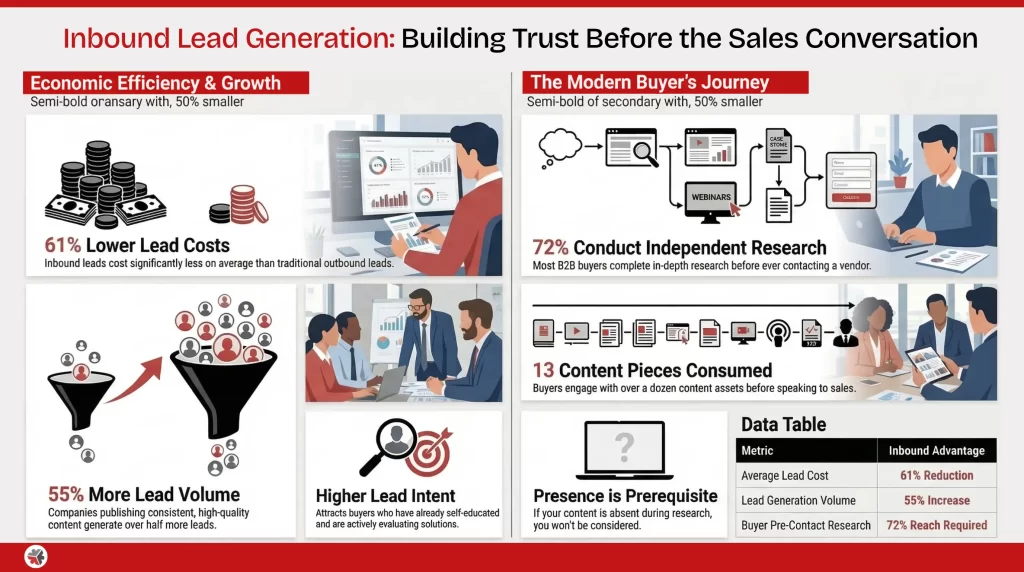
Inbound lead generation focuses on attracting buyers through content, organic search, and thought leadership. The goal is simple: when a prospect begins researching solutions, your brand is already part of the conversation.
The economic case for inbound is strong. HubSpot’s research shows that inbound leads cost 61% less on average than outbound leads. Companies that publish consistent, high-quality content generate 55% more inbound leads than those that don’t. More importantly for long sales cycles, inbound tends to deliver higher intent leads — buyers who have already self-educated and are actively evaluating, not just browsing.
Gartner’s research reinforces why this matters so much in enterprise contexts: 72% of B2B buyers conduct in-depth research before ever contacting a vendor, and buyers consume an average of 13 content pieces before engaging sales. If your content isn’t present during that research phase, you won’t be considered — even if you’re the better solution.
An effective inbound lead generation program includes:

- Long-form content aligned with the entire buyer journey
- Evaluation assets such as case studies, ROI tools, and implementation guides
- Webinars and expert discussions to build authority
- LinkedIn thought leadership targeting decision-makers
- SEO-driven landing pages addressing specific industry pain points
The limitation of inbound is straightforward: it takes time. Organic search authority, content library depth, and brand recognition don’t appear in the first quarter. For companies that need a pipeline within weeks, not months, inbound alone won’t close that gap.
Outbound Lead Generation: Building Pipeline on Your Timeline
Outbound lead generation is the proactive side of demand gen — identifying target accounts and initiating direct contact via cold email, phone calls, LinkedIn outreach, and appointment setting. For enterprise sales, it’s often the only way to reach buyers who aren’t yet searching for what you offer.
The real strength of outbound is control. You decide:
- Which industries to target
- Which company sizes to pursue
- Which job titles to engage
- When to start the outreach
Click Here:- Enterprise Lead Generation: Why SMB Tactics Fail at Scale
This level of targeting makes outbound especially valuable when companies are entering new markets or targeting specific enterprise accounts.
Appointment setting has evolved into a specialized capability. Securing a meeting with a CFO or VP of Operations in a large organization requires preparation, relevance, and persistence. Because of this, many companies work with outbound agencies or appointment-setting partners to scale this function quickly.
Where outbound is most effective:
- Account-based plays into a defined ICP list where brand awareness is low
- Re-engaging prospects who entered the funnel and went quiet during a long evaluation
- Expanding into new verticals where inbound hasn't yet built traction
- Filling pipeline gaps quickly when inbound volume dips seasonally
However, outbound quality matters greatly.
According to Forrester’s ABM research, companies using data-driven outbound targeting achieve 2.5× higher conversion rates and 35% larger deal sizes compared to generic outreach.
In enterprise sales, generic outreach doesn’t just fail — it damages credibility.
What Today’s B2B Buyers Actually Look Like — and Why It Changes Everything
One of the most important things in enterprise sales is how independently buyers now operate before they ever talk to a vendor.
Gartner reports that: 80% of B2B sales interactions now occur digitally 75% of buyers prefer a rep-free sales experienceearly in their research
This means buyers are reading your case studies, comparing your product against alternatives on review sites, and building an internal business cases long before responding to a sales message. By the time they reach out, many have already formed strong opinions about which vendors truly understand their challenges.
This reality changes how inbound and outbound work together. Inbound ensures your company is visible during the early research stage. Outbound ensures that high-value accounts eventually convert that awareness into real conversations.
Another challenge: 79% of leads never convert due to poor nurturing and qualification.
Generating leads is only half the job. Moving the right leads through long buying cycles is where most pipelines break down.
How Inbound and Outbound Work Better Together
The most effective demand gen strategies in enterprise sales treat inbound and outbound as an integrated system rather than competing channels.
A practical example: the database platform, MongoDB, mapped its content directly to funnel stages — awareness whitepapers for IT decision-makers, evaluation case studies for department heads, and ROI calculators for procurement.
The result was a 40% reduction in cost per lead and a doubling of demo request volume. The key insight is not just content volume — it is content aligned with how buyers actually make decisions.
The integration point between inbound and outbound that tends to deliver the strongest results is intent data. When a target account from your ICP list visits your pricing page, downloads a case study, or registers for a webinar, that behavioral signal is far more actionable than a cold contact pulled from a list. Outbound sequences triggered by those signals outperform cold outreach consistently because the timing is right and the relevance is provable. Companies using intent data in this way report 30% higher ROI on paid and outbound campaigns (Bombora, 2024).
This is why many organizations combine:
- an inbound lead generation agency building the content infrastructure
- an outbound partner or appointment setting team accelerating pipeline
The best inbound providers do more than create content. They help define what a truly qualified lead looks like for your specific sales cycle and deal size.
Choosing the Right Balance for Your Business
There’s no single inbound-to-outbound ratio that works for every business. But a few factors tend to point in the right direction:
- Stage of company: Early-stage companies with low brand recognition need outbound to generate a near-term pipeline while inbound builds over time. Deal size and cycle length: The longer and more complex the cycle, the more critical it is to build brand familiarity through inbound before outbound sales reps make contact.
- Sales team structure: If your sales reps are already capacity-constrained with inbound volume, adding outbound creates noise. If your inbound pipeline is thin, outbound helps fill the pipeline.
The honest answer for most enterprise-focused companies is that both are necessary, and the weight given to each shifts over time. Inbound lead generation builds the foundation — authority, consistent lead flow, and buyer familiarity. Outbound lead generation builds the pipeline where and when you need it most.
Final Thoughts
Long enterprise sales cycles punish reactive lead generation strategies.
The companies building the most consistent pipelines today are not the ones running the most campaigns. They are the ones creating a system where inbound and outbound reinforce each other.
Gartner reports that 77% of B2B buyers describe their purchasing process as extremely complex.
That complexity does not solve itself. It must be managed by vendors who:
- show up early in the research phase with valuable insights
- build credibility through useful content
- follow through with relevant, well-timed outreach
Whether you’re building an inbound strategy, refining outbound programs, or partnering with lead generation specialists, the principle remains the same:
Earn the buyer’s attention before asking for their time — and build a system designed for a long buying journey, not a quick transaction.
Fill your pipeline without burning out your sales team — talk to our appointment-setting specialists today.
FAQs
Inbound lead generation attracts prospects through content, SEO, webinars, and thought leadership, while outbound lead generation proactively reaches target accounts through email, calls, LinkedIn, and appointment setting. In B2B, inbound builds trust and awareness, while outbound creates direct pipeline opportunities with specific decision-makers.
For long B2B sales cycles, neither inbound nor outbound works best alone. Inbound helps buyers discover and evaluate your brand early, while outbound helps sales teams engage target accounts directly. The strongest enterprise strategies combine both, using inbound for trust-building and outbound for pipeline acceleration.
Inbound lead generation matters in enterprise sales because buyers often research extensively before contacting vendors. Strong content, SEO pages, case studies, and webinars help your brand appear early in that research journey. This builds credibility, improves intent quality, and increases the chance of being shortlisted by buying committees.
Outbound still matters because many valuable enterprise accounts are not actively searching when you need pipeline growth. Targeted outreach helps you enter specific accounts, re-engage stalled opportunities, and expand into new markets. In long sales cycles, outbound gives you control over who you contact and when.
Inbound leads are often better qualified because they usually come from buyers who have already researched the problem and are evaluating solutions. However, outbound leads can also be highly qualified when targeting is precise, messaging is relevant, and outreach is timed to real buyer signals such as intent data or engagement.
Lead nurturing is critical in long B2B sales cycles because most prospects are not ready to buy on first contact. Without consistent follow-up, education, and qualification, leads often stall or disappear. Effective nurturing keeps your brand relevant, supports buyer decision-making, and improves conversion across a complex enterprise journey.
Content is the foundation of inbound lead generation. Long-form articles, case studies, ROI tools, implementation guides, webinars, and LinkedIn thought leadership help prospects research solutions and validate vendors. In enterprise sales, content also demonstrates expertise and trustworthiness, which supports EEAT and improves visibility in search-driven discovery.
The best lead generation strategy for enterprise sales teams is a balanced model that combines inbound authority-building with outbound account targeting. Inbound supports long-term trust and discoverability, while outbound fills pipeline gaps and engages priority accounts. The right mix depends on brand maturity, deal size, sales capacity, and buying-cycle complexity.
Author
-
With 7+ years of experience and a background in media & communication, she brings stories to life that fuel lead generation success. She transforms complex B2B ideas into content that is clear, engaging, and results-driven—helping key decision-makers take action. A good cup of coffee fuels her writing ideas, and when off the clock, she enjoys unwinding with her dog by her side.