

In today’s B2B landscape, generating leads is no longer about running campaigns and hoping something works. Businesses are now expected to show clear contribution to revenue, predictable pipeline growth, and alignment with sales outcomes. This shift has made accountability, measurability, and automation essential for any company investing in B2B lead generation and demand generation services.
Many organizations still focus heavily on activity—emails sent, calls made, or campaigns launched. While these sales metrics provide surface-level visibility, they do not reflect real progress. What matters is how these activities translate into qualified opportunities, stronger conversion rates, and measurable pipeline impact. Companies that fail to connect effort with outcome often struggle to scale their sales pipeline effectively.
To succeed, businesses must adopt a structured, data-driven approach that connects sales & marketing execution directly to business outcomes.
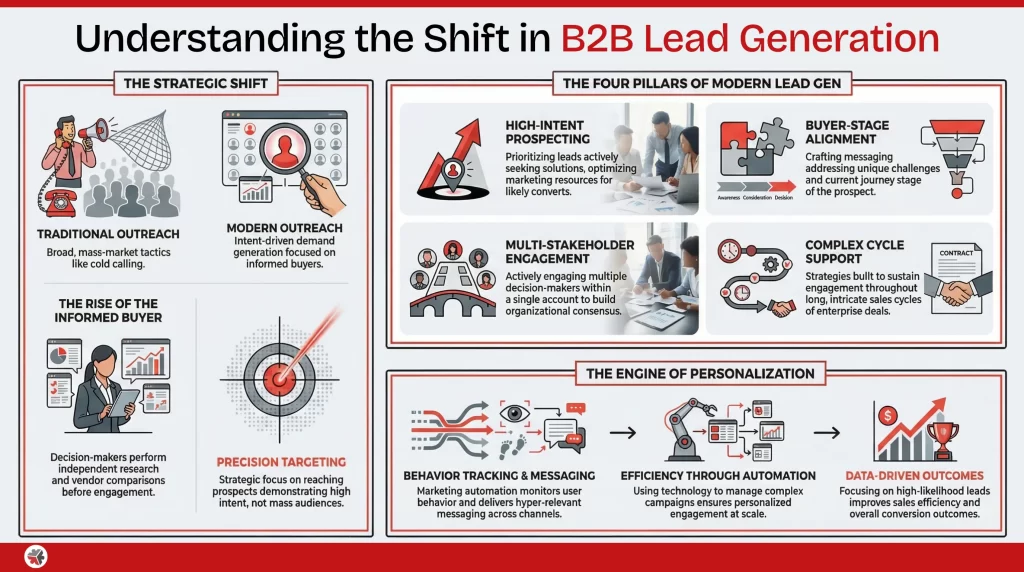
Understanding the Shift in B2B Lead Generation
B2B lead generation has evolved from broad outreach to precision targeting. Traditional methods such as trade shows and cold calling are no longer enough to capture today’s informed buyers. Decision-makers now conduct their own research, compare vendors, and engage only when they see clear relevance.
This change has shifted the focus toward intent-driven demand generation and personalized engagement. Marketing automation has enabled this transition by allowing companies to track user behavior, deliver relevant messaging, and manage campaigns across multiple channels.
Modern B2B lead generation is now defined by:
- Reaching high-intent prospects instead of mass audiences
- Aligning messaging with buyer stage and business challenges
- Engaging multiple stakeholders within target accounts
- Supporting long and complex enterprise sales cycles
This approach ensures that efforts are focused on leads that are more likely to convert, improving both efficiency and outcomes.
Why Accountability Is Critical in B2B Lead Generation
Accountability transforms marketing from a cost center into a revenue contributor. It provides visibility into how campaigns influence pipeline growth and business performance.
In B2B lead generation services, accountability means tracking not just activity, but outcomes. It connects marketing efforts to tangible business results such as qualified opportunities and revenue contribution.
Key indicators of accountability include:
- Number of qualified leads generated
- Conversion rates across funnel stages
- Cost per lead and customer acquisition cost
- Contribution to pipeline and closed revenue
However, true accountability goes deeper than reporting numbers. It involves analyzing performance to identify what is working and what needs improvement. For example, if a campaign generates leads but fails to convert, the issue may lie in targeting, messaging, or lead qualification.
Organizations that prioritize accountability make better decisions because they rely on real data rather than assumptions. This leads to more effective demand generation strategies and stronger alignment with sales.
Measurability: Turning Data into Actionable Insights
Measurability is the foundation of effective decision-making in B2B lead generation. Without it, campaigns lack direction, making it difficult to improve performance.
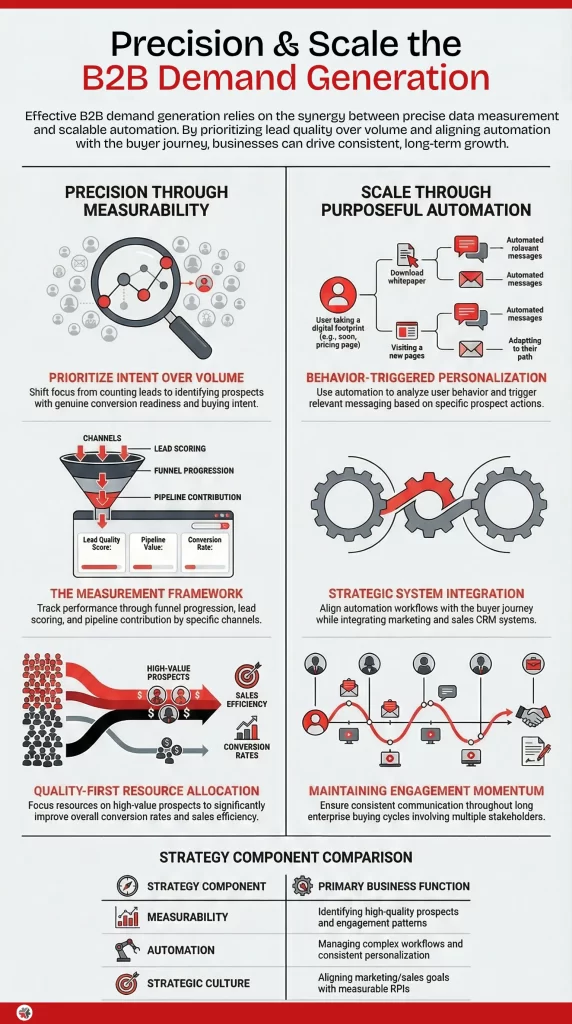
Measuring success requires more than counting leads. It involves understanding lead behavior, engagement patterns, and conversion readiness. Not all leads carry the same value, and identifying high-quality prospects is critical for improving outcomes.
A strong measurement framework typically includes:
- Funnel tracking from lead to opportunity
- Engagement metrics such as clicks, responses, and time spent
- Lead scoring based on behavior and intent
- Pipeline contribution by channel
These insights help businesses identify which campaigns are generating meaningful engagement and which are not. More importantly, they allow teams to focus on leads that show genuine buying intent.
By prioritizing lead quality over lead volume, companies can improve conversion rates and make better use of their resources. This approach strengthens the overall sales pipeline and supports long-term growth.
The Role of Automation in Driving Efficiency and Scale
Automation is now a core component of modern demand generation and lead nurturing. It allows businesses to manage complex processes efficiently while maintaining consistency across campaigns.
Automation is commonly used for:
- Email workflows and follow-up sequences
- Lead scoring and qualification
- CRM updates and data management
- Campaign performance tracking
While efficiency is an important benefit, the real value of automation lies in personalization. Automation tools can analyze user behavior and trigger relevant messaging based on specific actions.
For example, a prospect who engages with high-value content can be nurtured with deeper insights, while a prospect showing buying intent can be directed toward sales engagement. This improves both engagement and conversion rates.
In enterprise sales, where buying cycles are long and involve multiple stakeholders, automation ensures consistent and timely communication. It helps maintain momentum and keeps prospects engaged throughout the decision-making process.
Strategies to Strengthen B2B Lead Generation
Effective B2B lead generation services require a combination of precise targeting, relevant content, and consistent engagement. One of the most critical factors is identifying the right audience. Without a well-defined ideal customer profile, even strong campaigns struggle to deliver results.
Content also plays a central role in demand generation. It helps build trust, educate prospects, and position your company as a credible solution provider. Instead of focusing on volume, businesses should prioritize relevance and depth.
To strengthen lead generation efforts:
- Define a clear Ideal Customer Profile (ICP)
- Create content aligned with real business challenges
- Maintain consistent messaging across channels
- Focus on engagement rather than just reach
Multi-channel engagement further enhances visibility and ensures prospects interact with your brand across different touchpoints. When combined with personalization, this approach creates a more meaningful buyer journey.
Implementing Marketing Automation with Purpose
Automation delivers results only when it is aligned with strategy. Many organizations adopt tools without a clear plan, which limits their effectiveness.
Selecting the right platform is the first step. The tool should integrate with existing systems, support scalability, and provide meaningful insights. Equally important is ensuring that teams are trained to use it effectively.
Successful implementation involves:
- Aligning automation workflows with the buyer journey
- Integrating marketing and sales systems
- Defining clear lead scoring and qualification criteria
- Continuously monitoring and optimizing performance
Automation should not replace strategy—it should support it. When implemented correctly, it enhances efficiency while improving the overall customer experience.
Building a Culture of Accountability and Continuous Improvement
Sustainable success in B2B demand generation requires more than tools and processes. It requires a culture that values accountability, transparency, and continuous improvement.
This starts with setting clear goals that align with business outcomes. Every campaign should have defined objectives and measurable KPIs. Regular monitoring ensures that performance is evaluated consistently and issues are identified early.
To build a strong performance culture:
- Set clear, measurable campaign goals
- Monitor performance regularly and share insights
- Encourage collaboration between marketing and sales
- Continuously refine strategies based on data
Organizations that embrace this approach are better equipped to adapt, improve, and scale over time.
Conclusion
The future of B2B lead generation and demand generation services is built on clarity, precision, and accountability. Companies are no longer relying on activity alone—they must demonstrate measurable impact.
By focusing on accountability, measurability, and automation, businesses can create a more predictable and scalable growth engine. These elements work together to improve lead quality, increase conversion rates, and strengthen the sales pipeline.
When supported by strong targeting, relevant content, and personalized engagement, this approach helps organizations generate meaningful results and achieve long-term growth in a competitive B2B environment.

Turn your lead generation into a revenue driver. Get in touch to create a scalable, data-backed growth strategy.
FAQs
Accountability in B2B lead generation means measuring outcomes, not just activity. Instead of focusing only on calls, emails, or campaigns launched, businesses track qualified leads, conversion rates, pipeline contribution, and revenue impact. This helps teams prove what is working, improve weak areas, and align lead generation with business growth.
Measurability is important in demand generation because it turns campaign data into clear decisions. It helps businesses understand which channels, messages, and leads are actually moving prospects toward a sale. Without measurable performance, teams often chase lead volume instead of lead quality, which weakens conversion rates and wastes budget.
Automation improves B2B lead generation by making follow-up, lead scoring, CRM updates, and campaign tracking more consistent and scalable. It also supports better personalization by responding to prospect behavior in real time. When used strategically, automation helps teams engage the right prospects faster and maintain momentum across long sales cycles.
Lead quality matters more than lead volume because a large number of weak leads rarely creates predictable revenue. High-quality leads are more likely to fit the ideal customer profile, show buying intent, and convert into opportunities. Focusing on quality helps sales teams spend time on prospects that can actually move pipeline forward.
The success of a B2B lead generation campaign is measured by how well it contributes to pipeline and revenue, not just top-of-funnel activity. Strong measurement includes funnel progression, lead quality, engagement behavior, sales acceptance, and opportunity creation. A successful campaign creates meaningful conversations that support long-term business growth.
Sales and marketing align better when both teams agree on ideal customer profile, lead qualification criteria, campaign goals, and shared success metrics. Regular feedback between teams also improves targeting and messaging. This alignment reduces wasted effort, improves lead handoff quality, and creates a more consistent path from first touch to opportunity.
Marketing automation benefits enterprise sales by supporting long buying cycles, multiple stakeholders, and timely follow-up across many touchpoints. It helps businesses stay consistent, personalize outreach, and manage complex nurture journeys at scale. For enterprise teams, this means better visibility, stronger engagement, and fewer missed opportunities during slow decision-making processes.
A scalable B2B demand generation strategy starts with a clear ICP, relevant content, measurable KPIs, and strong sales and marketing alignment. It also needs automation workflows, lead scoring, and ongoing optimization based on data. The most effective strategies are built around lead quality, buyer intent, and pipeline contribution rather than campaign activity alone.
Author
-
Engineer-turned-marketer passionate about transforming complex ideas into impactful B2B marketing strategies. I blend technical insight with creative vision to build brands, generate demand, and drive revenue growth.
With deep expertise in brand strategy, marketing automation, and integrated campaigns, I’ve crafted high-performing assets—from websites and ebooks to sales enablement materials and digital experiences—that empower Sales and CS teams to convert faster.
I focus on content-driven marketing and smart automation to deliver scalable, results-oriented campaigns with clarity, creativity, and executional precision.