
Every sales leader has experienced the notion: you have leads flowing in, despite having campaigns going, activities logged—yet your sales pipeline refuses to grow the way it should. Deals stall. Quotas slip. Sales focuses on bad leads, while marketing focuses on lead quantity. And the sales cycle continues.
Increasing the sales pipeline involves more than just generating more leads; it’s about generating the right demand and converting it effectively. Without this alignment, even the best teams end up frustrated.
The fact is that in 2022, 53% of sales reps hit their quota. By Q1 of 2024, that number fell to 43%. And according to industry research, 75% of CROs and CEOs cite pipeline generation as their most significant revenue challenge. This confirms that there is a problem.
We at Beyond Codes specialize in B2B Appointment Setting and Lead Generation Services, and we have seen these challenges firsthand.
The good news? They can be fixed by shifting focus from lead volume to demand generation that fuels real pipeline growth.
Let’s unpack why your pipeline isn’t growing—and how to fix it with demand generation.
The Real Root of Pipeline Problems: Misalignment
Most leaders focus on either sales or marketing when their sales pipelines stall. However, pipeline issues begin with misalignment rather than isolated incidents.
- Sales wants revenue-ready leads.
- Marketing wants to show activity.
However, the pipeline breaks down if they are not aiming for the same customers or achieving the same goal. According to a 2023 LinkedIn survey, there is only an average of 16% alignment between B2B sales and marketing teams. Even worse, there is only 5% alignment between demand and brand marketing.
This means that marketing and sales are frequently engaged in very separate activities. As go-to-market expert Chris Walker puts it:
“It should be impossible for marketing to hit their targets two–three quarters in a row while sales miss quota and the company misses growth targets. Yet, it happens frequently.”
Why? Business outcomes aren’t always directly linked to marketing KPIs. Instead of having genuine buying intent, a “qualified b2b lead” could just be someone who consented to a meeting or filled the ‘contact us’ form. Sales wastes time chasing low-value opportunities, which in turn slows down the pipeline.
At Beyond Codes, we help solve this problem by aligning demand generation campaigns with sales qualification frameworks, ensuring that leads become pipelines rather than merely reporting numbers.
Click Here:- From Rookie to Rainmaker: Daily Routines of Top-Performing SDRs
The Demand Conversion Gap
Here’s a situation we see across almost half the companies we engage with:
- Marketing gets better at generating demand.
- High-intent leads show interest (like demo requests).
- Qualified leads spike.
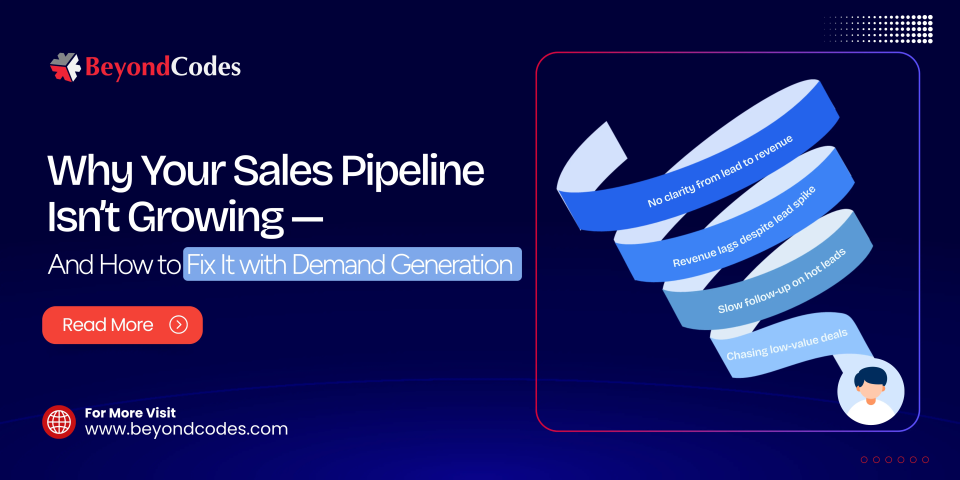
And yet…
- Pipeline growth doesn’t match.
- Revenue doesn’t increase at the same pace.
- Sales leaders blame marketing.
- Marketing gets pressured to generate more leads.
Fixing the Problem: Demand Generation That Fuels Pipeline Growth
Demand generation isn’t just about running ads or sending cold emails. It’s about creating the right conditions for ideal buyers to engage—and making sure sales converts that engagement into a real, revenue-driving pipeline.
Here’s how companies can bridge the gap between sales and marketing activities as well as outcomes:
Align Sales and Marketing Around the Same Buyers
Both sales and marketing teams need to work from the same playbook, targeting a clearly defined ICP (ideal customer profile) with precision—industry, company size, buying signals, and decision-makers. Without this alignment, pipeline generation becomes accidental rather than intentional.Redefine Lead Qualification
Forget the outdated split between MQLs and SQLs. What matters is whether a lead has the right intent and fits your ICP. A single, shared qualification framework prevents wasted effort and sharpens conversion.Improve Lead-to-Revenue Visibility
If you can’t measure what happens from first touch to booked meeting to closed deal, you can’t optimize it. Transparency across the sales funnel allows teams to pinpoint friction and maximize performance.Increase First-Meeting Efficiency
High-intent B2B leads often slip away due to slow follow-up, scheduling delays, or a lack of urgency. Streamlined processes and smart automation can lift the meeting rate from under 40% to well over 70%.Optimize First Calls
Not all prospects should be treated the same. Ensure that the right people—Account Executives, not just SDRs—handle high-value first calls, utilizing a process specifically designed for buyers who wish to engage.Educate Before the Call
If sales spends half an hour covering the basics, pipeline velocity suffers. Prospects should arrive at the first call already informed through relevant content, case studies, success stories, or personalized messaging.Streamline Qualification Stages
Ambiguous or subjective criteria can slow down deals. Clear, consistent rules for advancing opportunities ensure everyone is measuring pipeline growth the same way.Keep Optimizing Together
Demand generation is not “set it and forget it.” Constant feedback loops, performance reviews, and shared accountability keep both marketing and sales aligned.
What Happens When Demand Generation Works
When demand generation is done right, three things happen:
- Predictable Growth – Instead of feast-or-famine pipelines, you get a consistent flow of revenue-ready leads.
- Higher Conversion Rates – By focusing on quality over vanity metrics, sales teams can spend more time closing deals.
- Stronger Sales-Market Alignment – No more finger-pointing between sales and marketing. Both sides chase the same outcomes.
Why Beyond Codes?
At Beyond Codes, we use a combination of lead generation, demand generation, and B2B appointment setting strategies to power the sales pipeline generation.
Here’s what sets us apart:
- Extension of Your Sales Team – We don’t replace your sales function; we strengthen it.
- Data-Backed Prospecting – We use data insights and human expertise to reach the right buyers.
- Personalization at Scale – Every outreach is tailored to resonate with decision-makers, not just spray-and-pray campaigns.
- Proven Appointment Setting – We don’t just hand over names—we deliver scheduled meetings with high-intent prospects.
- Conversion Focus – Our goal isn’t just filling your CRM—it’s filling your pipeline with opportunities that close.
We’ve seen companies double their pipeline growth simply by improving alignment and demand conversion—not by doubling their lead volume.
Here is our demand generation case study showing how we powered the client’s demand generation by combining targeted research, smart contact discovery, and multi-touch lead nurturing—resulting in 46+ high-value appointments and a 3X boost in market penetration within six months. Click Here
Final Thoughts
If your sales pipeline isn’t growing, it’s time to look beyond lead counts and start fixing the demand conversion gap. Demand generation isn’t just about outreach—it’s about aligning sales and marketing, qualifying the right opportunities, and ensuring every engagement moves closer to revenue.
In today’s market, activity without conversion is wasted effort. Growth comes when businesses shift from chasing volume to generating meaningful demand and turning it into measurable outcomes. That’s how pipelines stay strong, resilient, and future-ready.
Let’s build a pipeline that grows with your business.
FAQs
This frequently occurs when the leads aren’t relevant to your target customer’s profile or goal. Marketing may generate a large number of leads, but if sales is unable to convert them—or if those prospects are not truly revenue-ready—the pipeline might slow down. The key is demand generation that targets the right buyers while ensuring that marketing and sales are operating under the same framework.
Misalignment shows up in several ways, including sales teams pursuing low-value prospects, marketing efforts meeting activity metrics without revenue growth, and reporting showing an increase in qualified B2B leads without actual pipeline growth. If your teams are working in isolation and utilizing various definitions of “qualified,” misalignment is to blame. Aligning around the same ICP, buying signals, and conversion-focused goals closes the gap.
Generating better leads isn’t enough; there’s frequently a demand conversion gap. Even high-intent leads require prompt, effective follow-up, educated prospects, and the appropriate sales reps handling initial calls. Optimizing sales processes from lead to revenue, educating prospects before they talk to sales, and streamlining qualification stages can all drastically increase conversions.
Absolutely. The purpose of demand generation is to increase the number of revenue-ready possibilities, not more contacts. When done right, it generates a consistent flow of leads that convert, bringing marketing and sales together around common goals, increasing pipeline speed, and eliminating wasted effort. It turns your focus away from quantity and toward quality, resulting in more constant growth.
The results vary depending on your current processes, alignment, and ICP definition, but companies usually notice substantial benefits within 3-6 months. For example, Beyond Codes helped a customer in generating maximum high-value appointments and triple their market share in a single year by focusing on targeted research, smart contact finding, and multi-touch nurturing—all without boosting lead volume. That means, pipeline growth isn’t about getting more leads — it’s about turning the right ones into real opportunities that actually close the deal.
Author
-

With 7+ years of experience and a background in media & communication, she brings stories to life that fuel lead generation success. She transforms complex B2B ideas into content that is clear, engaging, and results-driven—helping key decision-makers take action. A good cup of coffee fuels her writing ideas, and when off the clock, she enjoys unwinding with her dog by her side.