

Often, salespeople overlook B2B cold calling too early, especially in enterprise sales. Sales teams make a few hundred calls, notice low pickup rates, and quickly assume the channel no longer works. However, that conclusion misses how current B2B buying actually occurs.
Enterprise sales cycles generally last 6-9 months, involve 6-10 decision-makers, and rarely convert after a single interaction. According to industry surveys, most B2B opportunities are influenced after 6-8 meaningful interactions. Expecting results after a few calls is unrealistic.
Here’s the part most teams miss:
Cold calling doesn’t fail because prospects don’t answer. It fails because teams don’t stay consistent long enough.
Cold calling is an ongoing process for SDRs and inside sales teams working in complex B2B sales environments. It is a discipline. And like any discipline that produces large-scale outcomes, it rewards those who consistently demonstrate structure, relevance, and intent.
Consistency is the Real Differentiator in B2B Cold Calling
Cold calling is not a volume problem; it is a consistency concern.
Most sales teams measure their performance by the number of calls they make per day or week. Far fewer people consider whether such calls have a consistent, intentional rhythm. In enterprise sales, results don’t come from short spurts of effort. They result from showing up consistently over time.
Buyers do not engage just after one call or chat. They respond when your name, message, and relevance seem familiar when a need arises. Consistency is what leads to recognition.
In many enterprise deals, opportunities arise before buyers actively explore solutions—often while the problem is still being defined. Teams that maintain constant outreach appear during the early awareness window, not after competitors have formed the narrative.
At this level, consistency turns into a strategic advantage. It builds familiarity before intent and positions sales teams to engage when the timing is right.
Click Here:- How Enterprise Leaders Should Evaluate a B2B Lead Generation Agency
What Consistency Actually Means in Modern B2B Cold Calling
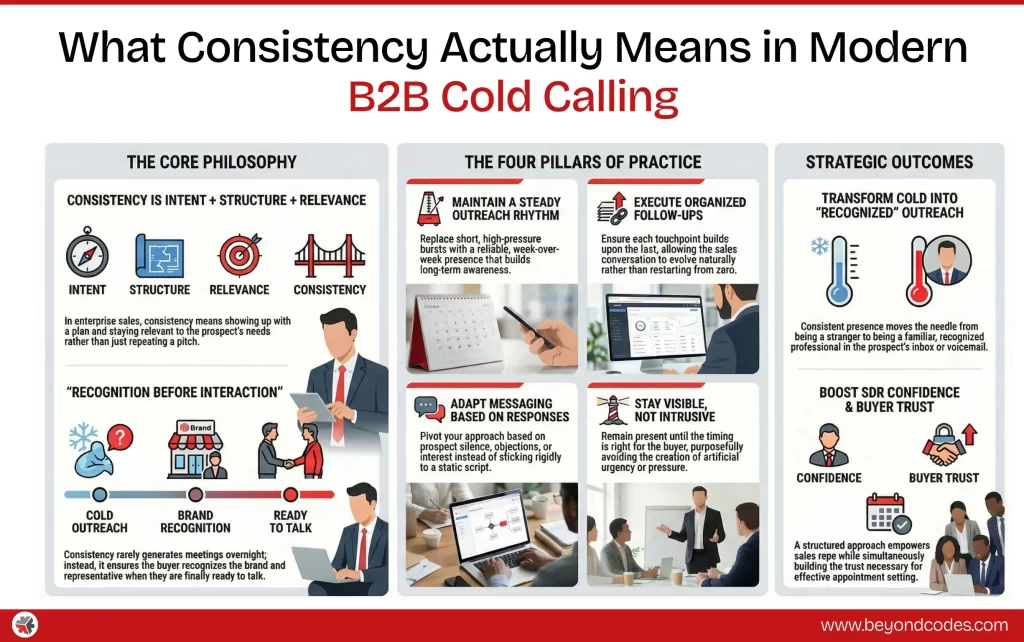
Consistency in B2B cold calling does not require repeating the same pitch every day. In enterprise sales, this involves consistently showing up with intent, structure, and relevance.
In practice, consistency looks like this:

- Maintaining a steady outreach rhythm Showing up week after week instead of relying on short bursts followed by long gaps.
- Executing organized follow-ups Each touch builds on the previous one, allowing the conversation to continue rather than restart.
- Adapting messaging based on prospect responses Adjusting outreach based on silence, objections, or interest—rather than sticking rigidly to a script.
- Staying visible without becoming intrusive Be present until the timing is right, without causing urgency or pressure.
“Consistency fails to generate meetings overnight. It provides recognition before buyers are willing to interact.”
This practice transforms cold outreach into recognized outreach.
It boosts SDRs’ confidence. For buyers, it fosters trust. And trust is the foundation of every effective appointment setting conversation.
The Myth of Instant Results in Cold Calling
One of the most common fallacies in B2B sales is that cold calls should result in quick appointments. Enterprise buyers rarely respond to the first or second contact. Often, not even the third. They are busy, risk-aware, and surrounded by competing demands. Expecting immediate results from cold calling ignores how actual B2B buying behavior works.
According to research, fewer than 5% of B2B buyers respond substantially to their first outreach attempt. Most engagement occurs after weeks, if not months, of repeated exposure.
In this case, cold calling is not about persuading. It’s about being present.
Each touchpoint increases familiarity. Each conversation lowers resistance. Prospects eventually move from “not now” to “let’s talk.”
Why One-Off Cold Calling Campaigns Fail
Instead of treating cold calling as a continuous sales process, many businesses see it as a temporary effort. When results don’t appear right away, SDRs are advised to put in a lot of effort for a few weeks before shifting their attention elsewhere.
This strategy results in three common issues—
Buyers forget you quickly
Enterprise buyers oversee multiple decision-makers, budgets, and goals. Early awareness fades when outreach stops after a few tries. The next call feels new again instead of continuing an existing conversation.
Conversations lose context
When there are no regular follow-ups, calls seem unconnected. Buyers see no progress, and SDRs struggle to recall past conversations. Every call resets instead of moving the relationship forward.
Momentum never builds
Cold calling works through familiarity and repetition. Every contact enhances relevance and recognition. That momentum never has a chance to grow when efforts end too abruptly.
Short campaigns also give a distorted view of performance from a leadership perspective. Sales reps ignore leading indicators like name recognition, callback interest, and quality discussions when evaluating cold calling, instead focusing primarily on early results like scheduled meetings. As a result, cold calling is usually stopped before it has time to deliver real impact.
Consistency Builds Trust Before It Books Meetings
In B2B cold calling, trust does not exist over the first call or interaction. Enterprise buyers must move carefully, keeping the business goal in mind and not rushing into vendor selection. They evaluate risk, internal impact, and timing long before they agree to a meeting.
When buyers hear a consistent message multiple times, something subtle but powerful happens. Your outreach stops feeling intrusive and starts feeling familiar. Even if the timing isn’t right, recognition builds. And recognition lowers resistance.
Consistent calling enables SDRs to:
- Reinforce a clear and credible value narrative over time
- Reference past touchpoints naturally, to maintain continuity
- Stay focused without forcing urgency
Over time, calls shift from interruptions to recognition. Conversations become easier. Meetings happen as a natural next step—not a forced outcome.
When buyers are ready to proceed, trust removes obstacles, but it doesn’t speed up the process instantly.
Why Maintaining Consistency is Hard—And How High-Performing Teams Handle It
It seems easy to be consistent. It’s perhaps one of the most difficult disciplines for SDR teams to uphold. SDRs work under real pressure every day. They deal with rejection fatigue, manage conflicting priorities, and are continuously evaluated based on quick outcomes. Even well-intentioned teams start to lose rhythm when results don’t appear right away.
Cold calling becomes reactive because it lacks structure. Calls come in short spurts. Follow-ups are postponed. Context is lost. And consistency, which is the key to outcomes, breaks down.
This is why many businesses choose to outsource cold calling. Not to reduce cost, but to execute the sales strategy in a disciplined manner.
A strong B2B lead generation partner provides:
- Dedicated focus on daily calling cadence Outreach happens consistently, regardless of internal distractions or shifting priorities.
- Standardized messaging and follow-up Every touch builds on the previous interaction (via text or call), so follow-ups feel connected instead of repetitive.
- Clear qualification frameworks Conversations are guided by intent, not guesswork—ensuring only relevant opportunities move forward.
Consistency isn’t a motivation problem. It’s a systems problem.
When execution is structured, persistence replaces randomness—and a pipeline is built through process, not luck.
What ISDRs and SDRs Need to Focus On
The lesson for ISDRs and SDRs is simple: consistency, not intensity, is the foundation of successful cold calling.
Pay attention to these three basics:
- Show up daily Missed calls and voicemails aren’t failures. When the timing is right, each attempt promotes recognition and fosters familiarity.
- Keep the message consistent Throughout calls and follow-ups, reiterate a concise value narrative. Customers are more likely to recall why you reached out when you use familiar messaging.
- Track conversations, not just calls Notes, objections, and timing signals create context. Context turns cold outreach into a meaningful conversation.
Every call builds awareness, every voicemail reinforces presence, and every follow-up boosts the probability that timing finally aligns. This is how consistency transforms effort into leverage—and conversations into pipeline.
Final Perspective
The goal of B2B cold calling is presence, not pressure.
Enterprise buyers do not respond to one-time outreach or short-lived campaigns. They respond to sellers who show up consistently, communicate with relevance, and respect the pace at which complex buying decisions are made. In long sales cycles with multiple stakeholders, consistency becomes the signal of credibility.
When executed with structure, clear messaging, and continuity, cold calling creates early awareness, builds trust before intent, and positions sales teams to engage precisely when buyers are ready.
Whether managed internally or supported by a B2B lead generation partner, the real differentiator is not effort—it is how consistently the motion is executed. Organizations that treat cold calling as a long-term motion don’t just book more meetings; they build a healthier, more predictable sales pipeline.
Consistency is more than just a habit for ISDRs and SDRs. This strategy turns cold calls into conversations—and conversations into pipelines.
Cold calling with intent. Ready to turn consistency into a pipeline that converts?
FAQs
Consistency in B2B cold calling builds familiarity and trust over time. Enterprise buyers rarely respond to a single outreach attempt. Repeated, structured follow-ups increase recognition, reduce resistance, and position sales teams to engage when timing aligns. Consistency turns cold outreach into meaningful pipeline momentum.
Most B2B buyers engage after 6–8 meaningful touchpoints, not the first call. Enterprise sales cycles often last 6–9 months and involve multiple decision-makers. Cold calling works when SDRs maintain structured follow-ups over time instead of expecting immediate results from one interaction.
Yes, modern B2B cold calling works when executed consistently with relevant messaging and structured follow-up. It is not about volume alone but about maintaining presence. Buyers respond to familiarity and credibility built over time, not one-off outreach attempts.
Most cold calling campaigns fail because they stop too early. Short bursts of outreach create no momentum, buyers forget the message, and conversations reset. Without a consistent cadence and follow-up structure, recognition never builds, and pipeline growth stalls.
Consistency means maintaining a steady outreach rhythm, executing organized follow-ups, adapting messaging based on responses, and staying visible without being intrusive. It focuses on structured engagement over time rather than repeating the same script daily.
Trust develops when buyers repeatedly hear a clear, relevant value narrative. Consistent cold calling reinforces recognition, references previous touchpoints, and demonstrates reliability. Over time, outreach feels familiar rather than intrusive, making meetings a natural progression instead of a forced outcome.
One-time outreach aims for immediate results, while consistent cold calling focuses on long-term engagement. Enterprise sales require repeated exposure to build awareness and credibility. Consistent calling creates pipeline momentum by staying present throughout the buyer’s decision-making process.
Companies often outsource B2B cold calling to maintain structured execution and daily cadence. A B2B lead generation partner ensures consistent outreach, standardized messaging, and qualification frameworks. Outsourcing helps prevent gaps caused by internal distractions and reactive sales cycles.
Author
-
With 7+ years of experience and a background in media & communication, she brings stories to life that fuel lead generation success. She transforms complex B2B ideas into content that is clear, engaging, and results-driven—helping key decision-makers take action. A good cup of coffee fuels her writing ideas, and when off the clock, she enjoys unwinding with her dog by her side.