
How can Account Profiling help businesses boost their sales goals?
Account Profiling gives sales and marketing teams a 360° view of their target accounts, including firmographic, technographic, and behavioral insights. This helps identify dream accounts with the highest revenue potential and buying intent. By prioritizing these opportunities through ABM strategies, businesses can focus resources on accounts that are more likely to convert, improving pipeline velocity and accelerating sales growth.
How to Create an Ideal Customer Profile (ICP)?
Creating an ICP helps your sales team focus on the right-fit customers — those most likely to convert and stay. Here’s how to do it:
- Analyze top clients: Identify customers with high retention, fast deal cycles, and strong ROI.
- Add firmographics: Note industry, company size, and region.
- Include technographics: List tools or software your ideal clients use.
- Map pain points: Understand the challenges your solution directly solves.
- Align with strategy: Use the ICP as the base for Account Profiling and ABM prioritization to target long-term, high-value accounts.
What kind of data does Account Profiling include, and why does it matter?
Effective Account Profiling combines both quantitative and qualitative data — from company overview and business priorities to technology landscape, industry challenges, and key decision-makers. This insight empowers sales and marketing teams to tailor conversations, anticipate needs, and build trust faster. For organizations practicing ABM prioritization, this depth of data ensures every touchpoint feels personalized, improving conversion rates with dream accounts that fit your ICP.
How can Account Profiling strengthen sales and marketing alignment?
When both teams work from a shared Account Profile, they gain a unified understanding of each target account’s priorities, challenges, and intent signals. This alignment ensures that ABM prioritization efforts — from content creation to outreach sales cadence — remain consistent across the funnel. It helps marketing generate high-quality leads and enables sales reps to engage dream accounts with tailored pitches, resulting in a smoother buyer journey and faster deal closures.
Why is ABM Prioritization Critical in Identifying Dream Accounts?
ABM prioritization ensures your outreach isn’t spread thin but focused where it matters most. Here’s why it’s crucial:
- Focus your energy: Spend time on accounts that show real buying potential.
- Segment smartly: Use Account Profiling to categorize Tier 1 (Dream Accounts), Tier 2, and Tier 3 targets.
- Drive personalization: Tailor ABM campaigns based on engagement and fit.
- Boost win rates: Align every touchpoint with your Ideal Customer Profile (ICP) for higher conversions and meaningful relationships.
How to Identify and Prioritize Your Best-Fit Accounts with Account Profiling
In today’s hyper-competitive B2B world, sales teams have learned one powerful truth — not all accounts are created equal.
Some accounts bring opportunities, generate steady revenue, and evolve into long-term partnerships. Others consume your team’s time and resources without ever converting.
The difference between the two lies in how well you identify and prioritize your dream accounts — the ones that align perfectly with your Ideal Customer Profile (ICP), show genuine buying intent, and fit your value proposition.
That’s where Account Profiling becomes your most powerful sales weapon. It helps you go beyond surface-level targeting — transforming raw data into actionable intelligence so your outreach feels intentional, strategic, and relevant.
At Beyond Codes, we’ve seen that the best-performing sales teams aren’t just closing deals — they’re closing the right deals. And that begins with precise Account Profiling.
What Is Account Profiling?
Account Profiling is the process of gathering and analyzing key insights about a company to understand how, when, and why they buy.
It’s not just about identifying key decision-makers — it’s about understanding business priorities, challenges, and market dynamics that shape their decisions.
When combined, these insights give your team a 360° view of each account — empowering smarter conversations, shorter sales cycles, and higher conversion rates.
Why Account Profiling Matters
Without Account Profiling, outbound sales often become a guessing game.
Your team might chase accounts that will never buy, while the most profitable prospects go unnoticed.
Account Profiling eliminates that risk by helping you:
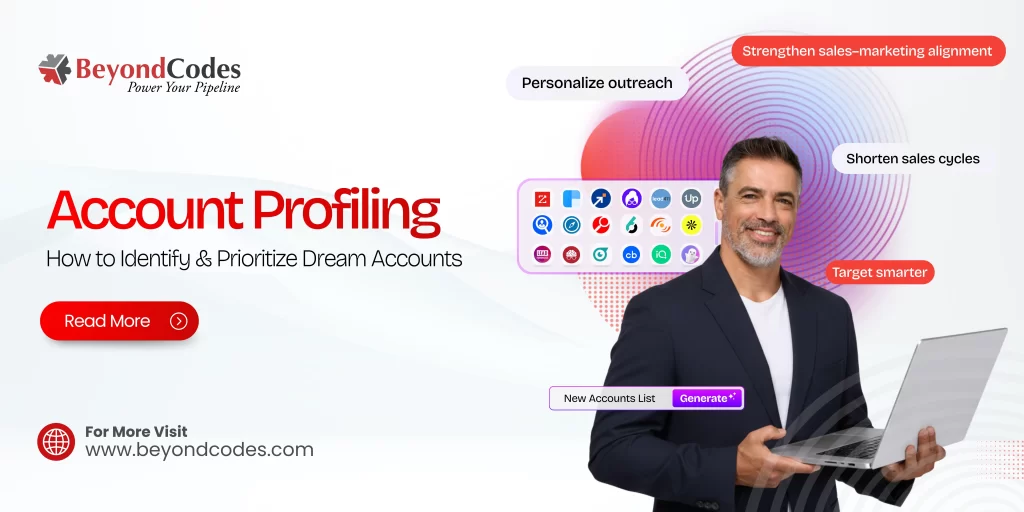
- Target smarter: Focus only on companies that match your Ideal Customer Profile (ICP).
- Personalize outreach: Craft messages that address real needs, not assumptions.
- Shorten sales cycles: Reach the right people, with the right message, at the right time.
- Strengthen sales–marketing alignment: Ensure both teams focus on the same high-value accounts.
In short, account profiling ensures that every call, email, and campaign counts.
Click Here:- The Silent Killer of IT Lead Gen Campaigns (and How to Eliminate It)
Step-By-Step Guide to Identify and Prioritize Dream Accounts
Step 1: Build Your Ideal Customer Profile (ICP)
Before you can identify your dream accounts, you need to define what “dream” really looks like for your business. That’s where your Ideal Customer Profile (ICP) comes in.
An ICP isn’t just demographic data. It’s a blueprint for the type of company that gains maximum value from your solution — and provides long-term value back to you.
Start by analyzing your most successful customers:
- Who renews contracts early?
- Who refers new business?
- Who expands consistently?
Look for patterns across key attributes:
- Firmographics: Industry, company size, annual revenue, and geography.
- Technographics: Knowing a company’s tech stack reveals opportunities and compatibility. If your solution integrates well with Salesforce, accounts already using Salesforce become prime targets.
- Pain Points and Goals: Go beyond “what they need” — understand why they need it. For instance, if their goal is digital transformation, position your offering as an enabler.
- Buying Committee Structure: Identify decision-makers, influencers, and blockers early to tailor your approach.
Finally, create a Negative ICP — companies that aren’t a good fit (too small, limited budget, or niche requirements).
Disqualifying early saves time, resources, and effort down the line.
Step 2: Identify Potential Accounts
Once your ICP is defined, it’s time to find the companies that fit it.
1. Leverage Your CRM
Start with existing data. Revisit dormant leads that match your ICP — often your best opportunities are already there, waiting for a refined approach.
2. Use Sales Intelligence Tools
Platforms like ZoomInfo, Apollo, or LinkedIn Sales Navigator help you discover new companies that mirror your best clients.
Look for buying intent signals, such as:
- Hiring for roles related to your solution.
- Visiting competitor or pricing pages.
- Announcing funding rounds or expansions.
- Sharing posts about pain points your service solves.
3. Monitor Buying Triggers
Stay alert to external shifts like mergers, new leadership hires, or market expansion. These trigger moments often create urgency for change — and your solution could be the timely answer.
Step 3: Prioritize Accounts Through ABM Tiering
Not all accounts deserve the same attention. That’s where ABM Prioritization through tiering comes in — helping your team balance effort with potential value.
| Tier | Type of Account | Description | Recommended Strategy |
|---|---|---|---|
| Tier 1 | Dream Accounts | Perfect ICP match, high-value potential, strong intent signals, strategic importance. | 1:1 ABM, highly personalized outreach, executive engagement, custom proposals. |
| Tier 2 | Strategic Targets | Good ICP fit, moderate intent, slightly lower deal size or urgency. | 1:few ABM, segmented campaigns, personalized emails, and targeted ads. |
| Tier 3 | Scalable Targets | Partial ICP fit, low intent, potential for nurturing. | Automated, scalable outreach for brand awareness and engagement. |
Step 4: Enrich, Analyze & Align
Once your accounts are tiered, deepen insights through data enrichment — fill information gaps using firmographic and technographic intelligence.
Tools like Bombora, Clearbit, or customized research help personalize outreach and refine prospect targeting.
Then, ensure sales and marketing alignment. Both teams must work from the same Account Profiling data, same ICP, and same target list.
When alignment exists, messaging stays consistent, and engagement feels cohesive.
At Beyond Codes, this synchronization is built into every client engagement. Our Account Profiling approach ensures marketing warms up the account while sales engages with precision — not repetition.
Step 5: Execute with Personalization at Scale
Account Profiling sets the strategy — but execution drives results.
Use your profiles to craft personalized, value-led campaigns for each tier:
- Reference recent company events (e.g., funding announcements or expansions).
- Mention known business goals or pain points (“We noticed your team is expanding in APAC — here’s how we’ve supported similar clients.”).
- Tailor outreach cadences by tier — 1:1 calls for Dream Accounts, nurture sequences for Tier 3.
Every message should make the recipient feel like you understand their world better than anyone else.
Step 6: Measure, Learn, and Refine
Account Profiling isn’t a one-time task — it’s a continuous, evolving process.
Review your top accounts quarterly to evaluate what worked, what didn’t, and what new trends are emerging.
Track key metrics such as:
- Conversion rate by tier
- Pipeline velocity
- Average deal size
- Customer lifetime value
The more you analyze, the sharper your Account Profiling and ABM prioritization become.
Beyond Codes: Turning Profiling into Pipeline
At Beyond Codes, we help B2B sales leaders bridge the gap between strategy and execution.
Our expertise combines human-led research with AI-assisted insights to identify and engage dream accounts that drive measurable growth.
From Account Profiling and list building to appointment setting, ABM campaigns, and multi-channel outreach, we ensure your sales team focuses where it matters most — with the right prospects, at the right time.
The result?
- Conversion rate by tier
- Pipeline velocity
- Average deal size
- Customer lifetime value
We don’t just help you find accounts — we help you win them.
Final Thought: Your Dream Accounts Are Waiting
The best sales teams don’t chase every opportunity — they choose them.
Account Profiling isn’t about narrowing your pipeline; it’s about elevating it.
When you know who your dream accounts are, how they think, and what drives their decisions — every campaign becomes sharper, every meeting more meaningful, and every close more predictable.
So before your next quarter begins, ask yourself: Are you reaching out to the right accounts — or just the available ones?
Let Beyond Codes help you identify, prioritize, and convert your Dream Accounts today.
Author
-

With 7+ years of experience and a background in media & communication, she brings stories to life that fuel lead generation success. She transforms complex B2B ideas into content that is clear, engaging, and results-driven—helping key decision-makers take action. A good cup of coffee fuels her writing ideas, and when off the clock, she enjoys unwinding with her dog by her side.